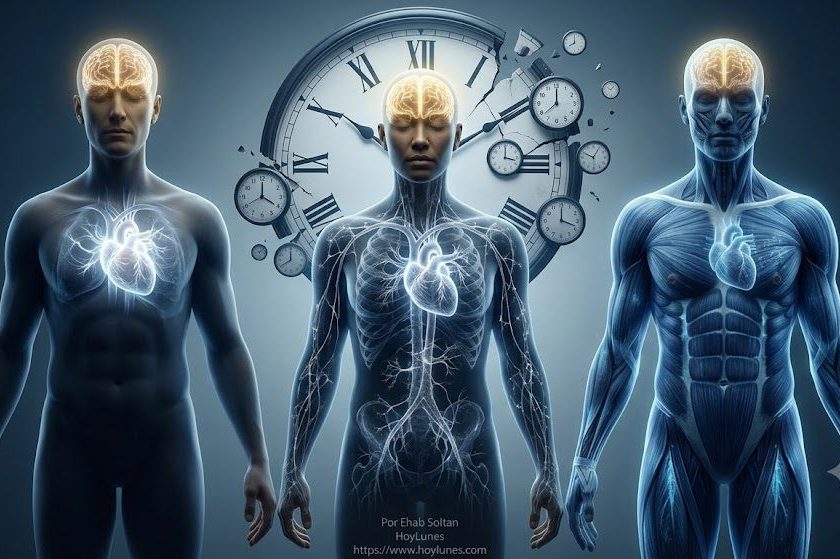

Most of us don’t change suddenly; we just discover late that our body has been transforming in silence for years.
By Ehab Soltan
HoyLunes — We don’t know the exact moment it happens, but one day the body stops forgiving us with the same ease. At 30 or 40, the organism doesn’t break: it simply stops being our silent accomplice. This “invisible move” does not warn with loud noises; it is noticed in the pant button that tightens on any given Tuesday or in that tiredness that settles in after a weekend that wasn’t that big of a deal. It starts long before the mirror or the scale have anything visible to say. The problem is that we try to fix an organism that has updated its version with the instruction manual from fifteen years ago. It is a losing battle if we do not change the strategy.
When the body stops responding the same way
We were sold that the body was a calculator: if the numbers didn’t add up, the fault lay with our lack of willpower or an excess of calories. Then we tried to blame genetics or hormones as if they were an inevitable fate. But none of that consoles you when you look in the mirror and repeat the thought that crosses so many people: “I do the same as always, but my body no longer responds to me the same way”. It is a real bafflement. What no one explains to us is that the change does not debut on the scale, but in small invisible fires: sleep that no longer repairs, hunger at odd hours, or energy that leaks through cracks that were not there before.
This feeling is not an individual hallucination; it is a recurring theme in many everyday conversations. Nothing made this clearer to me than Mariam’s story. At 43, she swore her life was a carbon copy of the one she had at 30: the same demanding job and the same habit of sleeping “just enough”. When her clothes started to tighten, Mariam did what almost all of us do: eat less and demand more of herself. It worked for a few weeks, but the weight slowly returned to the same point. I watched her get frustrated and punish herself, not understanding that her will was not the problem.
Mariam was trying to negotiate with a new woman using the laws of a girl who no longer exists.

The modern life trap
Many of us feel the same as Mariam. We are caught in a contradiction that is hard to see: with the years, our biology asks for more recovery, real movement, and a muscle mass that acts as a metabolic shield. But modern life offers us exactly the opposite: less rest, less time, and an exhaustion that accumulates in silence.
For years we treated muscle as an aesthetic issue, when in reality it is one of the main metabolic regulators of the organism. From a certain age, losing muscle not only changes physical strength: it modifies the way we manage glucose, inflammation, and daily energy expenditure.
That is why so many quick solutions fail. It’s not that our body is “broken.” The mistake is treating the organism as a linear machine capable of responding indefinitely to restriction and exhaustion. But human biology does not understand spreadsheets; it works adaptively.
Survival before aesthetics
When the organism perceives a prolonged threat —extreme diets, constant stress, or accumulated fatigue— it stops prioritizing tissue repair and prioritizes survival. At that moment, the body does the smartest thing: it reduces energy expenditure, increases hunger, and zealously protects its reserves. It is not a sabotage against your wellness plans; it is a brilliant adaptation to keep you safe.
That is why many people believe they have lost discipline, when in reality they have lost their biological margin of compensation.
Understanding this reality is not an invitation to resignation. On the contrary. One of the most dangerous mistakes today is believing that there are only two paths: declaring an aggressive war on the mirror or waiting for the inevitable with arms crossed. The body changes, yes, but what must also change is our way of listening to it. Metabolic prevention cannot start when clothes no longer fit; it must begin when the body is still whispering and not when it is already screaming. It is time to unlearn that taking care of oneself is punishing oneself or that discipline consists of ignoring exhaustion. The current intelligence is not to demand more of the organism, but to give it tools to adapt again.

A new biological maturity
Perhaps true biological maturity does not begin the day we notice the first physical change. Maybe it begins when we stop demanding that the body perform under conditions it can no longer sustain. There is a necessary honesty in accepting that the organism has its own timing. Many people do not get fat suddenly; they simply discover late that their body had been sending signals for years that they decided not to listen to. Understanding this is not giving up, it is living with the wisdom of someone who no longer fights against their nature, but walks in its favor.
This journey leaves us before a truth difficult to admit: we are not the same, and that is fine. Your body is not a problem to be solved, but a story that continues to be written.
The problem is not that the body changes; the problem is discovering it only when we are already fighting against it.
Before turning off the screen, maybe it’s worth asking these questions with honesty:
How much of what you recriminate as “lack of discipline” is actually an intelligent response of your body trying to protect you?
Is your way of taking care of yourself designed for who you are today… or for who you were fifteen years ago?
How many invisible changes did you ignore before noticing the first one in the mirror?

To deepen (without oversimplifying)
Sarcopenia: The natural process of muscle loss. Understanding it is understanding why strength exercise is one of the best metabolic life insurance policies.
Metabolic adaptation: The mechanism by which the body becomes efficient in the face of scarcity or excess stress. It explains why extreme diets usually fail in the long term.
Circadian rhythm: The internal clock that dictates when to burn energy and when to repair tissues. It’s not just what you eat, but when you do it.
Hormesis: How small levels of positive stress —such as exercise or certain controlled exposures to cold— strengthen cells.
Metabolic flexibility: The organism’s ability to use different energy fuels without entering a state of constant alarm.
#MetabolicHealth #HumanBiology #RealPrevention #MuscleMass #WellnessWithoutGuilt #ScienceBasedHabits #HealthyMaturity #HoyLunes #EhabSoltan