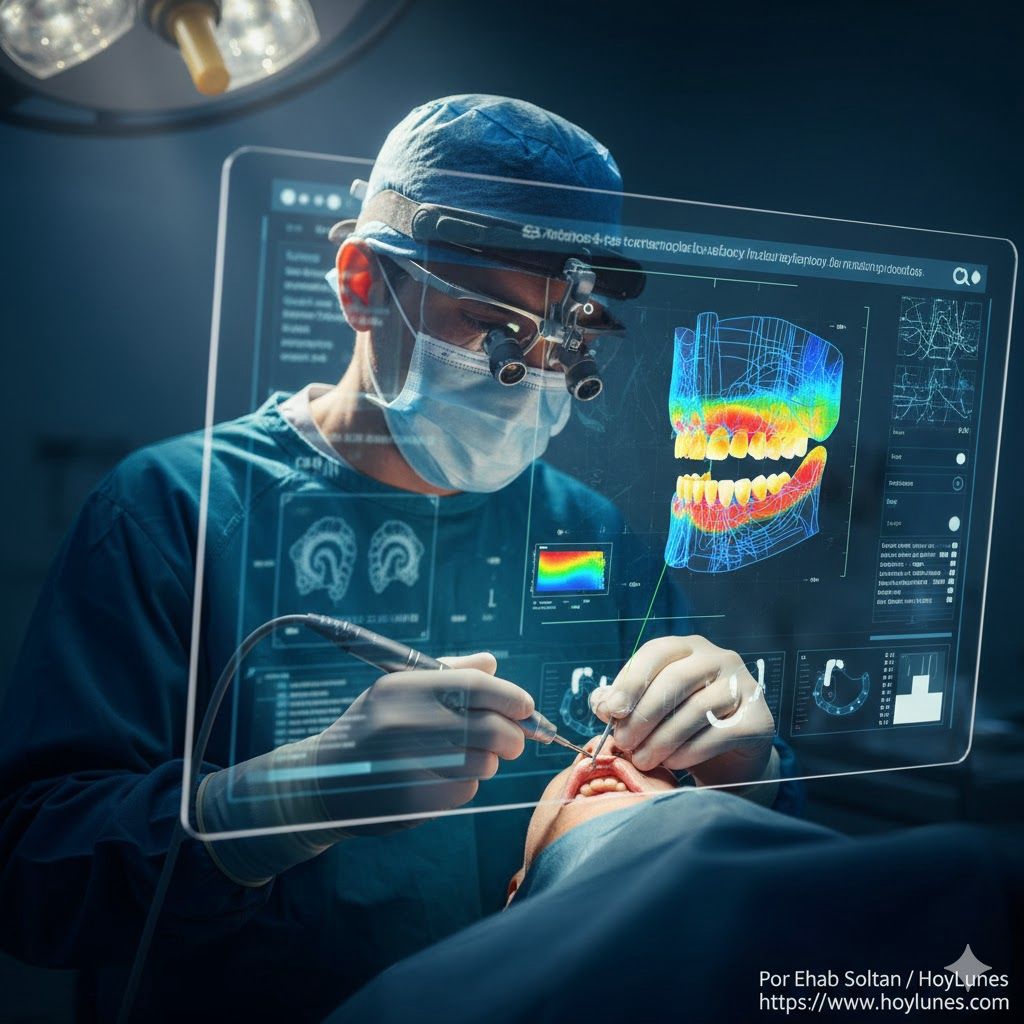
An analysis of biomedical engineering, computer vision, and industrial strategy at the convergence redefining European oral surgery.
By Ehab Soltan
HoyLunes – For decades, dental implantology was built upon a combination of manual expertise and a two-dimensional interpretation of anatomy. Surgeons relied on tactile sensitivity and panoramic radiographs to navigate a complex three-dimensional environment. However, we are witnessing the end of the era of approximation. In today’s European clinical ecosystem, the integration of Artificial Intelligence (AI) is transforming the specialist’s eye into a real-time big data processing unit. The thesis is clear: competitive advantage no longer resides in the steadiest hand, but in the best-orchestrated data system. In this new clinical architecture, data is the new instrument.
This transformation is neither an aesthetic choice nor an incremental improvement. In a European environment of rising costs, regulatory pressure, and accelerated consolidation, AI-based digital implantology has become a variable of economic survival. Clinics that fail to integrate algorithmic workflows will see their margins eroded on three simultaneous fronts: increased chair time, higher complication rates, and a diminished capacity to scale operations. The architecture of the algorithm no longer defines clinical precision alone, but the financial viability of the care model itself. We are facing a structural transition where biomedical engineering, data science, and industrial strategy converge at the dental chair.
Anatomy of the Revolution: AI in the Surgical Workflow
From Pixel to Intelligent Voxel
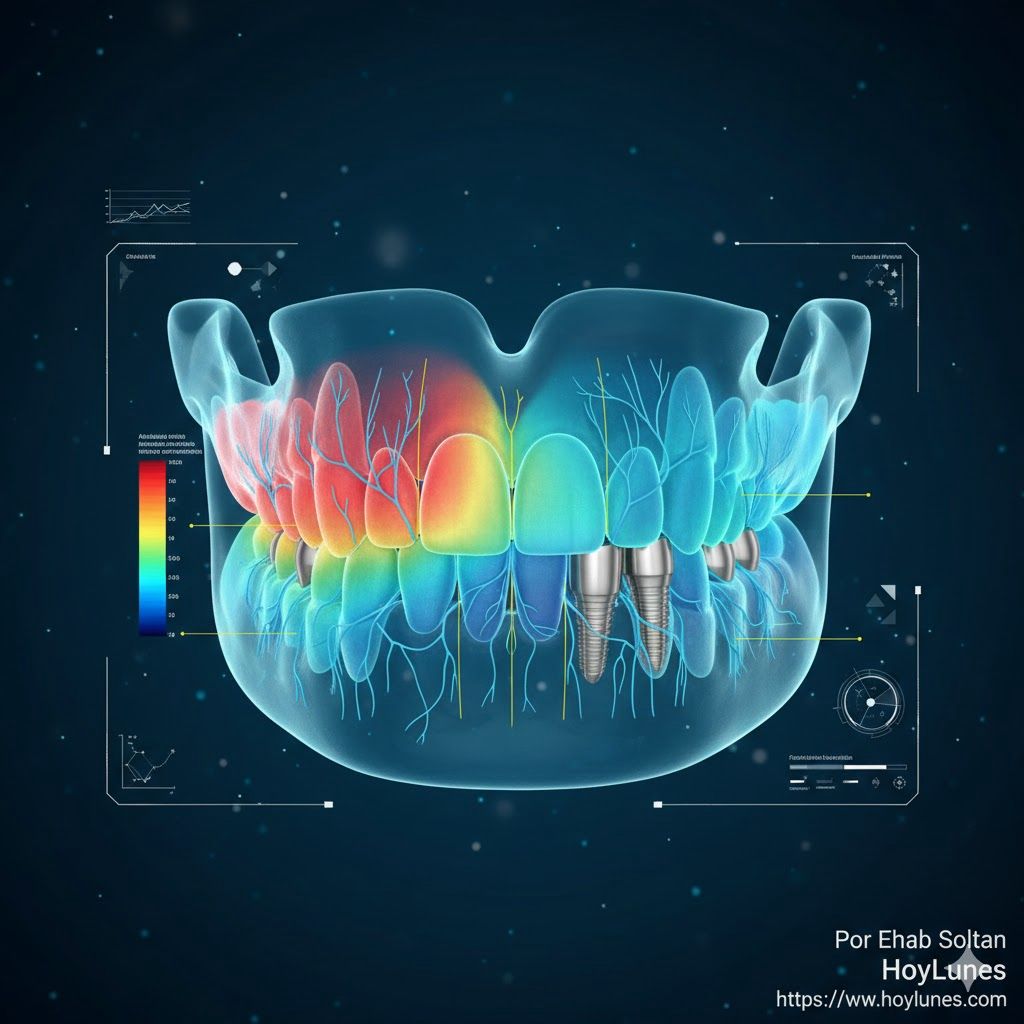
The revolution begins with CBCT (Cone Beam Computed Tomography). Where clinicians previously had to manually identify the dental canal or the maxillary sinus, today’s computer vision algorithms execute automatic segmentation with sub-millimeter precision. These systems do not merely see bone; they perform a volumetric reconstruction of vital structures, eliminating human bias during the most critical phase of planning.
This transition allows for the creation of the (Dental Digital Twin). In this virtual environment, AI suggests the optimal implant position based on:
Bone Density Maps: Analysis of Hounsfield units to determine primary stability.
Reverse Prosthetic Loading: The algorithm calculates the implant location based on the ideal position of the final tooth, applying principles of parametric optimization.
Dynamic Navigation: The Surgical GPS
The clinical impact culminates in the operating room. Dynamic navigation integrates real-time optical tracking and micro-movement compensation. Much like a GPS, the system guides the surgical drill with mean deviations of less than a millimeter under controlled conditions, offering clinically relevant reductions compared to conventional techniques. Here, AI does more than analyze: it corrects in real-time.
From an economic perspective, digital standardization reduces clinical variability, shortens the average procedure time, and improves the predictability of the prosthetic outcome. This reduction in uncertainty directly impacts annual financial planning and the valuation of clinical assets during acquisition or investment processes. Even moderate improvements in surgical times or retreatment rates can translate into sustained increases in operating margins. AI is not just a clinical tool: it is economic infrastructure.
Market Analysis: Figures and Regional Strategy
The European dental implant market is undergoing a phase of robust expansion, driven by demographic aging and digitalization.
The DACH Block: Sophistication and Rigor
In this context, investment in AI is not evaluated as a technological expense, but as critical infrastructure. Dental groups and manufacturers in the DACH axis are allocating capital to planning and automation algorithms because every percentage point of improvement in precision reduces legal costs, retreatments, and unproductive time. The equation is clear: lower clinical variability equals greater financial predictability, a key factor in attracting institutional capital in an increasingly regulated market.
The “DACH” region (Germany, Austria, Switzerland) is the epicenter of biomedical engineering. With a market valued at several billion euros, one of Europe’s highest concentrations of advanced dental technology manufacturers, and stable yet sustained annual growth, the DACH region prioritizes technological precision over accelerated expansion. Here, differentiation is not based on price, but on extreme precision and strict compliance with the “European Medical Device Regulation (MDR)”.
This positioning does not occur in a competitive vacuum. Europe competes with North American and Asian ecosystems that integrate artificial intelligence with faster regulatory speed and greater availability of venture capital. For the DACH axis, digital implantology is not merely a clinical improvement, but a piece within the global race for leadership in advanced medical technology.
Spain: Efficiency and Speed
Spain serves as the dynamic contrast. Boasting one of the highest penetration rates of private clinics in Europe, the Spanish market maintains growth above the Central European average, driven by private competition, the consolidation of dental groups, and international medical tourism. AI is adopted here as a tool for operational efficiency, optimizing chair time and facilitating immediate loading protocols (teeth in a day).
Real Case: DACH Clinic vs. Spanish Clinic
Clinic in Munich (DACH Ecosystem): Focuses on assisted robotics and Metal-Free materials (Zirconia). AI is used to guarantee total patient traceability under German ISO standards, justifying premium prices through technical excellence.
Clinic in Madrid (Spanish Ecosystem): Uses AI to integrate the digital flow from the first consultation. The goal is “conversion and patient experience”: the patient sees their future 3D smile design in minutes, the surgery is planned, and the implant is placed on the same day. Here, AI is the engine of profitability through volume and clinical success.
Graphical Consolidation of the Economic Sector
Digital implantology has become a key vector for corporate consolidation. Large groups do not acquire clinics solely for patient volume, but for their degree of digitalization and algorithmic integration capacity. AI elevates the individual clinic to a strategic asset within pan-European networks.
The industry has moved from fragmentation to a total solution ecosystem.
| Level of Consolidation | Key Players | AI Strategy |
| Infrastructure Giants | Straumann Group, Dentsply Sirona | Vertical integration: Hardware (Scanners) + AI Software. |
| Specialized Software | 3Shape, exocad | Creation of open and modular workflows. |
| Niche AI Startups | Diagnocat, Promaton | Automatic segmentation and predictive diagnostics. |
The massive adoption of AI in implantology must not be confused with uncritical automation. The more clinical decision-making is delegated to algorithmic systems, the greater the need to understand them. Future competitive advantage will not lie with whoever buys the most advanced technology, but with whoever masters its architecture, its limits, and its failure conditions.

Risks and Frictions in Adoption
An exceptional analysis does not ignore the challenges:
Legal Liability: Under the MDR framework, algorithm traceability is vital. If automated planning fails, liability shifts between the surgeon and the developer.
Algorithmic Black Box: There is a lack of transparency regarding the “datasets” used for training many commercial systems.
Training Gap: Technology evolves faster than academic curricula. Without constant updates, surgeons risk becoming dependent on a system they do not fully understand.
Toward Total Precision Dentistry
Implantology in the DACH–Spain axis is entering a phase of algorithmic maturity. This is not a technological fad, but a structural reconfiguration of the care model. The clinic of the future will not compete solely on medical reputation, but on digital architecture. Artificial intelligence does not replace human judgment; it redefines the ground upon which that judgment operates. In this transition, those who understand the logic of the algorithm will not only improve clinical outcomes—they will redefine the economic equilibrium of the European dental sector.
Documentary References
iData Research (2025): European Dental Implants Market Report.
Statista (2026): Dental Market Outlook Europe.
Regulation (EU) 2017/745 (MDR): Safety and performance requirements for medical devices.
Journal of Oral Implantology: Precision studies in assisted dynamic navigation.
`#TheArchitectureOfTheAlgorithm #ImplantologyAI #DentalTech #DentalStrategy #HoyLunes #EhabSoltan`