Inflammation, stress, and environment could be transforming hearing into an early biomarker of general health.
By Ehab Soltan
HoyLunes – For centuries, medicine has confined the human ear to the exclusive realm of sensory perception and communication; an instrument shaped by anatomy, the physics of sound, and neurology. In conventional clinical practice, its role has been, at best, that of an isolated organ: when it fails, it is treated locally.
However, we are facing a profound transformation in the conception of diagnosis.
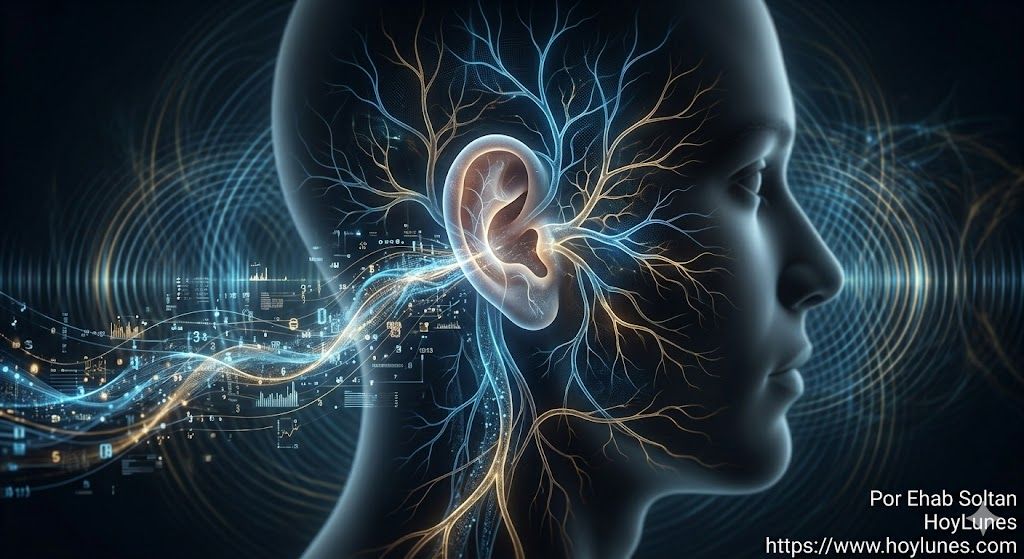
From the forefront of biomedical acoustics, immunology, and precision medicine laboratories, a hypothesis emerges that challenges traditional boundaries: human hearing is not just a sense, but an integrated, dynamic, and highly sensitive physiological system capable of reflecting the organism’s global health status in real time.
Far from being a symbolic interpretation, we are facing a quantifiable biological reality.
In experimental settings, this approach is already beginning to materialize. Pilot studies have shown that general inflammation markers can act as biological predictors of hearing loss, suggesting that the ear reacts to what is happening throughout the body before evident structural damage manifests. These are not yet tools for generalized use, but they are an unequivocal signal: hearing is beginning to behave as an early clinical indicator, not as a belated consequence.
In daily clinical practice, this introduces a silent discomfort: patients with mild or nonspecific auditory symptoms are treated as local cases, when they could be manifesting organismal alterations in early stages. The ear, in these scenarios, would not be the origin of the problem, but the first organ to evidence it.

An Organismal Sentinel: Hearing as a Mirror of Internal Health
The production and perception of sound is a phenomenon of astonishing complexity that transcends the mere vibration of the tympanic membrane. It is the acoustic manifestation of the harmonic interaction between multiple vital systems, the ear being one of the most sensitive organs in the body vascularly, neurologically, and immunologically.
The implication is direct and profound: any alteration, however subtle, in any of these invisible systems leaves a detectable fingerprint on hearing. Often, these variations are imperceptible to initial standard audiometric tests, but they could be perfectly quantifiable through advanced algorithms in the future.
This point is critical: it does not imply that every auditory alteration has a systemic origin, but it does imply that a relevant portion might be interpreted incompletely. The difference is not minor. It is the step from treating symptoms to identifying organismal processes.
Some research models already point in this direction:
Chronic inflammation, associated with conditions such as obesity, diabetes, and aging, is correlated with hearing loss, suggesting that hearing could be, in essence, an inflammatory symptom.
Chronic stress and elevated cortisol levels alter blood flow (microcirculation) of the inner ear, directly affecting its function and contributing to conditions such as tinnitus or auditory hypersensitivity.
Even environmental factors such as temperature combined with physiological stress can induce auditory alterations without direct structural damage, which posits that the ear responds to the climate and the internal environment more than we traditionally believe.
In short, the ear does not simply “break down”; it reacts dynamically to the metabolic, immunological, and psychological state of the individual.
The “Invisible Physiological Orchestra”: The Ear as a Biological Interface
This line of research postulates that hearing operates as a biological interface that decodes and projects critical information regarding the body’s homeostasis:
The Inflammatory and Metabolic Factor
Processes such as low-grade inflammation and metabolic status directly impact auditory health. There is a clear connection between hearing loss and accumulated inflammatory markers, redefining “auditory age” not as a simple reflection of chronological aging, but as an indicator of metabolic deterioration and accumulated chronic stress.
The particularity of the inner ear is its extreme dependence on microcirculation. Small inflammatory alterations, which in other organs might be compensated for, can here translate into perceptible functional changes. This makes the auditory system a particularly vulnerable, but also particularly revealing, territory.

Psychological Load and Emotional State
Sustained stress modifies neuroimmunological regulation and blood flow to the inner ear. Hearing, therefore, changes with emotional state and physiologically encodes psychological load.
Unlike other systems, where the impact of stress may take time to manifest, the ear responds quickly to changes in vascular and neurological regulation. This explains why some patients develop tinnitus or auditory hypersensitivity during periods of high emotional load without apparent structural damage.
Biological Architecture and Sex Differences
Auditory science has historically simplified the differences between men and women. However, the current hypothesis delves into the structural and functional divergences influenced by hormonal factors in inflammation and immunity. This suggests that female hearing might be intrinsically more reactive to internal physiological changes and the environment, presenting a differentiated susceptibility.
This point opens a little-explored line of research: whether greater female immunological reactivity also translates into greater auditory sensitivity to organismal changes. If confirmed, it would imply that current diagnostic models might be underestimating relevant clinical differences between sexes.
What We Do Every Day is Also Heard
Beyond biological factors, certain daily behaviors could be affecting auditory health cumulatively. Pro-inflammatory diets, sleep deprivation, constant exposure to moderate noise (not necessarily extreme), and sustained stress generate a physiological environment that the ear does not ignore. The problem is that these factors do not produce immediate damage, but rather a progressive degradation that is difficult to attribute to a single cause.

Toward a New Clinical Paradigm
If this hypothesis is confirmed—and accumulated scientific evidence suggests it will—the implication for medical practice is profound and disruptive: auditory medicine will cease to be an isolated specialty to integrate as a primary diagnostic tool in preventive and global medicine.
This forces a rethink of a fundamental premise and challenges specialists:
Are we correctly diagnosing auditory health problems? Or are we simply observing final symptoms without understanding the integrated process that produces them?
The ear could be used as:
An early warning system for systemic inflammation.
A marker of chronic physiological stress.
An indicator of metabolic health and tissue aging.
If this approach is integrated into clinical practice, the change will not only be conceptual. It will imply incorporating global variables—inflammatory, metabolic, and psychological—into standard auditory evaluation, shifting the diagnosis from the organ toward the complete patient.
From Sensory Perception to Clinical Metric
Hearing is one of the most intrinsically human manifestations. Paradoxically, it has been one of the most underestimated from a comprehensive medical perspective. In a clinical landscape that demands non-invasive, predictive, and continuous systems, it emerges as an exceptional candidate. It will not replace traditional diagnostic tests, but it could drastically anticipate them. And within that anticipation lies the power to redefine the relationship between diagnosis, technology, and the human experience of health.
If 20th-century medicine was built on imagery and laboratory analysis, 21st-century medicine could rely on continuous, invisible, and non-invasive signals. Among them, the ear stands out not for its novelty, but for having always been present—waiting to be listened to correctly.
The ear is not simply a passive receiver of sound. It is a sensitive, exposed, and reactive biological system. In a medical context that seeks to anticipate rather than react, its true value might lie not in what it allows us to hear, but in what it allows us to detect before the damage is evident.
Documentary and Authoritative Sources
World Health Organization (WHO) – Reports on hearing health and systemic determinants.
National Institutes of Health (NIH) – Cross-sectional studies on inflammation, stress, and hearing.
The Lancet – Recent publications on the intersection of systemic inflammation, aging, and global hearing health.
Nature Reviews Neurology / MDPI – Comprehensive reviews on hearing as a multisystemic marker (inflammation, metabolism, nervous system).
The Better Hearing Society / Frontiers – Research on the impact of stress, cortisol, diet, and metabolic status on hearing health.
Note: This information is purely for informational and educational purposes based on current lines of research. For medical advice, diagnosis, or treatment, always consult a qualified healthcare professional.
#AuditoryMedicine #AuditoryBiomarkers #IntegralHealth #PreventiveHealth #AuditoryInflammation #StressAndHearing #HealthTech #ModernOtolaryngology #EhabSoltan