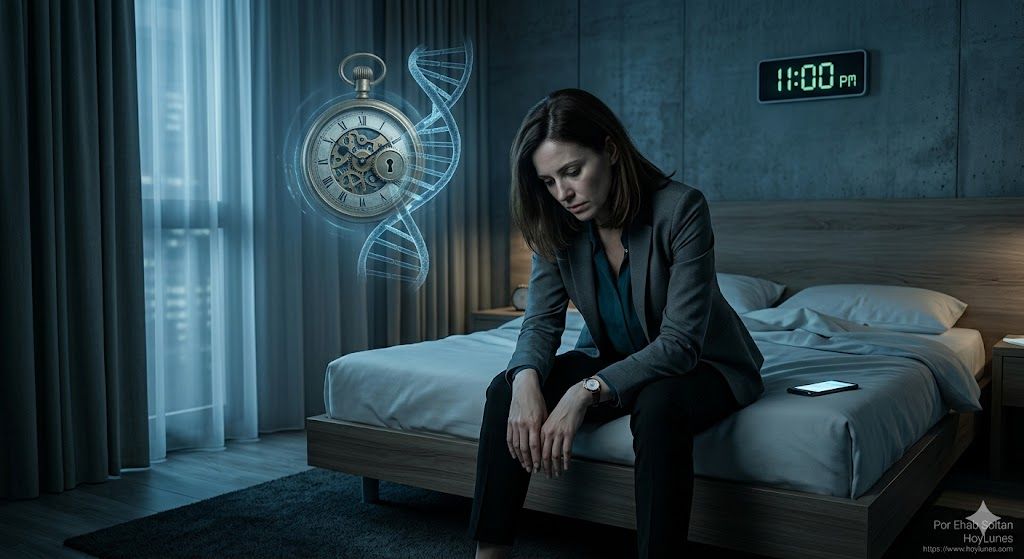
It is not how much you sleep, but when you do it: the misalignment between the internal clock and modern life could be driving specific diseases —differently according to sex and age— without the healthcare system measuring it.
By Ehab Soltan
HoyLunes – For years, medicine and popular wisdom have reduced sleep to a purely quantitative variable: hours. Sleeping seven or eight became an almost moral standard, a standardized figure that promised physiological balance, cognitive performance, and long-term health.
But that narrative, as comforting as it is simplistic, is beginning to show deep cracks under the light of modern chronobiology.
In this 2026, a hypothesis emerges with unusual force in the most advanced scientific and technological circles, challenging established dogma: sleep duration is an incomplete and often misleading metric. What is truly determinant for human health is not the total volume of rest, but the synchronization or misalignment between that actual sleep and the individual ‘optimal biological window’.
This distinction —invisible to the majority and absent in clinical practice— could be one of the underestimated mechanisms explaining why people who “sleep well” continue to develop complex pathologies.
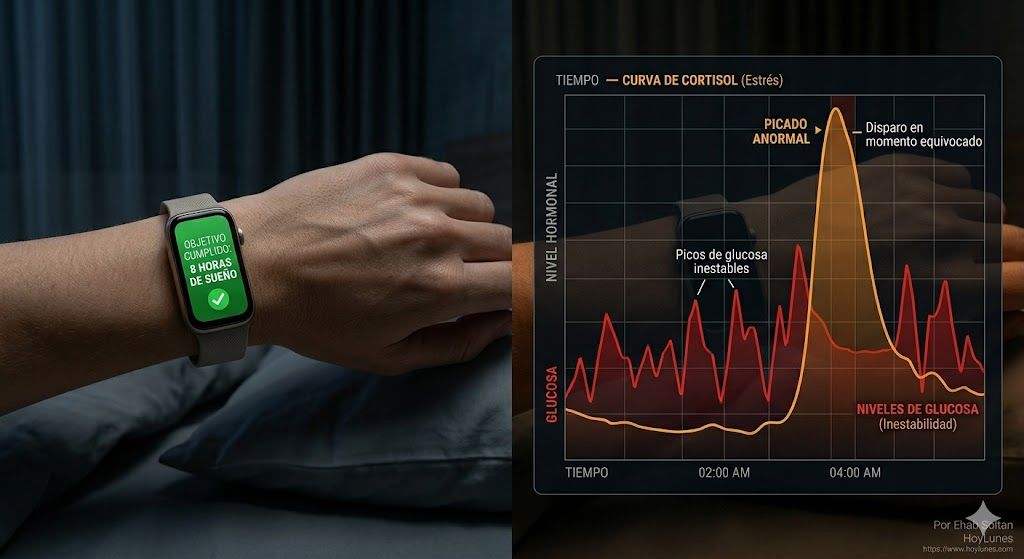
The Structural Error: Measuring Hours, Ignoring Biological Synchrony
The human body does not function like an hour counter, but like an orchestra of intricate biological rhythms.
Our circadian rhythm is the director of this orchestra, regulating critical processes with astonishing temporal precision:
The pulsatile release of hormones (such as cortisol and melatonin).
Fluctuations in body temperature.
Energy metabolism and digestion.
Mechanisms of cellular repair and brain cleansing.
Sleeping systematically outside of that optimal biological window —determined by each individual’s chronotype (whether you are a «lark» or an «owl»)— is not physiologically equivalent to sleeping less. It is, potentially, sleeping pathologically even if you subjectively feel you are sleeping enough.
The problem is not quantitative. It is chronological. Here lies the conceptual break we must assimilate: Two people can log exactly 7 hours on their tracking devices. However, if one sleeps from 10:00 p.m. to 5:00 a.m. (aligned with their lark biology) and the other from 2:00 a.m. to 9:00 a.m. (being a lark forced into an owl schedule), only the first is obtaining truly restorative rest. The second is, literally, fighting against their own physiology.
The Uncomfortable Hypothesis: Specific Diseases, Not «Worse General Health»
Classical medical discourse tends to link «bad sleep» with vague «worse general health». This lack of specificity dilutes the impact of the message.
The new hypothesis of 2026 is much sharper and, therefore, more worrying. It suggests that this chronic misalignment acts as a direct and differentiated driver toward very specific pathologies, depending on the individual’s sex and life stage.

The Female Pathway: Misalignment and Silent Hormonal Disruption
In women, the impact of sleeping outside the optimal biological window seems to prey upon the delicate endocrine system.
Incorrect «timing» of sleep relative to the circadian cycle alters hormonal signaling, potentially affecting:
The production and balance of estrogens and progesterone.
The regulation of the HPA axis (stress) and cortisol production.
Insulin sensitivity at the ovarian level.
This cascade of micro-disruptions, repeated night after night for years, opens a plausible pathway —though still under investigation— toward specific diseases such as polycystic ovary syndrome (PCOS), endometriosis, and, later on, a much more pathological transition toward menopause, characterized by severe metabolic disorders. It is not that these women lack hours of sleep; it is that their hormonal clock is receiving contradictory signals every night.
Although the evidence is not yet conclusive, studies in chronobiology and endocrinology already point to significant correlations between circadian alterations and female hormonal dysfunctions. The current void is not of signals, but of clinical integration.
The Male Pathway: Misalignment and Progressive Metabolic Deterioration
In men, the impact of this chronobiological blindness seems to shift more aggressively toward metabolism and systemic inflammation.
Systemic sleep misalignment hits fundamental pillars:
Nocturnal testosterone production, crucial for male metabolic health.
Efficiency in glucose metabolism and leptin signaling (hunger/satiety).
Increase in low-grade inflammation markers.
This altered metabolic pattern directly connects with specific diseases such as insulin resistance, type 2 diabetes, premature cardiovascular disease, and the selective accumulation of visceral fat. The typical patient is not someone with severe insomnia, but a functional man, with a demanding career, who dines late and sleeps his 7 hours… but on a schedule chronically out of step with his biology.
It is not about a lack of rest, but about a metabolism operating outside its optimal synchronization.
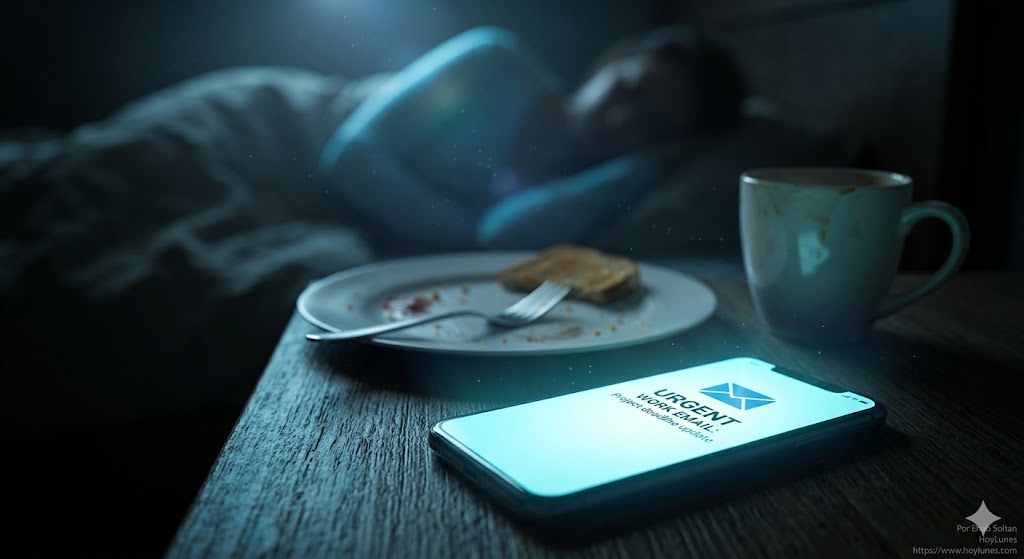
The Trap of the Innocent Habit and Chronic «Social Jet Lag»
The problem is not in extreme cases, but in normality. This hypothesis would not arise if it were not fueled by daily behaviors deeply rooted in our culture. We are not talking about extreme night shift workers (whose health is already known to be compromised).
We are talking about the majority of the working population that succumbs to apparently innocent habits:
Copious and Late Dinners: That force the digestive and metabolic system to work when they should be repairing themselves, altering core temperature and delaying the biological onset of sleep.
Massive Exposure to Nocturnal Blue Light: From smartphone and tablet screens, which inhibits melatonin and falsely indicates to the brain that it is daytime.
Rigid Social and Work Schedules: That systematically ignore individual chronotypes, forcing millions of people to live in a state of permanent «social jet lag».
The Challenge for the Healthcare System: What Is Not Measured, Does Not Exist
The current healthcare system remains trapped in the metric of the last century. The standard question in consultation continues to be:
«How many hours do you sleep a day?»
An answer of «7 hours» is noted as a positive health indicator. However, the system remains blind to the questions that really matter in 2026:
What time do you usually go to bed and get up?
Does your sleep schedule coincide with your biological chronotype?
Do you feel fatigue or mental fog despite having slept those 7 hours?
This structural blindness of the system is what allows specific metabolic and hormonal diseases to brew in silence, under the false security of «sufficient» rest in hours.
In practical terms, the healthcare system is validating as “healthy” a pattern that could, in reality, be dysfunctional.
Health No Longer Depends on Rest, But on Synchronization
We are entering a new era of personalized medicine.
Public health can no longer afford the luxury of basing its sleep recommendations solely on total duration. Sleep medicine must evolve toward an approach of personalized biological alignment.
The fundamental question we must ask ourselves today is not:
“Do you sleep enough?”
The real question, the one that can define your health over the next decade, is: “Are you sleeping at the right time for your unique biology?
Because if the answer is no, even if your tracker logs 8 perfect hours, you may not be resting… but accumulating disease in absolute silence.
And the most disturbing problem is that, today, no one is telling you that this is happening.
Solid Sources to Support This Hypothesis
National Institutes of Health (NIH): Research on circadian rhythms and health. [https://www.nih.gov]
European Sleep Research Society (ESRS): Guidelines and studies on sleep medicine and chronobiology. [[https://esrs.eu](https://esrs.eu)]
Harvard Medical School – Division of Sleep Medicine: Resources on sleep science and the impact of its disruption. [https://hms.harvard.edu/departments/division-sleep-medicine]
Nature Reviews Endocrinology: Review articles on the interaction between sleep, circadian rhythms, and the endocrine system. [https://www.nature.com/nrendo/]
Sleep (Journal – Oxford Academic)
Journal of Clinical Endocrinology & Metabolism
Nature Communications (circadian studies)
#Chronobiology #SleepMedicine #MetabolicHealth #CircadianRhythm #Prevention2026 #WomensHealth #MensHealth #HealthcareInnovation #HoyLunes #EhabSoltan