
The art of diagonal reading as a shield against information chaos and the alarming loss of the “slow gaze” in 2026.
By Nuria Ruiz Fdez
HoyLunes – In recent weeks, I have heard the same phrase repeated in television and radio debates, almost like a refrain: “I’ve read the judicial proceedings,” “It’s hundreds of pages, but it was given to me yesterday and I’ve read it…” Some pundits say it with staggering nonchalance, as if there were enough time between a coffee and a commercial break to digest entire legal volumes. The tagline usually follows, spoken in a half-whisper and with a certain pride: “and I read it… diagonally.”
As this confession was repeated more than once in a short span of time, curiosity began to work its way through me. What exactly was “diagonal reading”? A graceful way to save face or a genuine skill? It was then, as I looked into how one learns to read diagonally, that I realized something revealing and surprising: I have been reading diagonally for a long time without even noticing, like someone developing an instinct to survive daily chaos. But it wasn’t until I read—ironically enough—that this is an art, or rather, a recognized technique, that I understood I wasn’t doing it “wrong,” but exactly as I should. Suddenly, what seemed like a reader’s mischief turned into a silent superpower.
And of course, one begins to imagine things. First, literary contests: do they use this technique? Should they? Do they know how to use it well? Because sometimes it feels as though they don’t even read the text, or that they only read the author’s name. We already saw what happened with our latest Planeta Prize, where the packaging seemed more important than the content. So I asked myself: is it risky to judge a work this way? Undoubtedly. Diagonal reading can serve as a first glance, but never as a final sentence.
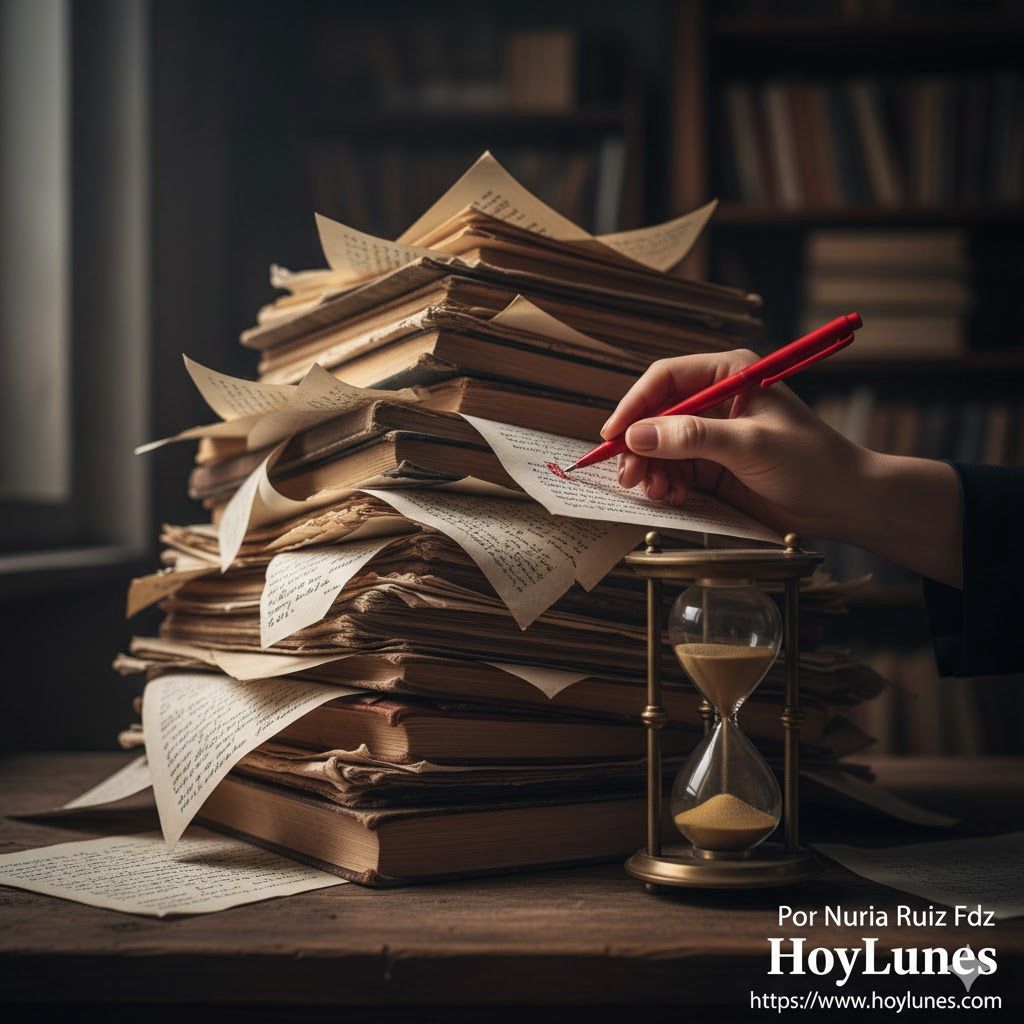
And if that happens in contests, what about publishing houses? I wonder if, when they receive a manuscript, they skim it with true attention or if they apply this technique like someone glancing at a shop window during rush hour. A suspicion always haunts those of us who write: is there anyone truly reading that manuscript that cost years of sleepless nights? Or will they decide its fate with a quick sweep, a couple of paragraphs, and a rushed intuition? Because if it is already risky in a contest, the risk is greater in a publishing house: a reading that is too fast can leave out authors who deserved a place.
And suddenly another question comes to mind, with a nod to this 21st century: those literary content creators on TikTok who spend hours promoting books they claim to have read…
Do they also master diagonal reading? Or have they invented their own method for devouring texts, with eyes leaping from line to line like digital acrobatics?
Of course, reading diagonally is not, in itself, a lack of respect for the text nor a crime against literature—even if more than one purist has raised an eyebrow as if I were speaking of a cultural apocalypse. It is a useful technique, one that emerged in the mid-20th century with the expansion of education and written information, which today, in the midst of an information storm, has become almost a survival tool. I recommend: *Lectura Rápida. Método completo de lectura veloz y comprensiva* (Speed Reading: A Complete Method for Fast and Comprehensive Reading) by Roberto García Carbonell. A Spanish text that brings together techniques and exercises designed for those who need to process information quickly without losing comprehension entirely.

But like any art, it requires knowing when to use it… and when not to. Because let’s be honest: no human being in their right mind can absorb the avalanche of emails, reports, articles, and messages that modern life sends our way daily. That is why, without realizing it, we have developed this skill.
Reading diagonally involves sliding your gaze over the text looking for signals: keywords, central ideas, phrases that shine, or red alerts that tell us “here is the important part.” It is like contemplating a landscape from a moving train: you don’t catch every detail, but you do get a general panoramic view. It is not just about skimming your eyes over the top; it is about reading selectively.
That internal radar works… but it doesn’t work for everything. And it certainly should not be the sole criterion for awarding a prize to a work or for deciding if a book deserves to exist in a publishing house.
There are those who see “skimming”—I must make a necessary aside: an Anglicism that means what has always been “ojear” (to leaf through). From here I recommend, I ask, I implore to use our Spanish and not try to “ennoble” it with foreign terms; enough of boycotting ourselves, forgive this parenthesis—as a threat to deep understanding, and they are right… halfway. A poem, a novel, or a letter that strips us bare or moves us should not be read in leaps.
It is true that practicing it improves reading speed and helps to prioritize, but abusing the technique limits our ability to appreciate nuances, which are so important in a literary work. And perhaps, who knows, it might leave us without the next great novel because of a hurried glance.
The key is to choose well: when to lighten the pace… and when to stop.
In a world that pushes us to go fast, read fast, and live fast, diagonal reading becomes a lifeline on many occasions. It allows us to surf the surface of the urgent without drowning in every detail. It is useful, practical, and almost necessary. But at the same time, it is a renunciation: a way of looking at the ocean without getting wet.
True literature—the kind that changes us from within—cannot be captured diagonally. It demands presence, time, and an almost loving attention. It invites us to get off the train, walk along the shore, and discover that where we once only saw a fast-moving forest, there are now roots, shadows, creatures, and flowers that only appear when one truly stops.

Therein lies the paradox: diagonal reading saves us from excess, but only slow reading saves us from the void. And perhaps the balance lies in knowing when to simply graze the pages… and when to stay within a reading that asks for our time.
And with that certainty—that of knowing how to choose the rhythm—I inaugurate this first article of the year in my bi-weekly column, *The Craft of Looking*. Because looking is also deciding where to stop, what deserves time, and what should be allowed to pass by. May this 2026 find us more attentive than fast, more curious than exhausted, more readers than lost souls in the noise. And may we know how to read life slowly… and without ever losing sight of it.
Happy 2026.