

How the ovarian-hormonal axis, the reproductive microbiome, the exposome, and artificial intelligence are transforming gynecology into a privileged laboratory for understanding and modulating female longevity.
By Ehab Soltan
HoyLunes – Throughout much of the history of modern medicine, the study of human aging focused on organs considered universal: the heart, the brain, or the immune system. However, this seemingly neutral vision concealed a fundamental bias. The female body—and, specifically, its reproductive physiology—was studied for decades as a variation of the male model rather than as a biological system with its own dynamics. The result has been a historical delay in understanding how women actually age.
Research in endocrinology, molecular biology, and precision medicine is revealing that the female reproductive system not only regulates fertility but also acts as a central hub for biological processes that influence the entire organism. This article explores a disruptive hypothesis: that gynecological health could constitute one of the most powerful predictors of female longevity.
The Great Blind Spot of Modern Medicine
For decades, gynecology was treated as an isolated field, limited to gestation and reproductive pathology. This reductionist approach led to a delay in the investigation of diseases that manifest uniquely in women. According to the World Health Organization (WHO), although women have a longer life expectancy, they also live a higher proportion of years with chronic illness and disability. Menopause, traditionally interpreted as a simple biological decline, is actually a critical physiological transition that sets the pace for systemic aging.
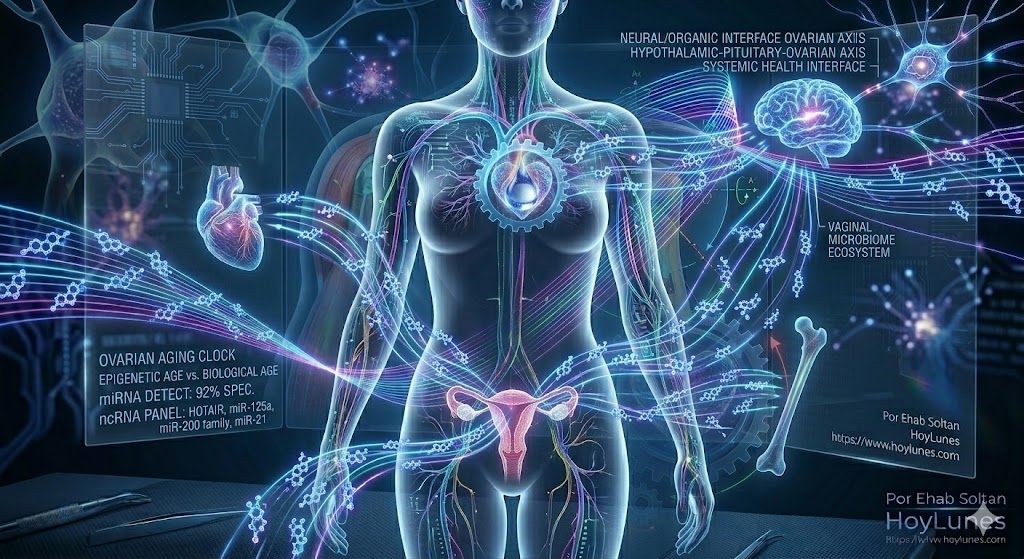
The Ovarian-Hormonal Axis: The Hidden Regulator of Aging
The central hypothesis of current longevity medicine suggests that the reproductive system regulates systemic processes far beyond the uterus. Estrogen and progesterone are key modulators of energy metabolism, cardiovascular health, neuroprotection, and bone density.
Menopause represents a profound endocrine reconfiguration. As hormonal signaling decreases, a state of low-grade systemic inflammation (known as inflammaging) is activated, accelerating the aging of arteries and neurons. Understanding this axis is key to understanding the rate at which the female body ages.
The Ovary-Immunity Axis: The Emerging Connection
Recent research suggests that the ovary does not only regulate hormonal processes but also maintains a constant dialogue with the immune system. During reproductive aging, the decline in estrogenic signaling alters immune regulation, favoring a chronic low-grade inflammatory state. This phenomenon directly connects reproductive biology with cardiovascular, neurodegenerative, and autoimmune diseases that appear more frequently after menopause. Understanding this interaction between the ovary and immunity could open new preventive strategies in female medicine.
The Reproductive Microbiome: The Forgotten Ecosystem
The vaginal and uterine microbiome is not just a barrier against infection; it acts as a systemic immune regulator. The dominance of Lactobacillus species is associated not only with better reproductive health but also with lower overall inflammation. Alterations in this ecosystem (dysbiosis) are linked to maladaptive immune responses that can influence metabolic health and the risk of preterm birth, acting as a biological sentinel of a woman’s resilience.
For years, it was assumed that the uterus was a sterile environment. However, recent research has identified specific microbial communities in the endometrium, opening a new area of study known as the uterine microbiome. This discovery is transforming the understanding of fertility, embryo implantation, and local immune responses, suggesting that the microbial ecology of the reproductive tract could play a role in a woman’s systemic health.
The Female Exposome: The Environment as Biological Architect
A revolutionary concept gaining ground is the exposome: the totality of environmental exposures (pollutants, diet, stress, endocrine disruptors) accumulated throughout life. Reproductive physiology is particularly sensitive to these external signals. Today, we know that microplastics have been detected in placentas and that endocrine disruptors found in plastics and cosmetics alter ovarian reserve.
This perspective is changing the focus of contemporary gynecology. If ovarian reserve and hormonal function respond to environmental signals accumulated over decades, the female reproductive system could become an extremely sensitive biological sensor of the environmental conditions in which a population lives. In this sense, studying reproductive aging offers a privileged window into understanding how the environment modulates human longevity.

Biological Reproductive Age”: The Ultimate Predictor
In recent years, a concept has emerged that is capturing the attention of researchers in the biology of aging: the so-called “Ovarian Aging Clock“. Various studies suggest that the rate at which the ovarian reserve declines may reflect broader biological processes related to systemic aging.
This is the scientific turning point: not all women age reproductively at the same rate. Biological reproductive age, estimated through ovarian reserve (Anti-Müllerian Hormone), hormonal biomarkers, and epigenetic profiles, is postulated as one of the best predictors of systemic aging. A woman with accelerated reproductive age could have an increased cardiovascular or cognitive risk decades before expected by her chronological age.
Precision Medicine and Digital Twins
The technological revolution now allows for the integration of genomics, data from wearable devices, and the study of the exposome to create Digital Twins. These predictive models allow doctors to simulate how a patient’s body will respond to certain treatments or lifestyle changes, enabling the prediction of early menopause or the risk of gynecological cancer with unprecedented precision.
The New Female Preventive Medicine
If gynecological health is the central predictor, gynecology must be transformed into the primary preventive discipline for women. This implies:
Personalized hormonal monitoring from early stages.
Specific cardiovascular prevention based on the hormonal profile.
Microbiome optimization to regulate systemic immunity.

Implications for Human Longevity
Studying the female reproductive system is, in essence, studying the biology of human aging in its most complex form. As a system that integrates metabolism, immunity, and environmental response, it offers a privileged observatory for understanding why and how we age.
This change in perspective has profound implications for biomedical research. If the female reproductive system integrates hormonal, immunological, metabolic, and environmental signals, then gynecology could become one of the most strategic fields for studying human aging. Analyzing female health is not only a matter of scientific equity but an opportunity to advance the global understanding of longevity.
The New Frontier of Medicine
Twenty-first-century medicine is shifting from treating disease to engineering healthy longevity. In this context, gynecology ceases to be an isolated specialty and becomes the epicenter of preventive medicine. Understanding the female biological clock is not just a matter of reproductive health; it is the key to unraveling the deepest mechanisms of life and human longevity.
Key Scientific Sources:
Nature Reviews Endocrinology: The role of ovarian aging in systemic health.
Nature Medicine: Epigenetic clocks and reproductive aging.
The Lancet Planetary Health: Environmental endocrine disruptors and female health.
World Health Organization (WHO): Women’s health and aging report.
#GynecologicalHealth #FemaleLongevity #PrecisionMedicine #Exposome #Microbiome #CommonGood #HoyLunes #EhabSoltan
This is for informational purposes only. For medical advice or diagnosis, consult a professional.