
It arrived with brain fog, invisible exhaustion, and the feeling of slowly disappearing inside a life that continued to demand normalcy.
By Ehab Soltan
HoyLunes — Sometimes, change does not arrive with a crash, but with a silence you don’t know how to fill.
I remember a night, not long ago, seeing my partner (52 years old) standing at the window. She wasn’t looking at anything in particular. She stood there, her hand suspended in mid-air as if she had forgotten the purpose of her own movement. It wasn’t the typical forgetfulness of “where did I leave my keys?”. It was something denser. When she turned toward me, her eyes had a lucidity that frightened me.
Months later, with a mix of shame and an honesty that still aches, she explained it to me: “It wasn’t a slip, Ehab. It was the feeling that, for a second, my body stopped speaking my language. As if something inside my system was no longer reacting the same way”.
That night, she remained herself. She kept answering emails, organizing the schedule for the following week, and remembering, as always, my mother’s birthday that I would have missed. From the outside, the world saw an impeccable, productive woman in control. But I, who shares her coffee and her silences, began to notice that she was inhabiting a transformation that no one had taught us how to name.
Because the public conversation about menopause has defrauded us. They sold it to us as a boring list of physical symptoms: hot flashes, night sweats, irregularities. But what I saw in her was not a “physical problem”. It was an internal displacement. As if something essential were changing while she kept trying to live exactly the same way as before.

The Fog Behind the Gaze
What came next was not an explosion, but an erosion. I started to notice that her fatigue did not resemble the tiredness of a long day at the office; it was something denser, a kind of brain fog that settled between her and the world.
Searching for answers, I understood that it wasn’t just “psychology”. I was surprised to discover the invisible dictatorship of estrogen. No one tells you that these hormones are not only useful for fertility; they are the ones that keep the brain’s lights on: they regulate sleep, memory, stress response, and even the serotonin that makes us feel like “everything is fine”. When that balance is broken, the world stops feeling the same.
I kept asking myself a question that still haunts me: How much of what we love about someone’s personality is, in reality, the result of a biology that functions in silence? To see her was to see a nervous system trying to process daily noise without the usual filters. The world, simply, had become too loud for her new biological reality.
The Body Does Not Enter This Stage from Scratch
As the months passed, I understood that the body does not arrive at menopause as a blank slate. It arrives carrying everything it has lived before.
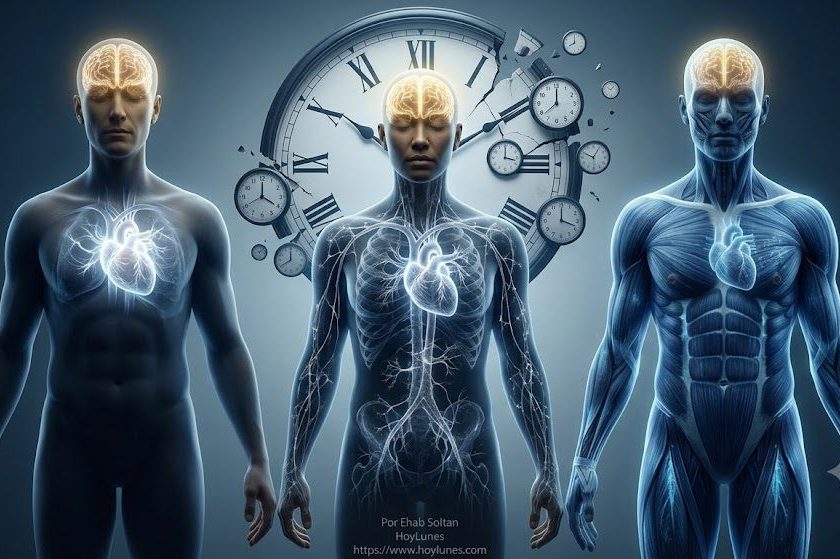
Not all women arrive in the same body. There is a brutal difference between crossing this biological threshold after years of health, or doing so after decades of sustained stress that the modern world considers “normal”. I understood that many arrive with systems deeply exhausted by years of fragmented sleep and emotional overload.
Menopause is not always the cause of the fire; sometimes it is simply the moment when the body stops having water to extinguish the fires that had been burning in silence for years. This stage does not always destroy balance; often, it simply strips bare the true state in which the organism had been living for decades.

When the Mirror Stops Responding the Same Way
There is a part of this transition that does not occur in blood tests, but in the atmosphere. She confessed to me the strange sensation of beginning to slowly disappear from the gaze of others. For decades, women are taught that their social value is tethered to youth and constant energy. When biology alters that pact, the social reflection cracks.
Even the irritability that sometimes appeared struck me as something much more human than a mere symptom. It wasn’t “bad mood”. It was the nervous system saying it could no longer automatically accept what it previously endured in silence. Sometimes, menopause does not create new emotions; it simply reduces the ability to keep hiding exhaustion that was already ancient.
The Labyrinth of Loose Pieces
There was a moment of apparent calm that confused us. Three months passed without a period, and we thought: “That’s it”. But biology is not a switch. We learned that menopause is a fluctuating process; cycles can return unexpectedly. The medical guidance is clear: one must wait twelve consecutive months of silence to consider the process closed.
And in that wait, the parade of specialists appeared. It was desolating to see her fragmented: the cardiologist looked at the heart, the neurologist at memory, and the gynecologist at hormones. No one looked at the whole woman. The most frustrating thing was that the analysis always came back “normal”, an isolating experience that causes many to think, silently, that the problem is only in their head.

The Body Finally Stops Keeping Silent
Over time, I stopped looking for quick fixes. I understood that menopause amplifies the frailties she had spent years compensating for. What she previously could hide was now exposed.
And perhaps that is one of the most important truths of this stage: the body does not suddenly become incomprehensible. It continues to respond to biology, rest, stress, isolation, and accumulated wear. What changes is that it no longer has the margin to keep compensating for everything in silence.
Amid that vulnerability, she began to question inertial patterns that had been functioning for years without examination: exhausting relationships, work demands, and the habit of always being available for everyone. Perhaps that is why so many specialists today insist on something that seems simple, but is not: sleeping better, reducing sustained stress, preserving muscle mass, asking for help before exhaustion, and stopping the normalization of extreme fatigue are not small wellness habits. They are real ways of giving the nervous system a chance to recover.
Today, when I look at her, I understand that her body was not betraying her. It was setting a limit for her. Menopause is not just a hormonal transition; it is a profoundly human experience. It is the discovery that we are not machines designed to sustain any rhythm indefinitely.
Perhaps menopause is not the moment when a woman begins to lose herself, but the moment when her body, exhausted from sustaining everything in silence, finally demands she return to herself.
#Menopause #WomensHealth #Hormones #HealthyAging #EmotionalWellbeing #HoyLunes #EhabSoltan