

Pollution, extreme heat, and new infectious diseases are redefining childhood epidemiology. Increasing numbers of pediatricians are warning that climate change is not just an environmental phenomenon, but one of the greatest determinants of child health in the 21st century.
By Ehab Soltan
HoyLunes – On an early spring afternoon, in any given pediatric practice in a large European city, the diagnosis seems familiar: an asthma crisis in an eight-year-old child. The doctor listens to the wheezing in the lungs, prescribes inhaled medication, and recommends avoiding exposure to known allergens and pollutants. Scenes like this have been repeated every season for decades. However, something has quietly changed around that practice.
Outside the hospital, the city air accumulates increasing concentrations of fine particles after weeks of anticyclonic stability. Heatwaves last longer than pediatricians remembered during their training. Calendars of infectious diseases are beginning to shift, and some tropical pathogens are appearing in temperate regions where they were previously unknown.
The child remains biologically the same. The environment in which they grow up is not.
This transformation of the environment is neither an abstract nor a distant phenomenon. In recent decades, the average global temperature has increased steadily, altering atmospheric patterns, biological cycles, and species distribution. What once belonged exclusively to the field of climatology is beginning to appear in children’s medical records. Pediatric medicine, traditionally focused on the individual development of the child, is now forced to consider planetary variables.
In recent years, researchers and pediatricians have begun to consolidate a hypothesis that until recently seemed more proper to sociology or environmental epidemiology than to cutting-edge clinical medicine: climate change is becoming one of the most influential determinants of child health during the 21st century.
It is crucial to make a medical distinction to uphold the scientific credibility of this approach: climate change is not a pediatric disease in itself. It is not a diagnosis that a doctor can write in a medical record alongside “pneumonia” or “type 1 diabetes.” It is something broader and more complex: an epidemiological framework and a structural determinant of health that alters biological development and silently influences the pathology of millions of children.
In epidemiology, structural determinants are those factors that shape the health of entire populations even before individual diseases appear. During much of the 20th century, these determinants were associated with conditions such as poverty, access to clean water, or vaccination. In the 21st century, a new factor is beginning to be added to this list: the climatic stability of the planet.
International health organizations are already warning with data in hand. Recent reports from the World Health Organization (WHO), UNICEF, and The Lancet Countdown monitor highlight that minors represent one of the most vulnerable groups to climatic alterations. The reason is not ideological, it is purely biological: children’s bodies are under construction and their adaptation mechanisms are limited.
Understanding this phenomenon requires a shift in perspective. For decades, pediatrics focused on genetic factors and pathogens as the primary causes of childhood illness. Today a broader vision emerges: the health of children also depends on complex environmental systems —the atmosphere, ecosystems, and climatic cycles— that act as invisible modulators of biological risk.
Biological Vulnerability as an Amplifier
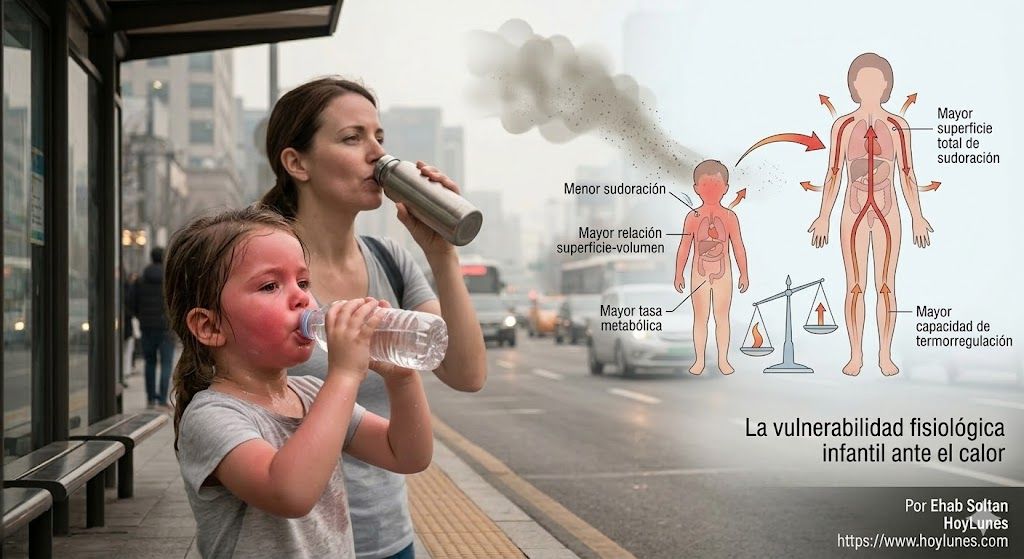
To understand why extreme climate enters the pediatric practice, we must look at the child’s unique physiology. They are not miniature adults.
Firstly, children breathe more air per kilogram of body weight than adults, increasing their proportional exposure to any atmospheric pollutant or pollen exacerbated by heat. Furthermore, their immune system is fully developing, learning to distinguish between friends and enemies, which makes them more susceptible to new infections. Their neurological development passes through critical stages where environmental neuroinflammation can have long-term effects. Lastly, their capacity for thermoregulation is lower; they sweat less efficiently and depend totally on adults to protect themselves from heat or to hydrate.
This biological vulnerability turns climate change into an amplifier of pre-existing diseases and a creator of new risks.
The Childhood Lung: An Environmental Sensor
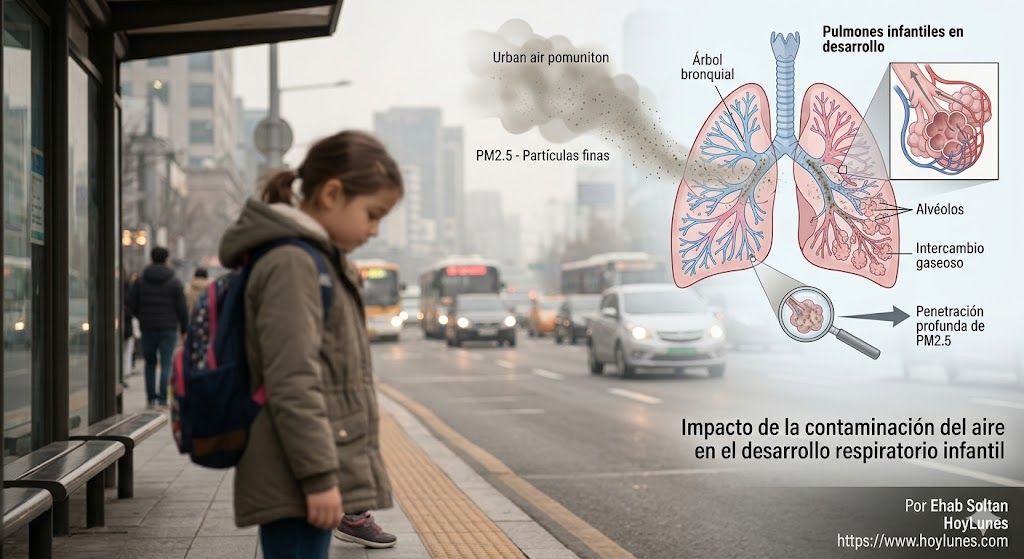
Atmospheric pollution is, perhaps, the most studied environmental factor in pediatrics and the most direct link with climate change, given that they share the same root: the burning of fossil fuels. The real medical evidence is overwhelming.
Fine particles (PM2.5) and ground-level ozone —whose formation skyrockets with high temperatures— are directly related to the increase in asthma crises, hospitalizations for acute respiratory infections, and, crucially, to reduced lung development. Cohort studies have demonstrated that children growing up in highly polluted areas reach adulthood with a lower lung capacity, a lifelong physiological stigma. Distressing evidence is also emerging linking prenatal exposure to pollution with systemic and even cognitive effects.
This finding has implications that go beyond childhood. Compromised lung function during development can increase future vulnerability to chronic respiratory diseases in adulthood. Thus, the environmental conditions of the first years of life can project their influence on health for decades, turning pollution into an intergenerational determinant.
The Child’s Body Facing a Hot Planet
If pollution attacks the lung, heatwaves stress the entire childhood physiological system due to the immaturity of their thermoregulation mechanisms.
During episodes of extreme heat, pediatric hospitals record an increase in admissions not only for direct heatstrokes, but for severe dehydration, electrolyte imbalances, and renal complications. Beyond the urgency, extreme heat affects sleep quality and, therefore, neurodevelopment and learning capacity in school, a less visible but profoundly limiting impact.
Some recent epidemiological studies suggest that extreme heat may also indirectly affect school performance and the psychological well-being of children, by altering sleep patterns, physical activity, and concentration. Although these associations are still being investigated, they point toward an impact of climate change that transcends the purely physiological.
Nutrition and Infection: The Changing Map
Climate change not only affects what the child breathes or the temperature they feel; it also alters what they eat and the pathogens to which they are exposed.
At a global level, extreme climate phenomena (droughts and floods) affect agricultural production and food security. This is not only a problem for developing countries; price volatility affects access to quality nutrients everywhere. In pediatrics, food insecurity translates into malnutrition, stunting, and alterations in cognitive development during critical windows of childhood.
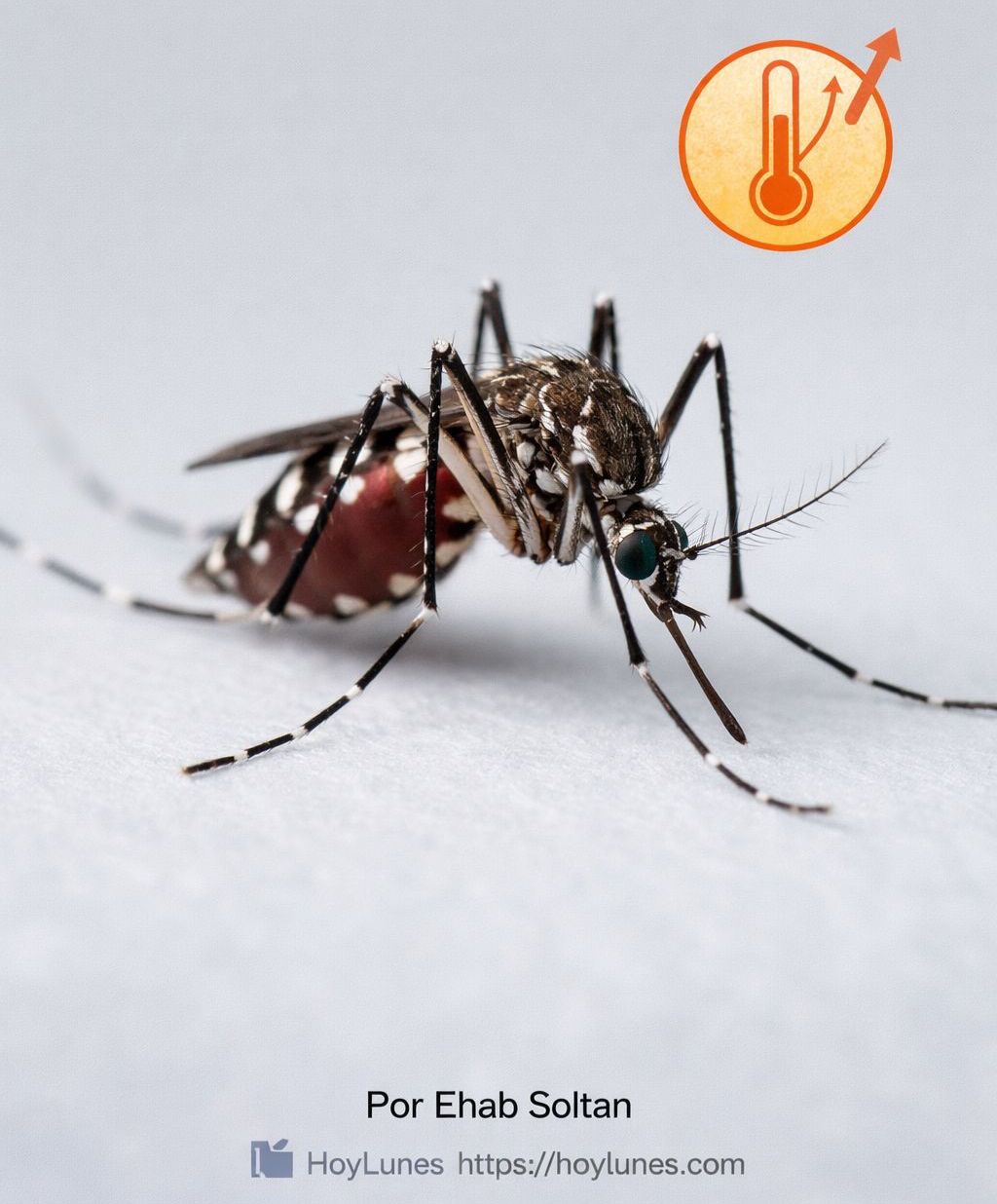
Simultaneously, global warming is reconfiguring the map of infectious diseases. Vectors such as Aedes and Anopheles mosquitoes or ticks are expanding their geographical territories into latitudes and altitudes that were previously safe. Diseases such as dengue, chikungunya, or Lyme disease are appearing in new areas of Europe and North America. Children, due to their outdoor play behavior and their immature immune system, are usually one of the groups most affected by these emerging vector-borne infections.
This geographic displacement of vectors illustrates how climate change can reorganize the global epidemiological map. Regions that for decades did not have to monitor certain diseases are now beginning to incorporate them into their public health systems. For pediatrics, this implies facing pathologies that until recently were considered exotic in many clinical contexts.
The Challenge for the Pediatrics of the Future
This confluence of factors —respiratory, thermal, nutritional, and infectious— compels us to propose a new conceptual framework for 21st-century pediatrics. The challenge elevates the profession beyond traditional clinical medicine.
Pediatrics finds itself before a historic crossroads: should it limit itself to treating childhood diseases within the walls of hospitals and practices, once they have already manifested? Or should it evolve toward an integral environmental medicine, actively participating in climate surveillance and in the promotion of public policies?
If we accept that climate is a structural determinant of health, the answer seems evident. The pediatrics of the future could integrate environmental surveillance, identifying patterns of disease linked to meteorological and air quality data. But, above all, it implies that the best preventative “prescription” a pediatrician can issue in the long term might not be a drug, but advocacy for clean air policies, decarbonization, and cities physiologically adapted to children.
A Matter of Global Environmental Medicine
The current generation of children will be the first in human history to grow up on a climatically unstable planet. This raises a fundamental medical question that transcends environmental rhetoric.
Child health in the 21st century will depend as much on the excellence of hospitals and pharmacological advances as on global and local environmental decisions. The pediatric practice is no longer an isolated space; it is a place where a child’s wheezing can be the echo of an altered atmosphere. Understanding climate change as a crucial epidemiological framework is the first step to protecting the biological development of childhood in this new era.
Ultimately, the issue is not solely environmental nor exclusively medical. It is a matter of human development. If childhood represents the most vulnerable stage of the life cycle, then protecting the climate on which the planet’s biological systems depend becomes also a form of preventative medicine on a global scale.
Documentary and Authority Sources:
World Health Organization (WHO): Reports on climate change and child health.
UNICEF: Reports on climate change and its disproportionate impact on childhood.
The Lancet Countdown: Annual monitoring of the impacts of climate change on global health.
American Academy of Pediatrics (AAP): Policy statements on climate change and child health.
Intergovernmental Panel on Climate Change (IPCC): Assessments on the impacts of climate change on health systems.
This information is for purely informative purposes. For advice or a medical diagnosis, consult a professional.
#ClimatePediatrics #ChildHealth #Epidemiology #ClimateChangeAndHealth #EnvironmentalHealth #Pediatrics #ChildrensHealth #ClimateChangeHealth #HoyLunes #EhabSoltan