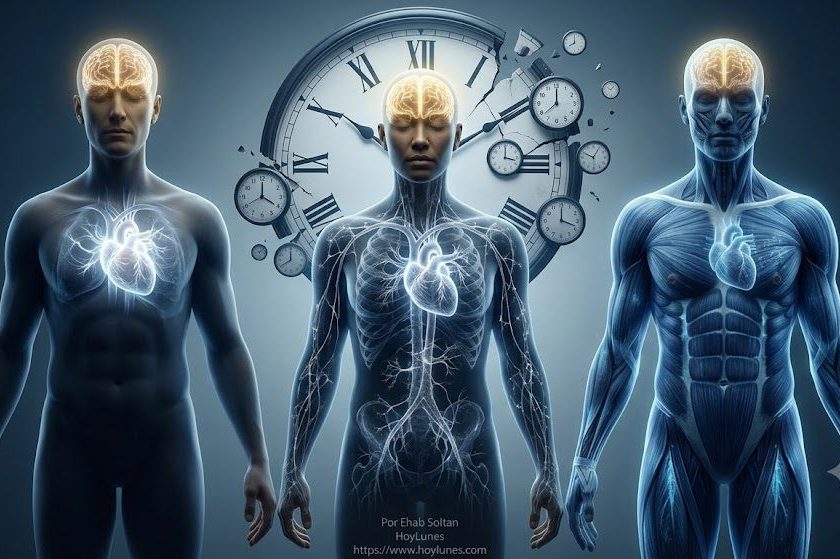

When a relationship ends, it is not just a bond that breaks: a system becomes disorganized. And what we do afterward — however superficial it may seem — is, in reality, a way of rebuilding it.
By Ehab Soltan
HoyLunes — Following a romantic breakup, no one walks into a hair salon thinking about the nervous system, but rather with the urgency to act immediately. However, popular observation confirms a direct correlation: there is a high probability that a woman will modify her bangs or her image after the end of a relationship. Conventional wisdom and social media interpret this gesture simply as a desire to “close chapters”, “reinvent oneself”, or as a mere aesthetic impulse.
This thesis holds that such an explanation is scientifically insufficient and strategically erroneous.
Saying that a woman cuts her bangs after a breakup is like saying someone flees when a fire breaks out. It is a correct observation of the fact, but it explains absolutely nothing about the mechanism that causes it.
The aesthetic gesture is not the event; it is the visible symptom of a highly complex underlying biological process.
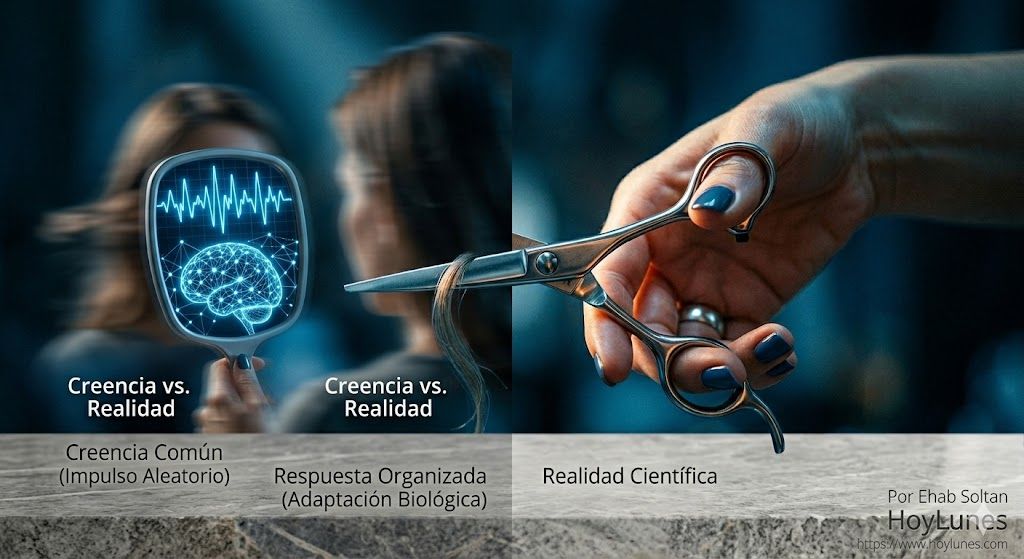
SYSTEMIC REGULATION HYPOTHESIS
To understand post-breakup behavior, we must shift the focus from aesthetics to applied neuroscience. What we usually interpret as an aesthetic decision is, in fact, an organized response of the nervous system.
| The Common Belief | The Scientific Reality |
| It is a change of image. | It is a regulation mechanism. |
| It is fashion / a trend. | It is a neuroscientific response. |
| It is a random impulse. | It is a biological adaptation. |
The Principle of Control Compensation
When an individual loses control over a macroscopic vital structure (the partner relationship, which organized their time, affection, and future projections), the brain automatically activates mechanisms to restore a minimum sense of stability.
The central thesis: Faced with the loss of control over what is important, the nervous system desperately seeks control over the immediate (the body, the direct environment, the routine).
Scientific Evidence: This pattern is documented in social psychology as Compensatory Control Theory (Kay et al., APA). Research demonstrates that the perception of randomness or disorder in the environment activates a compensatory motivation to perceive order and structure in other areas, even if these are symbolic or superficial. The haircut is a micro-structure of immediate order.
FRAGMENTATION OF IDENTITY
A breakup is not just the loss of an external bond; it is the disorganization of the internal structure of the “self”.
During a relationship, a narrative of shared identity is constructed. Psychologist James W. Pennebaker has shown through linguistic analysis that people going through trauma or breakups exhibit a fragmentation in their personal narrative. The use of pronouns changes, indicating confusion about their place in the world.
The silent disorganization:
Loss of predictability: Daily habits lose their anchor and meaning.
Cognitive dissonance: Decisions that were once automatic become blurred.
Narrative rupture: Internal dialogue, crucial for emotional regulation according to Ethan Kross, becomes critical and chaotic.
While the mind slowly attempts to reorganize this narrative chaos, the body, driven by the emotional system, acts. In simple terms: you no longer know exactly who you are in your own life.
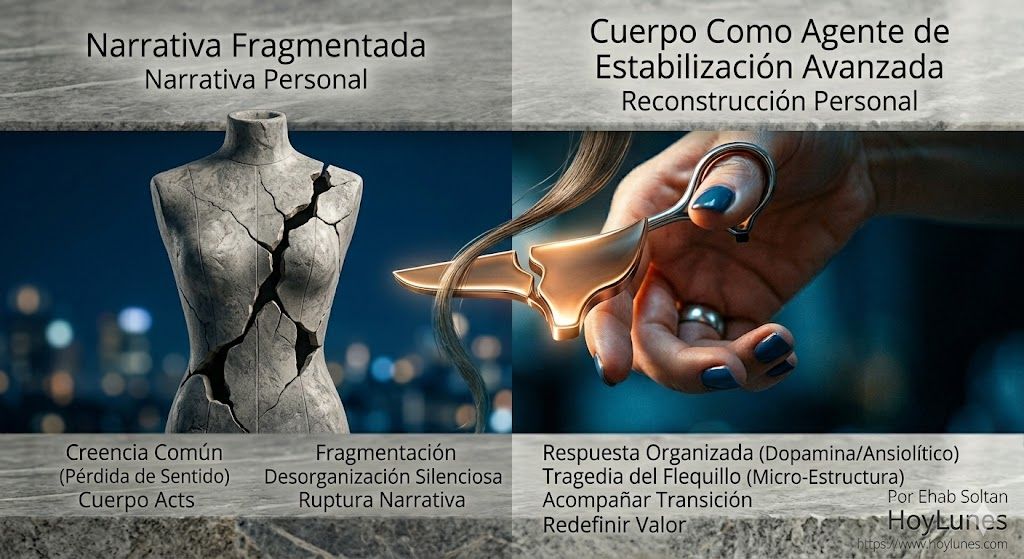
THE BODY AS AN AGENT OF ADVANCED STABILIZATION
Here lies the core of the social misunderstanding. It is assumed that the change of image is a random impulse. Neuroscience suggests the opposite.
Premise: The body acts before the mind finishes cognitively processing the event. This is why many decisions feel urgent, almost automatic, as if they cannot wait.
From a neuroscience perspective, the emotional system prioritizes the reduction of uncertainty. Visible and tangible action offers an immediate neurochemical reward (a sense of agency and control), regardless of whether it resolves the underlying problem.
Therefore, the aesthetic change works not because it is the solution, but because it is an effective short-term biological anxiolytic to reduce the internal disorder of the nervous system.
This is why many people do not recognize this process while living through it. They do not identify it as a biological response, but as a confused mix of urgency, impulse, and a need for change. But it is not chaos. It is a system trying to reorganize itself.
THE ERROR OF TRIVIALIZING ADAPTATION
Reducing these complex behaviors to clichés like “reinventing oneself” or a “new look” is a form of operational blindness that creates significant risks:
Pathologization of instinct: The person believes they are acting irrationally, when they are actually responding to a biological need for emotional survival.
Inertia of superficial solutions: A market is perpetuated that offers ephemeral aesthetic answers to deep structural problems.
CASE STUDY: The “Bangs Tragedy”
Situation: A woman cuts her bangs immediately following a breakup.
Superficial Interpretation: “She wants to look different to forget”.
Scientific Interpretation: Her nervous system is in a state of hyper-alertness due to the loss of predictability. Cutting her bangs is an action she can execute with total control (100% predictability of the immediate physical result), providing a spike of dopamine and control that temporarily calms systemic anxiety.
And for a few minutes — or a few hours — it works. Not because it has solved anything, but because it has restored a sensation that seemed lost: control.

REDEFINING VALUE
Post-breakup behavior is not erratic; it is systematic, measurable, and therefore, predictable. Far from being a marginal phenomenon, it is massive and recurrent. The persistence in its misinterpretation opens a gap of opportunity for sectors such as Mental Health and Psychological Clinics, Wellness and Self-care (Habit Apps), and Beauty and Personal Care brands with a preventive focus.
Organizations that understand this process will stop simply selling “changes” and start accompanying real human transitions. This enables a specific line of development: services that do not begin with aesthetic transformation, but with the diagnosis of the emotional moment. From support protocols in hair salons to guided self-care experiences, the value no longer resides in the visible result, but in the transition that precedes it.
A CHANGE OF LANGUAGE AND INTERPRETATION
The value of this systemic approach transcends the clinical and the commercial; it is fundamentally interpretative. It allows the individual to understand their own experience without reducing or dramatizing it.
Radically changing something — your image, your home, your routine — after a breakup is not an act of weakness or superficiality. It is an act of pure biological adaptation: the nervous system trying to reorganize itself after losing one of its main structures.
Because, in the end, a breakup does not disorganize your life; it disorganizes the system that sustained who you thought you were. Everything you do afterward is not superficial… it is reconstruction.
Sources and Frameworks of Reference
American Psychological Association (APA): Research on emotional regulation and compensatory behavior in the face of uncertainty.
James W. Pennebaker: Pioneering studies on narrative, health, and the emotional processing of trauma.
Ethan Kross (Emotion & Self-Control Laboratory): Research on internal dialogue (chatter) and its impact on emotional regulation.
#MentalHealth #AppliedPsychology #Relationships #EmotionalWellness #Identity #Neuroscience #HoyLunes #Strategy #SelfKnowledge #SocialInnovation #EhabSoltan