

How artificial intelligence, salivary biopsy, and data medicine are transforming dentistry into an early detection system for systemic diseases, redefining the role of the dentist, the governance of health data, and the future of preventive medicine.
By Ehab Soltan
HoyLunes – For a century, dentistry was perceived, and often practiced, as a reactive and mechanical discipline. The dentist was the “filler of holes,” the expert in extracting damaged pieces, treating cavities and, in the best of cases, managing periodontal disease. The mouth was a watertight compartment, separated from the rest of the organism by an invisible border that was rigidly respected by healthcare systems.
This fragmented vision contrasts with the actual magnitude of oral diseases in global health. According to international epidemiological estimates, more than 3.5 billion people suffer from some oral pathology, making these conditions one of the most prevalent chronic ailments on the planet. Untreated caries, advanced periodontitis, and tooth loss not only affect quality of life but are increasingly linked to systemic inflammatory processes associated with cardiovascular diseases, diabetes, and cognitive decline.
However, in 2026, we are witnessing a radical paradigm shift. The old model is collapsing under the weight of scientific evidence and technological innovation. Traditional dentistry is giving way to Systemic Precision Dentistry, a discipline that not only treats the oral cavity but uses it as the most accessible and powerful diagnostic window for general health.
This new approach, driven by the integration of Artificial Intelligence (AI) and salivary liquid biopsy, is transforming the dentist into a sentinel of global health. It is not a mere evolution; it is a revolution that is redefining the limits of the profession, raising profound ethical dilemmas, and demanding new governance for health data. Taking care of the mouth today is, fundamentally, protecting the integrity of the human being against systemic chronic diseases.

The Mouth as a Systemic Window
The basis of this revolution lies in understanding that the oral cavity is not an isolated organ. It is a complex ecosystem, rich in blood vessels and nerve endings, and bathed by an extraordinary biological fluid: saliva. The science of 2026 has consolidated the vision of the mouth as a “systemic mirror,” where molecular alterations in the rest of the body leave a detectable footprint at an early stage.
The “Salivary Mirror”: Liquid Biopsy for Ultra-Early Detection
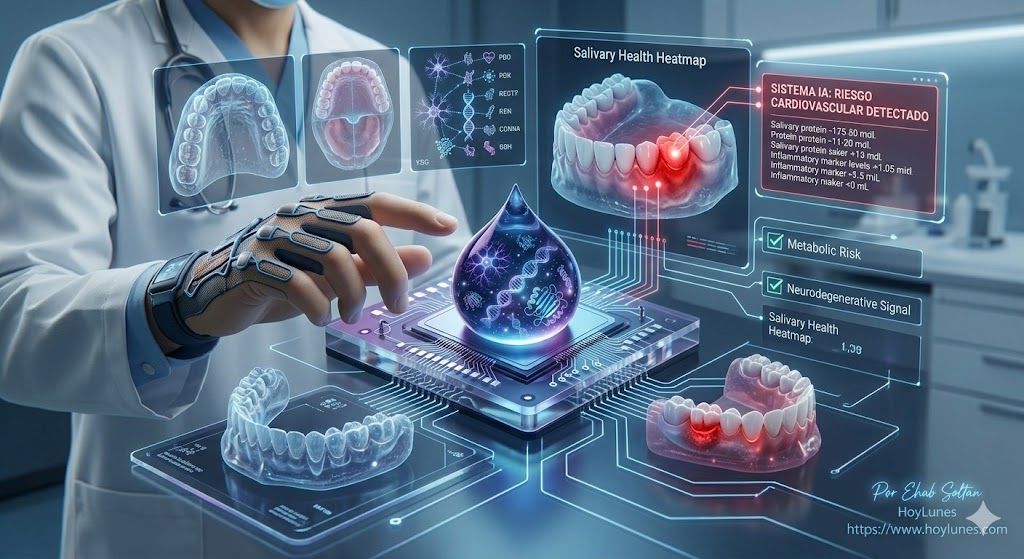
Saliva is no longer seen simply as a digestive lubricant. It is a non-invasive and easily obtainable “liquid biopsy” that contains a vast library of molecular information. Systemic precision dentistry is based on the ability to sequence and analyze the salivary microbiome, transcriptome, and proteome with unprecedented sensitivity.
Thanks to advanced RNA sequencing techniques and mass spectrometry, the dentists of the future can detect specific biomarkers of pathologies occurring far from the mouth. This salivary screening allows for the identification of early warning signs of autoimmune diseases, cardiovascular risk markers, and, crucially, the molecular signature of various types of cancer—including non-oral ones such as pancreatic, breast, or lung cancer—at stages where traditional diagnostic tests do not yet show alterations.
Although many of these applications are still in the multi-center clinical validation phase, advances in salivary genomics and proteomic analysis are accelerating their transition from the laboratory to clinical practice. Systemic precision dentistry thus sits within the realm of translational medicine, where the challenge is no longer just identifying promising biomarkers, but demonstrating their clinical utility in population screening programs and preventive medicine.
Cancer, Alzheimer’s, and Diabetes: Diagnostics Before Symptoms
The most disruptive impact of precision dentistry occurs in neurodegenerative and metabolic diseases. It has been shown that certain pathological proteins associated with Alzheimer’s, such as beta-amyloid, and markers of pre-diabetic systemic inflammation are detectable in saliva years before the first cognitive or clinical symptoms appear. During a routine check-up, the dentist could identify high-risk patients, allowing for preventive interventions when brain plasticity or insulin sensitivity are still manageable. The mouth thus becomes a unique window of therapeutic opportunity.
AI and Computational Dentistry: Beyond the Human Eye
The quantity and complexity of data generated by systemic dentistry exceed the analytical capacity of the human brain. This is where AI comes in. The oral pathologist and the dentist of 2026 work side-by-side with Deep Learning models, giving rise to Computational Dentistry. These algorithms do not just automate tasks; they “see” patterns invisible even to the most experienced specialist.
AI simultaneously analyzes high-resolution radiographs, 3D scans of the oral cavity, clinical records, and the results of molecular salivary analyses. By cross-referencing this information, AI can perform extremely precise digital phenotyping, correlating the morphology of periodontal tissue or bone quality with genomic and metabolic data in real time. This allows for predicting the trajectory of periodontal disease, the response to an implant, or the risk of progression of a precancerous lesion with an accuracy that redefines the standard of diagnostic excellence.
Furthermore, dentistry represents one of the most favorable clinical environments for the development of medical artificial intelligence. Unlike other specialties, dental practice generates large volumes of structured images—radiographs, intraoral scans, and three-dimensional models—that can be standardized and analyzed by algorithms with great precision. This abundance of visual data turns the discipline into a natural laboratory for developing AI-assisted diagnostic systems that can later be transferred to other areas of medicine.
Public Debate and Ethical Dilemmas
This technological metamorphosis is not without controversy. On the contrary, it is fueling a necessary and urgent public debate about the future of dentistry as an integral medical discipline.
Where Does the Mouth End and the Body Begin? The Dilemma of the Modern Dentist
The first major issue is professional and jurisdictional: Is a dentist trained to manage a risk diagnosis for Alzheimer’s or pancreatic pre-cancer? Although technology enables detection, systemic precision dentistry blurs the lines between medical specialties. The debate centers on the need to profoundly reform dentistry curricula—integrating bioinformatics, systems biology, and internal medicine—and to define clear protocols for referral and interdisciplinary collaboration. The legal and ethical responsibility of the dentist in the face of a serious systemic finding is a legal territory still under exploration in 2026.
Technological Democratization vs. Health Gap
There is a real risk that this cutting-edge dentistry could deepen health inequalities. If access to AI, salivary biopsy, and computational diagnostics becomes a privilege of high-standing private centers, the health gap will widen. The challenge for public policy is to democratize access to these tools, integrating systemic oral screening into public health systems as a long-term investment in preventive medicine.
Data Sovereignty and the European Model
Computational dentistry feeds on data. Managing this massive amount of oral and systemic information raises crucial questions regarding privacy and security.
The European Oral Health Data Ecosystem: A Strategic Imperative
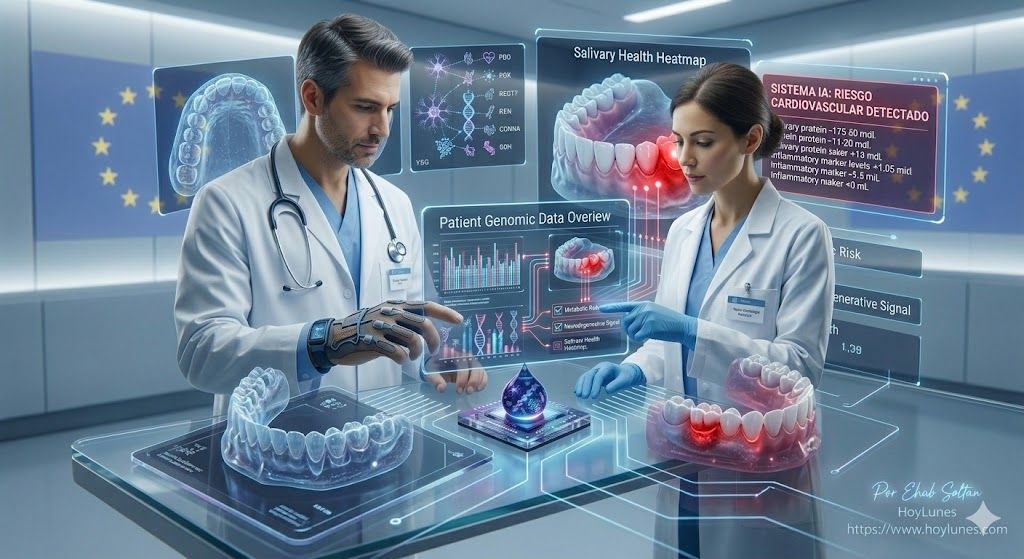
As in other areas of health, Europe is in a strategic position to lead its own model of dental data management. Faced with more commercial models in the US or centralized ones in China, the continent must commit to creating an interoperable and secure oral health data space, based on principles of data sovereignty and privacy by design.
Pan-European initiatives must ensure that data generated in the dental clinic can be interoperably integrated into the patient’s global medical history, respecting the GDPR while simultaneously allowing for the translational research that continues to feed AI algorithms. This sovereignty is fundamental not only for citizen protection but also for maintaining the competitive advantage of European dental research.
Toward Integral Medicine: Caring for the Mouth is Protecting Human Autonomy
Precision medicine has taught us that many organs act as systemic mirrors; contemporary dentistry now demonstrates that the mouth can be one of its most accessible diagnostic sentinels. This advancement forces us to overcome the fragmented vision of the human body and understand health as an integrated system. The dentist of the future is no longer a mere “filler of holes”; they are a bioinformatician and an expert in systems biology—a key player in contemporary preventive medicine.
Science has been clear: taking care of the oral cavity is, ultimately, protecting the integrity, autonomy, and longevity of the human being. The current challenge is political and social: to democratize this technology and establish ethical governance that allows us to harness its full systemic potential without leaving anyone behind.
Sources and Bibliography
Wong DT. Salivary diagnostics powering precision medicine.
AI in Dentistry: Current Applications and Future Directions. Nature.
OECD Health at a Glance – Oral Health Indicators.
Journal of Dental Research [https://journals.sagepub.com/home/jdr]
The Lancet Digital Health [https://www.thelancet.com/journals/landig/home]
World Health Organization [https://www.who.int/health-topics/oral-health]
#SystemicDentistry #SalivarySentinel2026 #PrecisionMedicine #AIinHealth #SalivaryBiopsy #PreventiveHealth #HoyLunes #EhabSoltan
This is for informational purposes only. For medical advice or diagnosis, consult a professional.