It is not that the body deteriorates. It is that it stops negotiating under the rules we imposed on it.
Clara believed something that now begins to seem suspicious to her: that her body functioned like an account where effort always generates returns.
By Ehab Soltan
HoyLunes — There is a day, difficult to pinpoint, when the mirror stops reflecting the image it always used to. There is usually no seismic event, but rather a silent erosion.
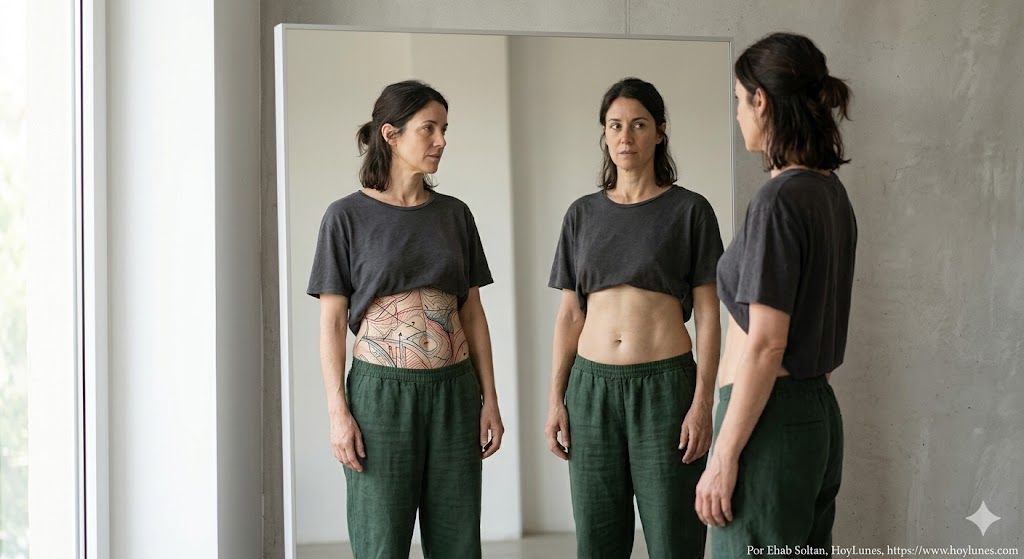
For Clara, it began as a hint of stiffness around her waist. Then came that strange feeling that her clothes —the usual ones, the “safe size”— were beginning to belong to someone else. It was not a matter of excess volume; it was a migration. Matter that had once been predictable began to shift toward the center, ignoring the protests of her aesthetics.
Clara did not gain weight: she was expropriated from her own body map. What was unsettling was not the number on the scale, but the autonomy with which that weight decided to stay.

The narrative of blame: an all-too-comfortable refuge
Society, the industry, and that inner judge we all feed have a ready, swift, and lethal answer: “You’ve let yourself go”.
It is a perfect explanation because it is punitive. There is something seductive in believing that the body is a slave that only rebels if the master is weak.
Under this logic, if the problem is laziness, the solution must be punishment. Around this idea, one of the most profitable markets of the century has been built.
But there is a crack in that narrative that few dare to look at: Clara did not let herself go; on the contrary, she became obsessed. She did what any rational person does when the engine fails: she pressed harder on the accelerator. She ate less, ran more, and counted calories like someone counting the days of a sentence.
Here, the uncomfortable truth emerges: the body, when attacked by restriction, does not surrender. It entrenches itself. The more Clara tried to “regain control”, the more efficient her metabolism became in the art of resistance. She was applying the laws of physics to a system governed by survival. Perhaps it was not about controlling the body, but about understanding how to influence it.

When logic stops working
There comes a point when the relationship between effort and reward enters technical collapse. It is the moment when a meal outside the norm is paid for with three days of inflammation, while a month of discipline barely registers on the scale. In that void, the most unsettling suspicion arises:
What if the body is not broken? What if what is broken is our way of understanding it?
Clara began to notice that her biology no longer responded to commands, but to states: stress, lack of sleep, accumulated tension. Stress ceased to be a psychological concept and revealed itself as a chemical command to store; lack of sleep was not just fatigue, but a biological alert signal to conserve energy.
She stopped searching for the “how” and began confronting the “why”. Her system was not trying to sabotage her social life; it was managing hormonal decline with an emergency engineering that she insisted on calling “being fat”.
The question we would rather not ask ourselves
Whoever reaches this point expecting a concrete solution will likely feel uncomfortable. This text does not seek to comfort, but to recognize.
The question Clara stopped asking was: “How do I become who I used to be again?”
The question that truly kept her awake was: “Why did I accept the idea that my value depended on my ability to keep my body in a permanent state of pause?”

The end of force and the beginning of negotiation
Clara did not solve the problem; she did something far more radical: she stopped framing it as a war of conquest.
For years, her idea of health was an exercise in authoritarianism. Taking care of the body meant imposing punitive discipline, trying to drag it back to a version of the past that no longer existed. That was the structural error. Not because effort is useless, but because the objective was a ghost.
The body after forty does not surrender, but neither does it respond to force. Understanding that the rules have changed does not free Clara from responsibility; on the contrary, it redefines it. She stopped asking how much she could force her body and began to observe under what conditions it started to respond.
What she found was a structural truth:
The body does not obey orders, but it reacts to sustained patterns.
It does not understand the urgency of the calendar, but it responds to the consistency of habit.
It does not punish an isolated mistake, but it accumulates the tension of a life lived on alert.
There was no miraculous transformation. There was something more solid: fewer fluctuations, less internal noise, and the end of the biological civil war. Over time, the body ceased to be a hostile territory. Not because she regained total control, but because she abandoned the fantasy of absolute control in order to exercise real influence.
Perhaps this is the point that stings the most: the problem was never that the body changed; it was our inability to manage that change without resorting to sabotage. The final question is no longer how to prevent time from passing, but a much sharper one:
What part of what you call health today is truly care… and what part is still a sophisticated way of imposing control on yourself?
#MetabolismoReal #BeyondTheDiet #WomenHealth #BodyChange #HoyLunes #EhabSoltan