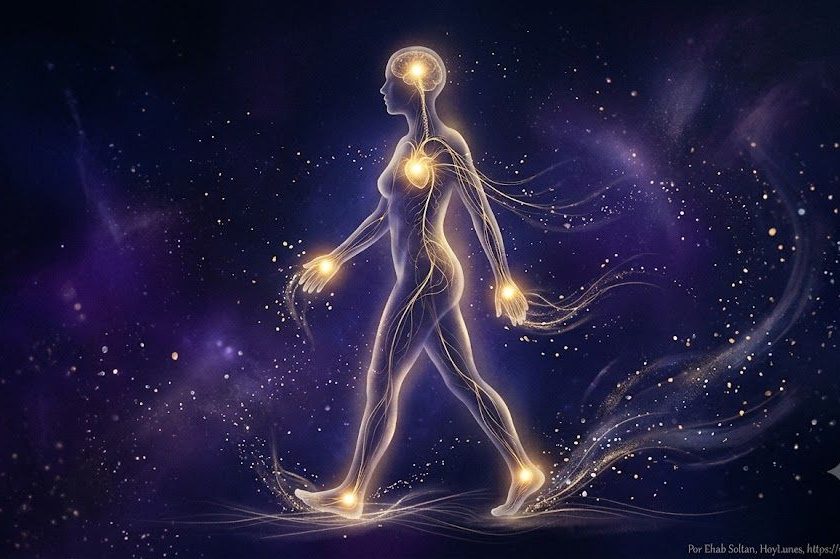
Today, the industry does not merely sell shine or softness; it sells “biological resistance” protocols. Yet, behind the laboratories promising to stop time, a new form of exhaustion emerges: the strain of living while trying to ensure the body does not betray our own history.
By Ehab Soltan
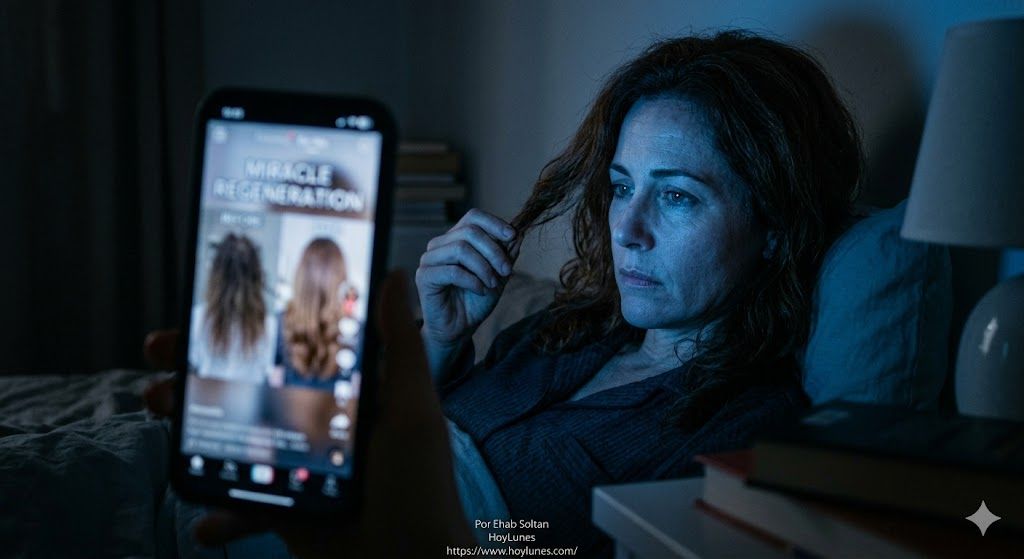
HoyLunes – The mobile screen glows in the darkness of the room. Sara slides her thumb and, in less than a minute, watches the same miracle repeat itself three times: a woman enters a salon with dull hair, surrendered to gravity and graying, and emerges transformed into a version of herself that seems to have regressed two decades. The video amasses millions of “likes” and thousands of comments asking in desperation: “Where?”, “How much does it cost?”, “I have an appointment in six months, is it worth the wait?”.
That is the reality today. It is not marketing exaggeration; there are waiting lists that cross borders and invoices equivalent to a month’s rent, all for a truce against the mirror.
The Laboratory of Illusions
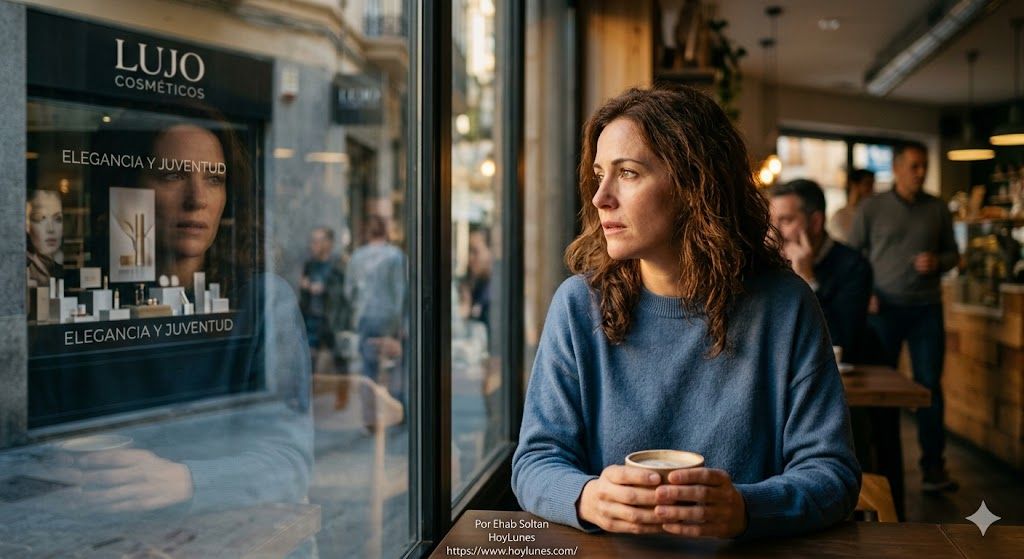
A few days ago, I attended an opening in the center of Valencia. I did not know if I was in a hair salon or a biotechnology bunker. The shelves were filled with jars that no longer promise “beauty”, but rather “cellular regeneration”, “hair reversal”, and “nocturnal follicle activation”. The cosmetics industry has ceased to be an ally of style, disguising itself instead as a clinical laboratory.
By using medical terms to sell a shampoo, they are subtly telling us that aging is a disease requiring urgent treatment. The idea is sold that every weakened strand is a failure of our “personal management”. And that is where medicine merges with anxiety: hair, that complex filament of keratin sprouting from the scalp, is actually a terminal of our identity.
Scientifically, hair reacts to cortisol (the stress hormone) and hormonal changes, but its most severe impact occurs in the limbic system, where emotions are processed. When Sara feels her hair is “aging“, her brain does not just record a physical change; it records a jolt to her self-esteem and her most intimate identity.
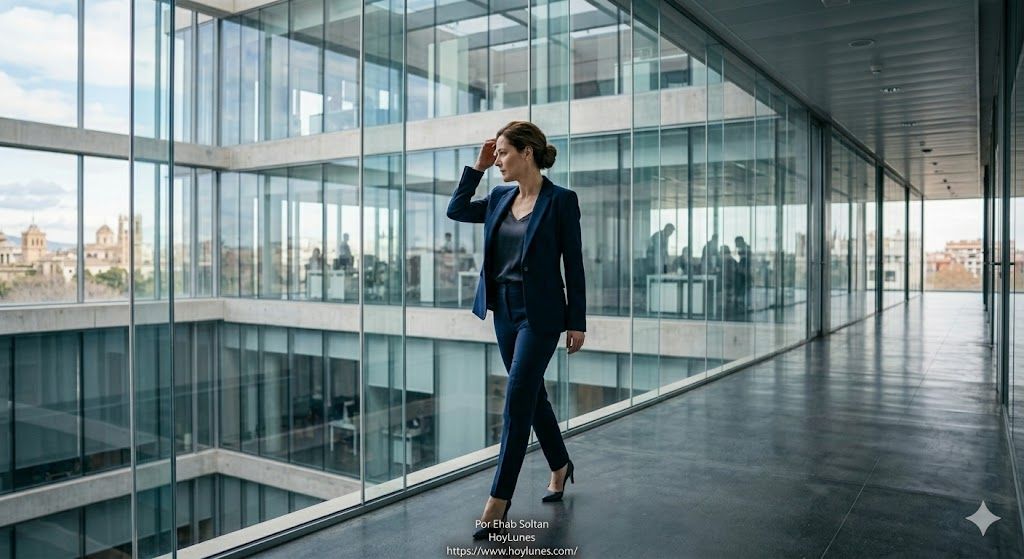
Silent Vulnerability: Beyond the Surface
For a woman like Sara, hair is not an accessory; it is a language that speaks of her sexuality and her power. The fear of hair aging is not vanity; it is the fear of invisibility. When volume decreases or grays advance, many women feel their eroticism blurring, as if society were pushing them out of the market of desire. In intimacy, this change sometimes translates into silent shame, into turning off the light, into ceasing to feel “seen” by one’s partner.
At work, the pressure is different but equally fierce. Sara knows that, in competitive environments, visual youth is erroneously translated into competence and energy. A neglected mane can be interpreted, unjustly, as a symptom of neglect or a lack of professional rigor. Even in motherhood, when children grow and the body changes, hair is often the last bastion of the “woman she was”, before being absorbed by the role of caregiver.
The Punishment of “Concern”
The true emotional rift opened the day Sara decided to simply do nothing. She stopped dyeing her hair for a few weeks because she was fed up with the slavery of the calendar. She wanted to rest. But the world has its own control mechanisms.
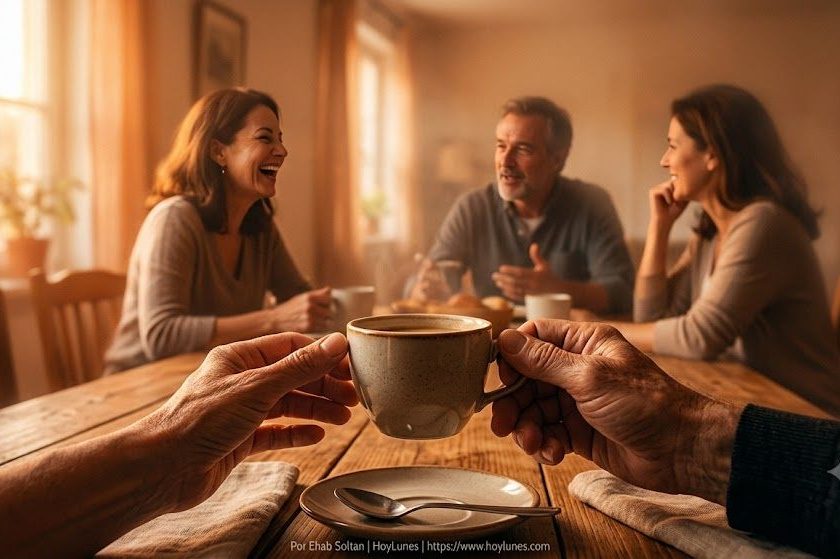
At dinner with her friends, the looks were not of rejection, but something much more hurtful: they were looks of veiled pity.
“Are you alright, Sara?” one of them asked, tilting her head with feigned tenderness. “You look… different. As if you’re going through a rough patch”.
“You look tired, aren’t you sleeping well?” another added, while her eyes fixed, almost involuntarily, on the silver root peeking through her temples.
No one mentioned the gray hair. There was no need. In our world, the punishment for aging is not an insult; it is condescension. It is that tone of voice we use with the sick. Sara felt then that her face was communicating a fragility she did not feel inside. Her friends, victims of the same system of comparison and insecurity, evaluated her as a declining asset. That is the real exhaustion: being your own auditor twenty-four hours a day to avoid social isolation.
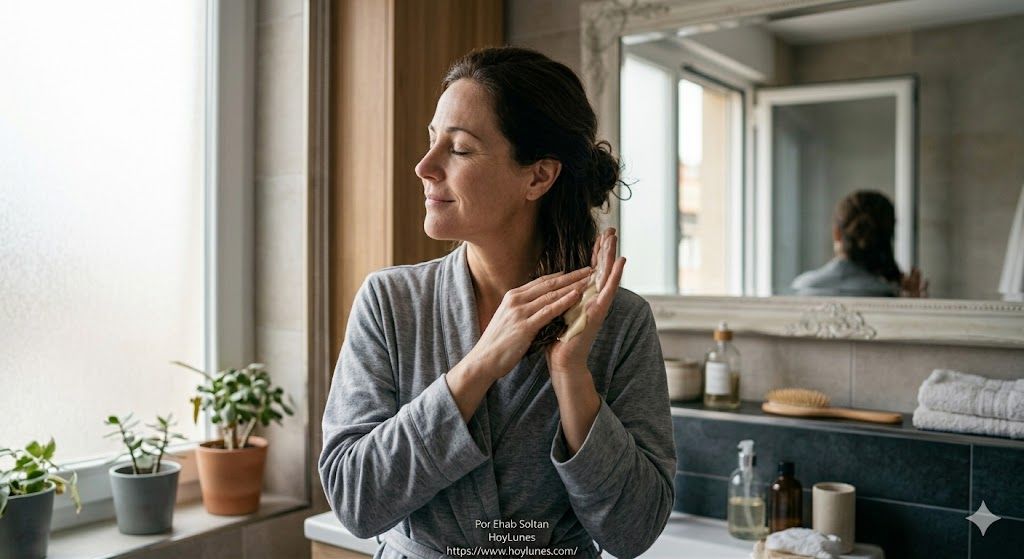
The Bridge Toward Calm
Is there a way out? Perhaps it is not in five-hundred-euro jars, but in a change of frequency. Recently, I saw Sara in a café. She wore her hair tied back simply, without the artifice of TikTok videos. She told me she had started filtering what she watched on the screen to protect herself from digital dysmorphia.
“The secret”, she told me, “is not to stop taking care of yourself, but to change the ‘why’“. When you apply a hair mask so that your hair is healthy and strong, you are caring for your biology. When you do it so that others stop asking if you are tired, you are feeding a monster that is never satisfied.
The solution appears indirectly, almost like a whisper: reclaiming the sovereignty of the mirror. Understanding that hair medicine is a fantastic advancement for scalp health, but it does not have the power to grant us happiness. Peace begins when one decides that their value is not a figure measured in millimeters of hair thickness or in the absence of silver at the temples.
Technology will continue to advance, and we will likely soon have lotions that maintain original color until one hundred. And that will be good news for those who wish to use them. But the question that gnaws at us from within remains the same: What happens to us when we feel we must hide our transformation to remain “acceptable”?
True aging does not begin with the first gray hair, but on the day we stop feeling free to show the world who we are becoming. Because, in the end, living a century is only worth it if we can walk down the street—and enter someone’s room—without feeling like a defective maintenance project.
#WatchfulMirror #FemalePsyche #RealLongevity #HoyLunes #EhabSoltan