

How a tiny dark line on a nail triggered the fear of melanoma, debunked sun myths, and revealed why observing our nails can be a silent tool for medical prevention.
By Ehab Soltan
HoyLunes – It began as an almost invisible thread. One Monday morning, while drinking her coffee, my colleague Ester looked at her right hand and noticed a thin, vertical, dark brown line originating right from the base of her thumb. At first, she thought nothing of it; she assumed she had bumped herself without realizing it while puttering around the garden over the weekend. However, as the days passed, a subtle anxiety began to gain ground: there was no throbbing pain, no swelling, nor the classic purple hue of a hammer blow. It was a perfect, static, and silent line.
Although most dark lines on nails are benign, subungual melanoma represents one of the most aggressive and difficult-to-detect forms of skin cancer, precisely because it is frequently mistaken for trauma or harmless changes. Worried, Ester turned to the advice of one of her best friends, who, with the best of intentions and the logic of popular culture in hand, diagnosed her with a supposed vulnerability to ultraviolet rays. “That’s from the sun, Ester. With all the driving you do and the sun hitting your hands on the steering wheel, the skin of the matrix is suffering”, she told her. Following that recommendation, Ester began meticulously applying SPF 50 sunscreen onto her nail every morning, convinced she was shielding her finger against a greater evil.
“Cosmetic nail polish can become an unintended smoke screen: camouflaging color changes in the nails delays a diagnosis that, on the skin, requires immediate attention”.
The true psychological storm arrived the following Friday during lunch. When discussing the matter at work, another coworker in the office turned pale upon seeing her thumb and, with a catching voice, unleashed the alarm. She shared the story of a direct relative who had underestimated a very similar spot on his foot. That man paid no attention to it for months because, additionally, he usually wore closed-toe shoes and, in the case of the women in the family, the sign had been completely buried under layers of semi-permanent nail polish.
The polish had delayed the observation of the color change. When it was finally removed out of pure routine and the alteration became evident, the diagnosis was heartbreaking: subungual melanoma. And it had arrived too late because the affected cells had spread. At that moment, Ester’s anxiety verged on the absolute limit. The suspicion that this tiny line on her hand could be something serious paralyzed her. It was then that, attempting to rationalize the situation and applying the logic of clinical analysis, we decided to evaluate her case step by step to discern whether we were truly facing a warning situation.
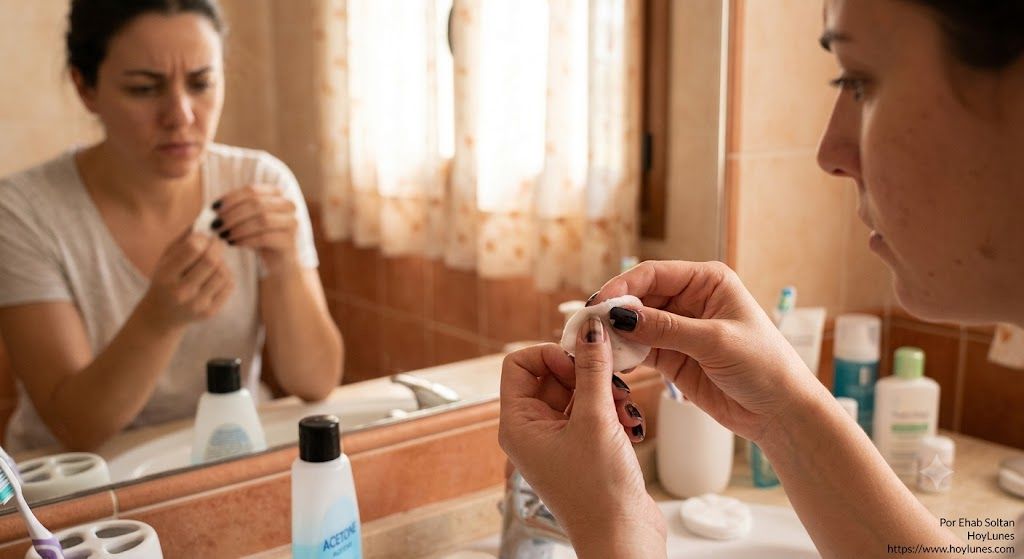
Triage in the Mind: Analyzing Ester’s Nail
To restore her calm, we sat down to contrast her reality with what medicine terms the differential diagnosis of dark chromonychia (the scientific term for color changes in the nails). The majority of these alterations are not malignant, but some require rapid evaluation to rule out dangerous lesions. The first thing we did was ask ourselves the question that anyone at home should consider: Does the spot move?
If Ester had bumped herself, we would be talking about a subungual hematoma. In these cases, the blood becomes trapped, but since the nail grows continuously from the root outward, the “bruise” travels jointly with the nail plate. Over the weeks, a clean band appears at the base and the spot eventually disappears at the free edge. Furthermore, in acute impacts, specialists sometimes perform a small drainage to relieve pressure, but this only works within the first 24 to 48 hours when the blood is liquid. After that time, it loses effectiveness. But Ester’s case was different: her line originated uninterruptedly from the cuticle. It was a longitudinal melanonychia.
“A bruise shifts as the nail grows; lines that emerge continuously from the root are the ones that demand the gaze of a specialist”.
To determine if this continuous production of dark pigment was dangerous, we reviewed a clinical standard that dermatologists use in consultation: the ABCDEF rule for nail melanoma.
| Letter | Clinical Criterion | What should be observed? |
| A | Age / Ethnicity | Higher statistical concentration of diagnoses between 50 and 70 years of age. It is proportionally more frequent in individuals with dark skin phototypes. |
| B | Band (Pigment band) | The thickness and boundaries of the line. Bands with a width equal to or greater than 3 millimeters, or with diffuse and irregular edges, require attention. |
| C | Change (Evolutionary change) | The speed of transformation. One must monitor if the line widens rapidly within weeks or if it varies in hue (brown, gray, black). |
| D | Digit (Involved finger/toe) | The affected digit. There is a notable predilection for areas of greater activity and friction: the thumbs and the big toe are the most frequent. |
| E | Extension (Hutchinson’s sign) | The most critical alarm signal. It occurs when the dark color is not limited to the nail, but extends and stains the skin of the cuticle or the sides of the digit. |
| F | Family (Background) | The hereditary factor. Having a personal history or first-degree relatives who have suffered from melanoma makes much stricter check-ups mandatory. |
This rule does not replace a medical evaluation, but it helps identify signs that should not be ignored. We looked at Ester’s thumb closely: fortunately, the skin around her nail was completely pink and healthy. The pigment was confined within the plate.
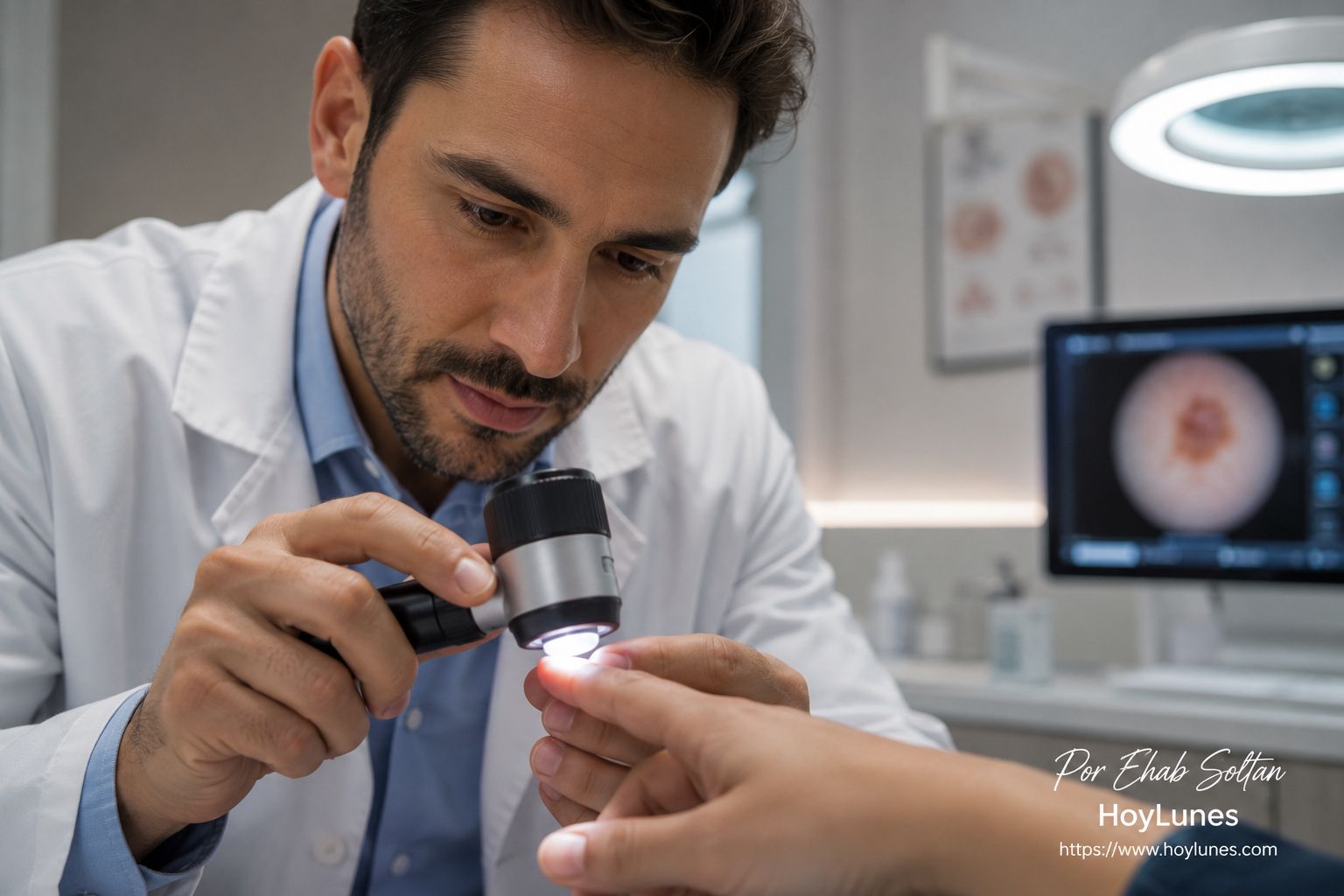
The Visit to the Specialist and the Verdict of Science
Even so, the shadow of doubt and the risk of the hidden polish weighed too heavily, so Ester went to a dermatological consultation that very afternoon. The specialist examined her using a nail dermatoscope, a high-resolution instrument with polarized light that allows the microscopic structures of the pigment to be seen without the need for invasive interventions.
There, the doctor dispelled the first great myth—that of the sunscreen Ester applied with such diligence. With absolute explanatory mastery, the doctor detailed that, unlike other skin cancers, subungual melanoma does not appear to be strongly related to direct sun exposure. The nail matrix is deeply protected by the skin fold and the keratin itself, which acts as a natural shield against ultraviolet radiation. Applying sunscreen there has no preventive effect on this type of lesion; instead, it is believed that factors such as repeated microtraumas, genetic predisposition, and cellular alterations may influence its appearance.
The doctor observed that Ester’s dark lines were perfectly parallel, symmetrical, and homogeneous. There was no suspicion of malignancy nor any need to perform a matrix biopsy (the histological study conducted by removing a small fragment of tissue when reasonable doubts exist). Nor was it a case of onychomycosis, that deep fungal infection that usually thickens the nail, makes it brittle, and gives it brown or greenish tones.
Such associated bacterial or fungal infections typically require specific oral treatments for months, as superficial lacquers can barely penetrate the dense structure of keratin.
What was Ester’s final diagnosis? A benign melanocytic activation. Her melanocytes (the cells that produce color) had simply activated temporarily, producing more melanin than usual in that area—something that also frequently occurs due to hormonal fluctuations, the use of certain medications, or inheritance. In many cases, these bands remain stable for years without posing a risk to health.

The Return to Calm: When to Keep Up Your Guard
Ester’s story began as a nightmare, but correct analysis restored her peace of mind. Not all dark lines on our nails reflect a serious pathology; in fact, the vast majority turn out to be benign moles (nevi) or temporary activations. Even so, any new or progressive change must be carefully monitored.
The lesson her experience leaves us is that uncertainty is managed with information and observation, never with alarmism. Maintaining the habit of checking your nails when they are natural, free of polishes that might hide reality, is an excellent preventive practice.
To know when it is necessary to stop observing at home and visit a specialist immediately, it is useful to follow this clear outline of priorities:
| Warning Signal | Reason for Consultation |
| New dark line without a previous bump | Requires evaluation |
| Band greater than 3 mm | May indicate abnormal growth |
| Rapid change in color or thickness | Suggests active evolution |
| Pigment on the cuticle (Hutchinson’s Sign) | Classic alarm signal |
| Pain, deformity, or bleeding | Needs medical assessment |
In taking care of our health, haste does not help, but timely attention makes all the difference. Because between ignoring a sign and panicking lies a more intelligent territory: observing, questioning, and acting in time.
Sources Consulted and Recommended
American Academy of Dermatology (AAD) — Guidelines for self-examination and detection of nail signs.
Mayo Clinic — Differential diagnosis protocols for melanomas of the nail matrix.
Cleveland Clinic — Clinical guide on longitudinal melanonychia and benign causes.
National Cancer Institute (NCI) — Statistics and research on acral lentiginous melanoma.
#Melanonychia #NailHealth #Dermatology #SubungualMelanoma #Prevention #SkinCancer #Health #HoyLunes #EhabSoltan