While travelers, hotels, airlines, and booking portals compete to capture customer attention, a new silent battle is being waged in milliseconds: one driven by mathematical formulas that decide which offers we see, what prices we pay, and who keeps the money from each booking.
By Ehab Soltan
HoyLunes – The scene is deeply familiar across the globe: a family sits in front of a screen to plan their next vacation. They browse different portals, compare options, debate proximity to the beach, and finally click “book”. Deep down, they are convinced they have made a free choice based on their tastes and budget.
But what if the decision was already halfway cooked before they even started searching?
The reality is far more complex than it appears. Behind that screen, in the brief sigh it took for the page to load, a network of connected systems competed and negotiated to decide which options that family would see, in what order, and at what exact price. Because of this, the great question in modern tourism is no longer which hotel chain opens more properties or which airline adds more routes. The real strategic question for the coming years is: Who controls the system that connects supply with demand?
From the War of Storefronts to the War of Systems
To understand where we stand, one only needs to look at how quickly the way we sell travel has shifted. Just two decades ago, the path was predictable: the hotel or airline negotiated fixed room blocks and seats with traditional brick-and-mortar agencies and tour operators. The customer went to the office, looked at a catalog, and bought a closed package.
With the internet, the battlefield moved to online travel agencies (OTAs) and metasearch engines. For years, the major challenge was simply appearing on the first pages. Today, the focus has completely changed: the goal is to guess what the customer wants before they even ask for it. Artificial Intelligence is creating a third invisible layer in the business: machine against machine. It is no longer enough to have the best hotel or the most eye-catching advertising campaign; now success depends on who possesses the most agile technology to shift their prices and inventory by the second.
“Success in tourism is no longer a matter of who has the best brand, but of who owns the most agile technological infrastructure to anticipate the market”.

Anatomy of “Invisible Arbitrage”
In economics, traditional arbitrage consists of buying cheap in one market to sell higher in another and pocketing the difference. In digital tourism, this phenomenon has become invisible and ultra-fast. Today, arbitrage is no longer just about searching for a tariff error. It consists of discovering, before the rival, where an opportunity exists to match a customer with a room in the most profitable way possible.
Behind every booking lies a very human and simple question: which offer stands the best chance of convincing a specific person at a precise moment? To answer it, technology relies on three daily movements:
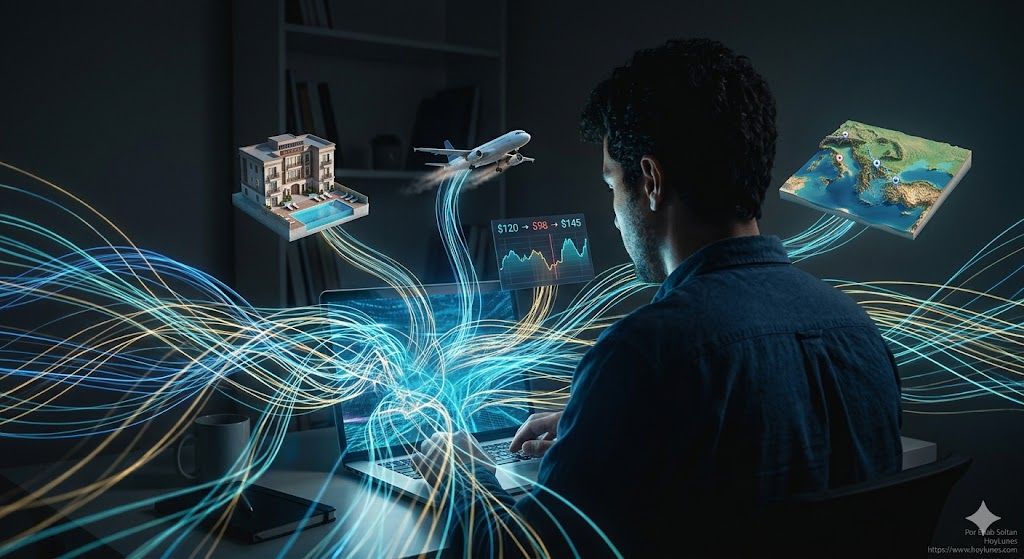
Prices that react instantly: Systems analyze how sales are going, what the competition is doing, and even what the weather is like outside to change rates multiple times a day.
Automatic room redistribution: If a portal notices that a hotel is selling slowly in one city, the system repackages those rooms or diverts them to agencies in other countries where demand is higher at that moment.
Storefront organization: The order of hotels on the screen is no coincidence. The system predicts which hotel best fits the user at that exact second to secure the sale.
For this reason, two people searching for the same room on the same day but from different cities can see entirely different options. The key is not always the accommodation itself, but how the system interprets the situation of the person searching.
The Ecosystem of ‘Coopetition’: Who Adds More Value?
It would be a mistake to view this evolution as a war where one side wins and the other loses. Today’s market is based on coopetition (cooperating to be able to compete). Global mega-portals are indispensable allies; hotels need them because these platforms shoulder an acquisition cost to secure customers that an independent business could never afford.
However, this dependence creates a dilemma: to what extent do you truly own your business if the vast majority of your guests arrive through someone else’s screen? In this new scenario, the cards are dealt as follows:
The Great Distribution Platforms
Their major strength is the ability to squeeze mountains of information in real time. By knowing what people around the world are searching for before anyone else, they successfully convert more users into buyers and provide vital visibility to the hotels they work with.
Hotel Chains
Large groups are responding by investing heavily in their own pricing systems (Revenue Management). In many cases, they no longer compete solely on price or location, but on the quality of information they hold regarding their guests. Their strategy is to use data from loyal customers to offer exclusive advantages that can only be found if they book directly on their website.
“The great paradox of the industry: global platforms are vital allies for filling rooms, but a silent danger to a hotel’s profit margins”.

The Return of the Smart Vacation Package
One of the clearest trends is the rebirth of the traditional package (flight + hotel), but created instantly by computer. By tying both services together in a single click, technology allows businesses to camouflage the individual price of the room and the airplane seat. This protects corporate margins and gives the customer a unified purchase without the headaches.
The New Challenge for Destinations
Tourist cities and regions are also entering this game. Those destinations capable of understanding real data regarding how travelers move, what they spend money on, and when they come will possess better tools to manage tourism, attract different audiences, and stop relying so heavily on the high season. Knowing how to read this information is no longer a marketing extra; it is a cornerstone for ensuring tourism is sustainable and does not saturate the destination.
The Real Impact on the Traveler
For the everyday traveler, this entire gear goes unnoticed. What they see on their screen is a comfortable, fast, and easy experience where everything seems tailored specifically for them. However, this convenience also opens up a necessary debate regarding price transparency, the use of our personal data, and, above all, how much freedom of choice we have left when the real options have already been filtered and chosen in advance by a machine.

The Balance Between Code and Hospitality
Technology has not arrived to replace human interaction—which is the soul of tourism—but to grease the wheels of sales. Mathematics is unbeatable at calculating how much a customer is willing to pay, predicting consumption, and putting the right product right before the eyes of the ideal buyer.
Despite everything, power remains divided. Whoever dominates the system controls the sale, but whoever takes care of the guest at the front desk, at the table, or during an excursion is the one building the real value of the brand. For decades, success in tourism depended on who had the best hotels, the most modern airplanes, or the most beautiful beaches. Today the question is different: Who best understands the data connecting those millions of travelers with the actual experience? The next chapter of the travel industry depends entirely on the answer.
#Tourism #TravelTech #ArtificialIntelligence #DigitalTransformation #TourismDistribution #TourismInnovation #Hotels #RevenueManagement #DataAndTourism #SmartTourism #DigitalEconomy #FutureOfTourism #Hospitality #GlobalTourism #HoyLunes #EhabSoltan