
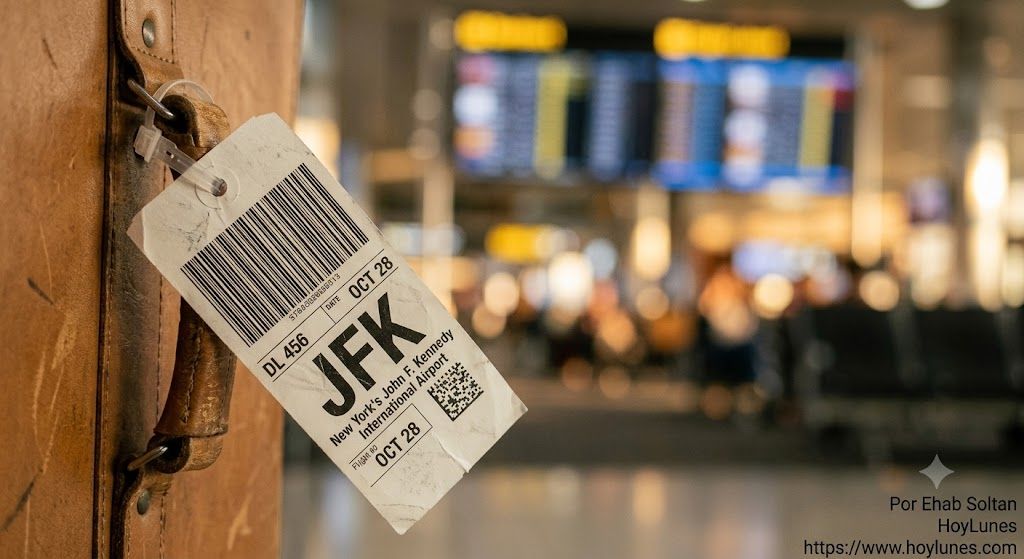
The beginning of the leap of faith: a printed barcode and a leather handle hold the promise of reunion in the dim light of the terminal.
Beyond steel and algorithms, “certainty is the true infrastructure” of aviation. When the thread of trust breaks, it is not just a suitcase that goes missing; the entire aviation system suffers.
At the heart of every great infrastructure, there is not just steel, algorithms, or next-generation turbines. There is a far more fragile, invisible, and yet absolutely indispensable element: trust. When that certainty breaks, it is not just a suitcase that goes missing; the relationship between the passenger and the entire aviation system also suffers. Every day, millions of people repeat an automated ritual in airports around the world—a gesture so commonplace that it has lost its extraordinary nature. Precisely because of this apparent normalcy, we rarely think about the massive network of decisions, people, and technologies that sustains every journey.
By Ehab Soltan
HoyLunes – The journey does not begin on the runway, but at that exact second in front of the check-in counter. A person lifts their suitcase and places it onto the conveyor belt. The agent attaches the tag, the mechanism activates, and the luggage moves forward until it disappears behind black plastic curtains.
This gesture lasts only a few moments. In that millisecond, the passenger’s gaze follows the object until it is lost from sight. There is no longer any control, no visual contact, no physical certainty. This small, daily act is, in reality, a massive leap of faith. Unlike other services, the passenger cannot oversee any stage of the process. The entire experience depends on the reliability placed in third parties. It is the only moment of the journey in which the user completely hands over a fundamental part of their life to an impersonal system, blindly expecting that they will meet again thousands of miles away.
Handing over a suitcase is the only moment of the journey in which the user completely relinquishes control of their most valuable belongings to an invisible system.
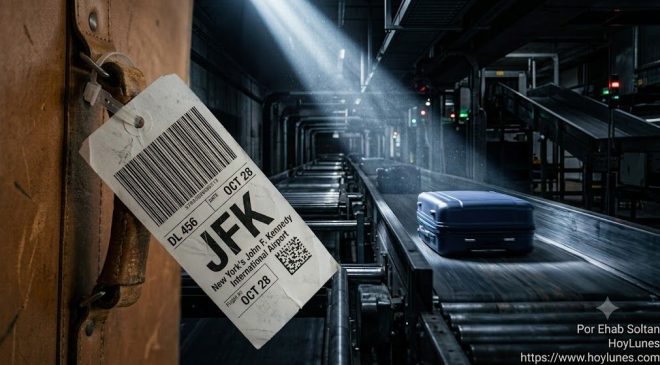
The Invisible Journey
While the traveler walks toward security, buys a coffee, or waits patiently at the boarding gate, their luggage begins a parallel, subterranean odyssey. Far from public view, the suitcase enters a labyrinth of miles of high-speed conveyor belts, clears automated sorting systems driven by code reading, crosses rigorous X-ray security checks, and is distributed into tarmac vehicles.
Finally, under the supervision of the baggage handlers, it is meticulously stowed in the aircraft’s cargo holds. It is a massive logistical ballet where every link in that chain depends on the coordination between automated systems, ground crew, airlines, and airport operators. An invisible world that sustains the promise of travel.
When the Thread Breaks: The Human Cost
The true dimension of this system is measured not when it works, but when it fails. What happens when a passenger stands in front of the arrival carousel, the flow of objects stops, and their suitcase does not appear?
At that moment, the real impact is not the loss of a piece of luggage; it is the abrupt interruption of the continuity of a life. A suitcase rarely transports only clothes. It contains a photographer’s work tools, a patient’s vital medications, a bride’s gown, a musician’s instruments, or strategic documents for a business meeting that does not allow for a second chance. When luggage fails to arrive, a project is broken, an obligation is suspended, or a family memory is tarnished. The cost is not material; it is deeply human. Therefore, the impact of lost luggage rarely ends when the suitcase appears.

The Intangible Asset of Airlines
For the airline industry, the consequences of this breakdown go far beyond regulated financial compensation. The true impact is measured in intangible assets: reputation and customer loyalty. In highly competitive markets, perceived security also constitutes a strategic advantage that is difficult to recover once lost.
A passenger may forgive a delay due to bad weather, but the loss of their belongings directly wounds the bond with the passenger and the company’s operational credibility. A suitcase recovered days late may be operationally settled, but the emotional wear and tear and the loss of control suffered by the user can cost the airline a recurring customer for years. A user’s peace of mind takes decades to build and a single flight to vanish.
PASSENGER AIRPORT SYSTEM
[Initial Certainty] —————> [Belts / Security / Loading]
│ │
▼ ▼
[Continuity of Life] <──────────────> [Transparency and Traceability]
When any of these elements fails, the problem ceases to be logistical and becomes a deeply personal experience for the traveler.
The Silent Revolution
Aware that certainty is the minimum required standard, the industry is undergoing a silent transformation. Airlines and airports are not implementing technology to optimize simple internal processes, but to shield the user’s peace of mind. Technological success does not consist solely of reducing errors, but of making visible a process that for decades remained completely hidden from the passenger.
The digitalization of tags, universal traceability at every touchpoint, and automation through predictive analytics seek to eradicate the factor of uncertainty. Real-time data sharing between airports and operators allows bottlenecks to be anticipated before they occur, transforming baggage management into a science of exact precision.
From Passive Passenger to Connected User
This technological shift has caused a cultural mutation in the traveler. The paradigm of the passenger waiting resignedly in the baggage claim area has come to an end. Today, the user demands the same level of visibility over their belongings as they have when purchasing an item online.
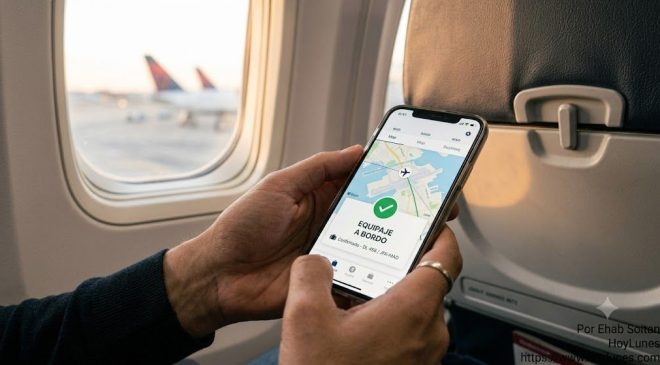
The ability to track the exact location of a suitcase from a mobile application is not a mere digital accessory; it is an indispensable exercise in transparency. By sharing data, the airline returns control to the passenger, alleviating travel anxiety and strengthening the ecosystem of mutual trust. Transparency is beginning to become just another component of the service itself.
The ability to track the exact location of luggage from a mobile phone is not a digital accessory; it is an exercise in transparency that alleviates travel anxiety.
Toward the Threshold of Infallibility
This evolution brings us to a fascinating future scenario. The maturity of digital traceability systems outlines a horizon where losing a suitcase ceases to be an acceptable statistical contingency and becomes something as unusual and critical as the failure of an international bank transfer. Reaching this level of reliability will radically transform service expectations, elevating air transport to a standard of absolute precision where operational uncertainty is completely banished.
Baggage management also serves as an indicator of the operational resilience of the entire airport system. Every incident reveals how technology, organization, and coordination interact among multiple actors who rarely appear before the passenger.
The Return to Peace of Mind
In the end, everything returns to the starting point. To the same gray carousel in the terminal. To the hand that releases the handle and walks away.
The true success of modern aviation does not reside solely in the technical capacity to transport millions of people and their belongings through the skies each year. It resides in guaranteeing the integrity of that invisible bond linking people to their projects and their lives. Because the most advanced technology and the most complex logistics do not have the ultimate goal of moving luggage: their true purpose is to return the absolute peace of mind of knowing that, upon landing, our life will be waiting for us intact. In an industry built on schedules, engines, and routes, perhaps trust remains the most difficult resource to replace.
If the aviation of the future aspires to be increasingly automated, will it be able to preserve that which no algorithm can generate on its own: passenger trust?