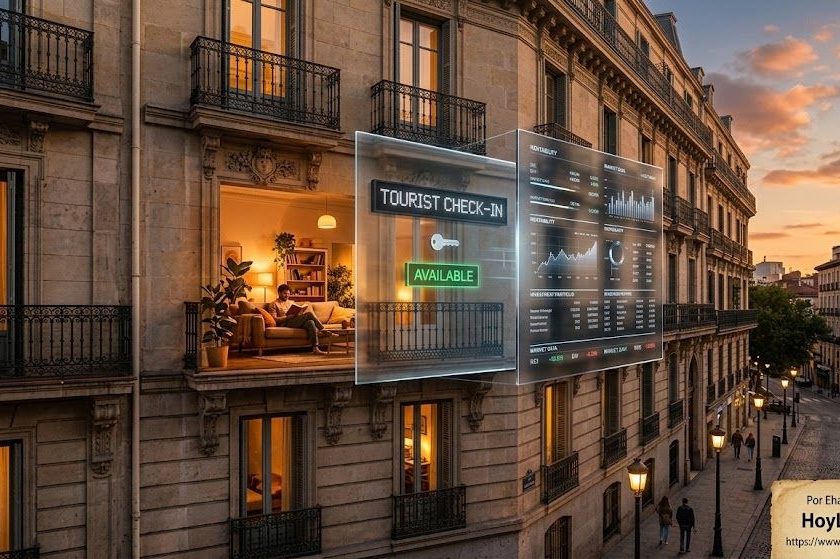

The mental map precedes the territory: the exact moment when imagination breaks through the screen.
Before buying a ticket or booking a hotel, millions of people have already begun their journey. The decision to visit a country is born long before the airport, in the mental image that each destination manages to build through culture, communication, shared experiences, and trust—long before the trip even has a date.
By Ehab Soltan
HoyLunes – A screen lit at midnight holds ten open tabs in the browser. An interactive map unfolds on one; on another, a high-definition video of a content creator walking down a pedestrian avenue; alongside, a forum where local residents explain the dress code and rules of courtesy, followed by an article on contemporary architecture and three reviews on urban safety. The person observing this amalgam of data has not entered their credit card digits nor selected a date on the calendar. They are not buying. They are imagining. They rehearse the trip in their mind, measuring the distance between the unknown and the hospitable. They have not booked yet, but the journey has already begun. This reality transforms the industry’s old commercial logic: true competition begins before a reservation even exists. Travelers always visit a country twice: first in their imagination and then, if everything aligns, in reality.
The Journey Begins Long Before the Airport
The tourism industry has historically focused its logistical efforts on physical displacement: airline efficiency, border control speed, and the comfort of hotel infrastructure. However, the psychological process that determines the final destination operates on an entirely different timeline. The decision to travel does not arise spontaneously from a seasonal offer; it is the result of a cognitive incubation that can last weeks, months, or even years.
In the attention economy, the true initial tourism product is not a hotel room, but an expectation. The first territory a destination must conquer is not geographic, but mental. When a potential visitor interacts with a country’s digital stimuli, success depends on its ability to transform the uncertainty inherent in the unfamiliar into an attractive certainty, long before the passenger shows up at the boarding gate. That is where a destination’s competitive advantage begins.
The first territory a destination must conquer is not geographic, but mental. What the traveler consumes before the ticket is an expectation of habitability.
Today, Countries Compete for Something Different
The traditional model of tourism competition was based on a catalog of tangible assets: the average temperature of beaches, the monumentality of archaeological remains, or the accumulation of stars in vacation resorts. While these elements retain their value, the globalized ecosystem has homogenized the offering of luxury and connectivity.
Today, countries compete on a much more complex board: that of perception, identity, narrative, and reputation, long before prices or itineraries are compared.
Countries no longer compete solely to attract visitors; they compete to occupy a place in the imagination. The contemporary battle is psychological and reputational.
Two nations with equivalent natural or heritage resources can experience diametrically opposed visitor flows depending on how they manage their nation brand. Countries no longer compete solely to attract visitors. They compete to occupy a place in the traveler’s imagination. The contemporary battle is psychological and communicational; any destination that fails to project a coherently magnetic narrative in the digital sphere is disqualified before the user even initiates a flight search.
The New Infrastructure of Tourism is Invisible
When analysts evaluate a nation’s readiness for tourism, they usually audit the highway network, airport capacity, and the number of available beds. Nevertheless, the digital transformation has given rise to a parallel infrastructure—intangible in nature but definitive in impact.
This invisible infrastructure is composed of trust, credibility, consistency, shared experiences, and the editorial coherence of its online presence. A state-of-the-art airport loses effectiveness if the digital ecosystem preceding it transmits opacity or cultural disconnection. The contemporary traveler seeks consistency between the institutional promise and the organic reality described by other users. Therefore, the most important infrastructure of a destination perhaps cannot be photographed, as it resides in the framework of psychological safety and social validation that the country projects to the outside world.
A Reputation Takes Years; A Perception Changes in Minutes
Today, a negative experience documented by a traveler can travel the world in a matter of hours. In the same way, a gesture of authentic hospitality can become a destination’s best ambassador. In the digital economy, reputation is no longer built solely through institutional campaigns; it is also strengthened or weakened through thousands of individual experiences shared in real time.
Who Really Builds a Country’s Image?
The monopoly on the tourism narrative no short of belongs to ministries or large advertising agencies. The design of stylized institutional campaigns coexists—and often collides—with a decentralized flow of information.

Nowadays, the international perception of a nation is a multi-factor fabric in which participate:
- Travelers and digital creators: They provide an aesthetic of immediacy and an assumed authenticity that young audiences value above official brochures.
- Journalists and media outlets: They contextualize the geopolitical and social reality of the destination.
- Universities and scientists: Through conferences and publications, they place the country on the map of knowledge and the vanguard.
- Cinema, gastronomy, and sports: Cultural industries that act as subtle ambassadors of soft power, familiarizing the viewer with the flavors, landscapes, and values of the host society.
- Local residents: Their daily interactions on social media shape the real thermometer of the place’s hospitality.
Each of these actors adds a thread to the international identity of a destination, forcing institutions to shift from a model of “message control” to one of “conversation orchestration”. No single actor controls a destination’s reputation alone.
The Tourist is No Longer Simply Looking for Places
The maturity of the global consumer has modified travel motivations. The mere accumulation of passport stamps or visits to iconic geographic landmarks no longer satisfy the demand of an audience seeking meaningful experiences.
This need for narrative belonging implies that emotion must be managed at its source. If the story prior to the trip does not generate an intimate resonance with the individual’s values, curiosity, or aspirations, the destination becomes an interchangeable commodity. The sharpest positioning strategies are those that manage to make viewers visualize themselves as the protagonists of a story within that specific geographic environment.
An International Case Study
This paradigm shift is clearly observed in the repositioning strategies of various nations seeking to open themselves to global scrutiny. The Kingdom of Saudi Arabia constitutes a highly illustrative case study in this matter. Beyond the massive investments in physical infrastructure, the country’s true strategic challenge lies in the sphere of perception.
In attempting to position itself as a new hub for global tourism, the country is working to build a narrative of openness, cultural exchange, and innovation. This effort to integrate historical heritage—such as the sites of AlUla—with technological platforms demonstrates that physical transformation must be preceded by a reconfiguration of mental space. The challenge consists not only of attracting visitors, but of transforming expectations for an audience that historically associated the region with exclusively energy-related dynamics. It is a phenomenon similar to what destinations like Iceland experienced in their day, which redesigned its global identity after a crisis by focusing on the purity of its natural stories, or South Korea, whose current tourism boom is the direct result of a calculated sowing of popular culture for over two decades.
The Great Question for the Tourism of the Future
Frente a este panorama, industry leaders, academics, and decision-makers must reformulate their essential questions. The traditional metric based exclusively on arrival volumes proves insufficient to evaluate the long-term health of a nation brand.
Contemporary management forces us to elevate the level of debate and pose a question applicable to any territory: How do you build an image that inspires trust before the visitor arrives? The answer to this question is not found in increasing advertising budgets, but rather in digital transparency, active listening, facilitating access to information, the real integration of the local community into the narrative, and the ability to maintain two-way communication channels that withstand the critical analysis of the hyper-connected traveler.
Let us return to the user in front of the screen. The tabs remain open. The cursor hovers over the booking button. In that instant of suspension, the individual weighs everything they have read, seen, and felt during weeks of abstract exploration. They do not yet know the air of the place, nor the sound of its traffic, nor the taste of its food, but the architecture of their imagination has already built a version of that country. The decision is already almost made.

The destinations of the future will not be remembered solely for what they show when the traveler arrives. They will be remembered for the story they manage to awaken even before the ticket is bought. Success will belong to those nations that understand that the most difficult border to cross is not an airport’s customs, but the threshold of attention and trust in the human mind.