
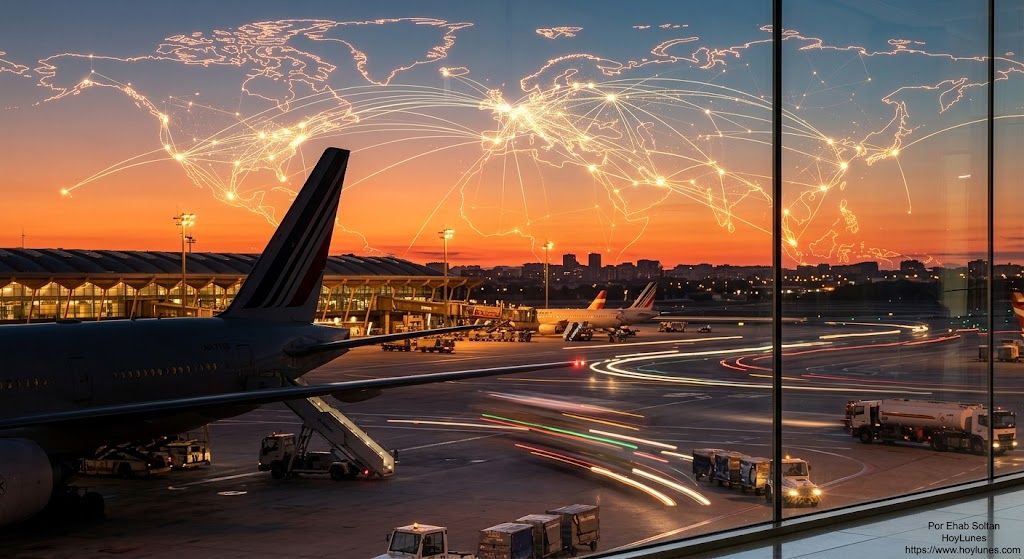
Aviation does not end when the passenger leaves the terminal. Behind every flight lies an economic network connecting employment, trade, tourism, suppliers, and territories far beyond the airport.*
By Ehab Soltan
HoyLunes – An airplane lands and hundreds of people walk down the jetway. For most, the journey ends there. For the economy, something else has just begun.
In the following hours, suitcases will reach hotels, taxis will add kilometers, suppliers will deliver goods to restaurants, and technical crews will inspect aircraft. The plane is no longer in the air, but the economy traveling with it is still starting to move.
Because a flight never transports only passengers.
The Economy That Does Not Appear on the Ticket
The usual conversation about aviation is often limited to routes, prices, or passenger volume. These are relevant metrics, but they only show the surface. A flight is, in essence, a bridge between companies, professionals, goods, and territories.
To check how far this invisible activity reaches, numbers are needed. The study that Air France-KLM has conducted for the fourth consecutive year helps analyze this dimension. In its 2025 edition, the measurement expands its scope for the first time to the entire European Union, evaluating its three strategic pillars: passenger transport, cargo, and aeronautical maintenance.
According to the study, the group’s activity is associated with nearly 114 billion euros in annual economic impact in the European Union, linked to approximately 1.2 million direct, indirect, and induced jobs. In Spain, this figure exceeds 4.7 billion euros and supports more than 68,000 jobs.
The data is impressive, but the essential metric goes beyond the financial.
The real question is how far economically a flight can extend.
The Passenger Is Only the Beginning
The journey begins with a person buying a ticket to move to another point on the map. However, the economic gear starts long before takeoff and continues after landing. The visitor will require accommodation, transport, and food; they will visit cultural spaces, consume local products, and hire services.
Behind each of those decisions operate companies and workers. And behind them, a supply chain that multiplies. And there an essential difference appears: the passenger is visible; the economic chain accompanying them, almost never.
For this reason, addressing air connectivity as a mere matter of mobility is reductionist. Connectivity is a fundamental economic infrastructure that allows people and companies to access markets that would otherwise be unreachable. This effect is decisive for those territories whose development depends on their external projection.
The Economic Geography of Aviation Is Larger Than Its Airports
An airline’s activity does not exclusively benefit the cities where its planes land. The Air France-KLM report shows how its economic impact reaches regions without a direct air connection. An illustrative case is Bourgogne-Franche-Comté in France, favored by the wine purchases made by the group for its onboard services.
To benefit from aviation, it is not always necessary to have a runway next door. A regional product can be incorporated into the supply of a global company, or a local commodity can access new markets thanks to international logistics networks.
The economic geography of aviation is, therefore, much larger than the geography of airports. And perhaps there lies one of the least visible keys to connectivity: it does not only bring places closer; it brings economic capabilities closer.
The economic geography of aviation is much larger than the geography of airports: it does not only bring places closer, it brings economic capabilities closer.
The Airport as an Ecosystem
Observed from the outside, an airport looks like an aircraft transit point. Inside, however, engineers, maintenance technicians, ground staff, logistics specialists, security, catering, technology, and transport personnel coexist. Around it, hotels, specialized services, and auxiliary industries flourish.
What looks like an entrance gate is, in reality, a meeting point between multiple economies. It becomes an economic ecosystem.
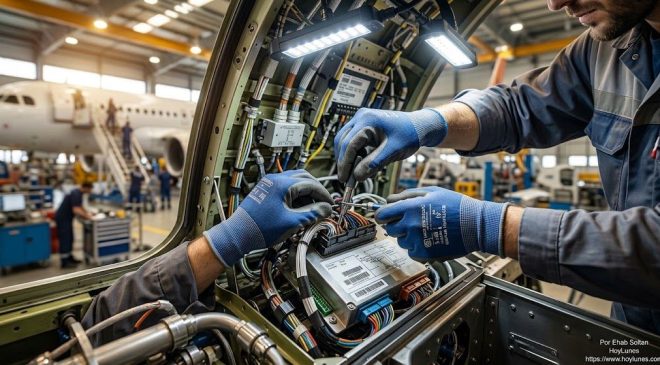
The aeronautical maintenance segment illustrates this dynamic well. In 2025, Air France-KLM serviced more than 3,000 aircraft, both from its own fleet and from around 200 external clients. Aviation thus demonstrates its ability to articulate technical knowledge, industrial development, and high-value-added qualified employment.
But Connectivity Alone Is Not Enough
Having air links does not guarantee that the wealth generated remains in the territory. Connectivity can bring activity. Turning that activity into lasting value is another matter.
The opportunity depends on the strength of the local framework:
- Are there local suppliers capable of integrating into the chain?
- Do visitors find a quality cultural, gastronomic, and heritage offer?
- Does tourism establish real synergies with local production?
- Does connectivity facilitate local companies exporting and competing abroad?
These questions redefine how airport impact is measured. The focus shifts from counting passengers to analyzing the quality of the economic relationships born through them.
An airport can open a door. The territory decides what to do with it.
Beyond Tourism: Business Competitiveness
The economic significance of air transport does not end with tourism. Air cargo introduces a key strategic dimension for high-value products, critical industrial inputs, and high-priority goods.
Cargo does not only transport what people need to travel; it also allows companies to compete beyond distance. Behind every shipment there is a company, a human team, and the livelihood of multiple families. The air movement of a commodity may last only a few hours, but its economic impact on the productive network extends for months.
The Human Dimension Behind the Data
Macroeconomic magnitudes — GDP, investment, cargo volume — are necessary to measure the scale of the sector. However, these figures acquire their true meaning when translated to a human scale.
Behind every employment figure lies a career story, a family, and a local economy that rarely appear in statistics. Similarly, a visitor is not a mere traffic statistic: they are a client, a service user, and a potential ambassador for the destination.
The maturity of a destination perhaps begins when it stops merely counting how many visitors it receives and starts asking what value it manages to generate around them. What do we want to happen thanks to them?
The Flight Ends. The Connection Remains
When an aircraft takes off, it leaves the runway behind, but keeps a productive engine in motion. The local supplier continues manufacturing, the technician continues their work, the cargo moves toward its destination, and companies preserve their international business alliances.
Aviation is not just an industry that moves people from one place to another, but an articulating infrastructure where economies converge.
There are people who work, companies that grow, territories that connect, and opportunities that were once too far away.