

A journey from neurochemical stress under the sun to regaining clarity and focus through strategic nutrition.
By Ehab Soltan
HoyLunes – Last Sunday, those of us who call ourselves the «Naughty Brigade» gathered to face the first onslaughts of the May swelter. The air felt so heavy it seemed as though one had to push it aside with their hands just to move forward. We are a diverse group: some with volcanic temperaments and others with an almost academic calm, but it is this blend of characters that makes us vibrate. Between the sound of ice clinking against glass and stories to close out the weekend, the inevitable topic arose: the change of season and that invisible weight it drags along.
—«For me, summer is living in a cloud of confusion,» confessed Marta, whose mind is usually the sharpest of the group. «I wake up exhausted, go to work without a drop of motivation, and feel like my brain simply won’t start. It’s as if someone has placed interference in my signal».
Carlos tried to apply logic to the matter. He explained that the body makes a titanic effort not to overheat, sending blood to the skin like a radiator at its limit, which inevitably leaves the brain at half power. He mentioned that once temperatures exceed thirty-five degrees Celsius, our capacity to process complex thoughts plummets due to dehydration and poor sleep. We all nodded, resigned, accepting this lethargy as a natural toll.
However, I found myself observing Marta. Her issue wasn’t just the heat; it was a full-blown cognitive surrender. I wondered: What if what is happening to Marta isn’t fatigue, but a real short circuit? That doubt pushed me to review the latest neuroscientific research. What I found among the studies kept me thinking all night: when the thermometer rises, a process of micro-inflammation occurs that is much deeper than a simple lack of water.
The Brain Under Fire: The Physiology of «Fog»
To understand why we feel like we are walking underwater, we must talk about the blood-brain barrier. Imagine it as the bouncer of an exclusive club who decides who enters and who stays out of your brain. Thermal stress makes this «bouncer» dangerously permissive.
When this barrier is compromised, certain inflammatory substances circulating through your body leak into the central nervous system. This is where the real problem begins: the magnesium leak. Through prolonged sweating, we lose this mineral, which acts as the «host» in charge of maintaining order. Without it, glutamate (an excitatory neurotransmitter) becomes that annoying guest who doesn’t know when to leave the party and starts shouting.
The result? A mild excitotoxicity: your neurons fire chaotically, consuming their energy at an absurd rate and eventually exhausting their dopamine reserves. That fuel that makes you feel capable of taking on the world vanishes, leaving you in a permanent «metabolic hangover». Seen this way, Marta’s situation takes on a new meaning: it’s not a lack of will; it’s that her neurons have run out of supplies.
Your Action Plan: Neurometabolic Restoration Protocol
Recovering your spark is not a matter of willpower, but of biological logistics. We need to protect our internal chemistry intelligently.
Identify and Expel the Intruders
Before adding nutrients, we must stop losing the ones we already have. Some foods act as gasoline for this cerebral fire:
Monosodium Glutamate (E-621): Present in snacks and industrial broths. It is gunpowder for neurons already under heat stress.
Rapid Sugars: Sweets and white flours trigger insulin, which ends up «hijacking» magnesium before it reaches your cells.
Sweeteners like Aspartame: In a brain with a weakened protective barrier, it is prudent to reduce these disruptors that can aggravate neuronal irritability.
The Master Resource: Magnesium Threonate
This is where science becomes practical. Common magnesium often stays in the gut, but magnesium L-threonate has a «VIP pass»: it is one of the few forms capable of effectively crossing the blood-brain barrier to stabilize the nerves.
What we usually apply in these cases is a total regimen of two thousand milligrams of magnesium L-threonate daily (providing the correct amount of elemental magnesium). My suggestion is to divide them into two doses: five hundred milligrams in the morning and the rest in the afternoon/evening to calm the system. It is vital that you perform this adjustment under medical supervision to ensure it perfectly fits your personal situation.
The Support Team: Vitamins and Real Food
Magnesium requires an escort to function:
Vitamin B6 (P-5-P): This is the tool that transforms excess glutamate (the noise) into GABA (the silence and focus). You can find it in tuna, pistachios, and sunflower seeds.
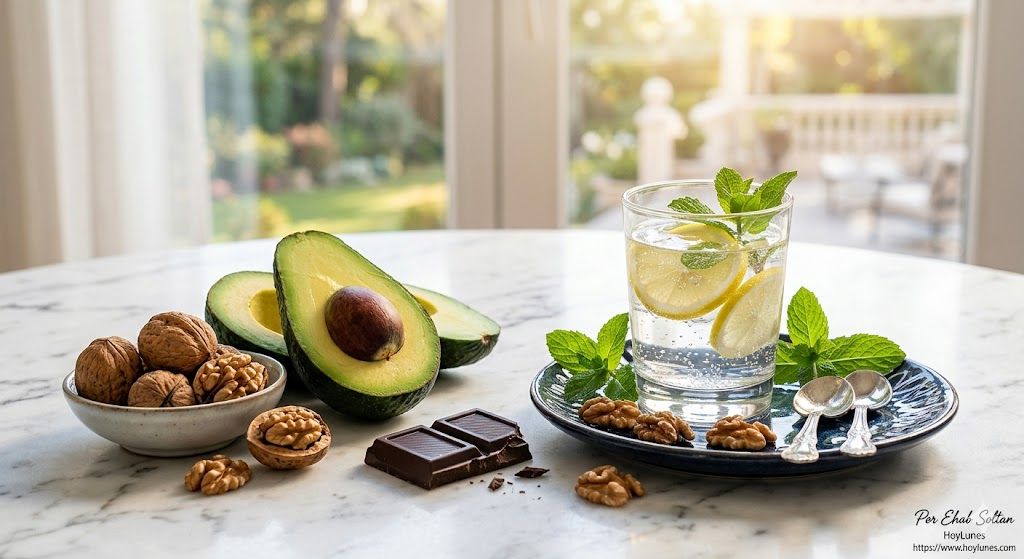
Real Remineralization: Drinking plain water can sometimes «empty» us of minerals. You need nutrient-dense foods like avocado, spinach, and zucchini to keep your neurons’ electrical pump running at full capacity.
While I was explaining these points, Tania interrupted me with a frankness that made us all smile:
—«Enough biochemistry! Translate this to the plate. Tell me what to eat and what to avoid starting tomorrow so I don’t feel like I’m dragging my body. I want to enjoy the sun without being a zombie. Give me habits, not theories».
She was absolutely right. The brain does not live on concepts; it lives on nutrients. So, right then and there, we designed this daily framework.
Daily Nutrition Guide: The Rescue Protocol
| Time of Day | Your Allies (What to eat) | The Real Benefit | Your Enemies (What to avoid) | The Risk to Your Brain |
| Breakfast | Organic eggs, avocado, and walnuts. | Stabilizes your neuronal membranes with noble fats from the first minute. | Pastries, white bread, or sugary cereals. | The insulin spike guarantees a mental «blackout» within two hours. |
| Lunch | Tuna or sardines with a spinach and zucchini salad. | Vitamin B6 helps manufacture GABA, «cooling» your brain under the sun. | Pasta, white rice, or soft drinks. | They raise internal temperature and promote permeability of your brain protection. |
| Snack | Natural pistachios or dark chocolate (>85%). | Provide pure potassium and magnesium to sustain your energy and focus. | Industrial ice cream or sugary slushies. | Sugar drains your vitamin B1, leaving you without a «spark» and much more irritable. |
| Dinner | Chicken or turkey with steamed broccoli or asparagus. | Clean amino acids that repair neurotransmitters while you sleep. | Alcohol, pizzas, or very heavy dinners. | Alcohol blocks restorative sleep; you wake up with a «dirty» brain. |
| All Day | Mineral water with a pinch of sea salt and lemon. | You recover the electrolytes that sweat steals without straining your pancreas. | Energy drinks or excess coffee (>3). | Excessive caffeine in the heat exhausts your glands and triggers anxiety. |

The Covenant of the Brigade
I made it clear to Tania that this is not a restriction; it is shielding. We don’t do it for aesthetics, but to stop the neurochemical leak. If we ignore these guidelines, the damage is silent: sudden forgetfulness, chronic fatigue, and total vulnerability to thermal stress.
Tania noted the list on her phone, and her expression changed completely:
—«Tomorrow is Monday. I’ll start with that breakfast of eggs and avocado. If my motivation returns and that fog clears, the next coffee is on me».
That afternoon, the Naughty Brigade said goodbye with more than just vacation plans; we left with the certainty that summer does not have to be a lost battle, but an opportunity to nourish our intelligence and enjoy the sun with a mind clearer than ever.
#TherapeuticNutrition #Dopamine #BrainHealth #SummerDiet #Biohacking #RealWellbeing #EhabSoltan #HoyLunes