
The longest distance is not measured in kilometers, but in the words that are lost in the middle of an after-dinner conversation.
Auditory function usually declines gradually, modifying the way the nervous system processes sound long before many people seek help. Understanding its effects makes it possible to protect communication, personal relationships, and quality of life in an increasingly long-lived society. Early detection and proper intervention can reduce part of that impact.
By Ehab Soltan
HoyLunes – A Sunday family lunch. Dishes clatter, laughter erupts in unison after an anecdote, and the room is filled with that deeply familiar warmth. At the far end of the table, a man smiles. His gesture is flawless, perfectly synchronized with the joy of the others. However, his eyes reveal a subtle disconnection: he did not understand the punchline of the joke. The combination of clattering cutlery, crossing voices, and an acoustic frequency he can no longer perceive have turned the words into a blurry murmur. Instead of interrupting the flow of the moment by asking them to repeat it, he opts for the safest and least invasive strategy: simply smiling. This gesture usually goes unnoticed by those around him.
This is where, for many people, one of the first social consequences of hearing loss begins. It does not start in an otolaryngologist’s office or with a clinical diagnosis of hypoacusis; it begins in the invisible fabric of our daily lives. Silence does not suddenly assault the house or instantly turn off the world. Rather, it is a stealthy thief that first takes away the nuances, the weak consonants, and the whispers, leaving the individual in an acoustic twilight of which they are not even fully aware.
The Brain Begins to Work Harder
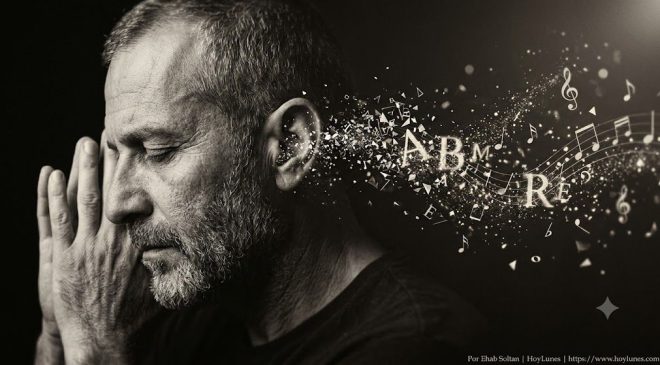
Before the ear noticeably fails medical tests, the nervous processing center has already begun to fight a silent and exhausting battle. When the hair cells of the cochlea begin to deteriorate—whether due to the natural wear and tear of the years or the accumulated impact of excessively loud headphones in one’s youth—the signals they send to the corresponding cortex become weak and fragmented.
It is here that the spotlight shifts from the sensory organ to brain activity. To compensate for this lack of clarity, the mind is forced to perform a cognitive overexertion. It activates frontal and parietal areas designated for attention and problem-solving in order to try to “guess” and reconstruct the missing words from the context. This phenomenon, which neurologists and audiologists call listening effort, consumes more energy resources. As a direct consequence of this power diversion, fewer resources remain available for other crucial cognitive functions:
- Working memory: It becomes much more difficult to retain information that has just been heard. Not all people experience this effort with the same intensity.
- Sustained concentration: Exhausting mental fatigue appears after barely an hour of interaction.
- Rapid processing: Following the thread of dynamic communication or learning something new becomes a titanic task.
The individual does not notice that they hear less, but rather feels unusually tired, overwhelmed, or unable to maintain attention in dynamic environments.
What first evaporates with gradual hearing loss is not sound, but the spontaneity of participating in life without having to calculate every interaction.
What Disappears First Are Not the Sounds
There is a false belief that losing the ability to hear simply means no longer perceiving the ticking of a clock or the chirping of birds. In reality, the first thing to evaporate is something far more valuable: spontaneity.
This process is not a list of fixed symptoms, but a behavioral and emotional sequence that advances in a predictable manner:
[Spontaneity] ➔ [Asking to repeat] ➔ [Intervening less] ➔ [Avoiding gatherings] ➔ [Isolation]
The speed at which this sequence progresses varies considerably between people. At first, the subject navigates situations naturally, but as the effort to understand increases, they are forced to calculate every interaction. The uncomfortable need to ask for things to be repeated arises, a gesture that soon generates self-reproach or embarrassment. To avoid becoming a burden in the exchange, the person consciously chooses to intervene less, assuming the role of a passive spectator. Over time, the anticipation of mental exhaustion causes them to begin declining invitations and avoiding gatherings. The final destination of this sequence is not physical silence, but emotional isolation.

Conversation Changes Before Hearing Does
Long before an audiometry rings the alarm bells, the person’s behavior has already completely mutated. A repertoire of daily coping strategies begins to develop:
- Automatic nodding: Learning to say “yes” with the head and smile based solely on the interlocutor’s facial expression, risking misunderstandings.
- Selection of environments: Systematically avoiding restaurants with poor acoustics, crowded cafes, or dinners with long tables, preferring enclosed and easily controlled spaces.
- Speech reduction: Being unsure of one’s own tone of voice or whether one is interrupting someone, silence is preferred over active participation.
The change transcends the ear and affects the way we relate to others. We are not dealing with a biological tissue that is simply aging, but with a way of inhabiting public and private space that shrinks day by day.
The Family Also Changes
The health of our senses is a strictly transversal matter. When someone experiences this decline gradually, their environment usually progressively adapts its way of communicating.
The affective dynamics are altered almost imperceptibly. Couples stop making casual comments from another room because they know it will involve a shout or a misunderstanding; the complicity of the whisper is lost. Children and grandchildren, tired of having to repeat sentences or modulate their voices unnaturally, begin to simplify their stories, eliminating nuances, jokes, or secondary details of their daily lives. Talks become strictly instrumental and functional (“Have you bought the bread?”, “What time is the appointment?”).
Family communication usually becomes one of the main challenges, transforming complicit chats into strictly functional messages.
Without realizing it, the family begins to communicate less and in a more superficial way with the affected person, which accelerates emotional estrangement. Not all families experience this process in the same way, but communication usually becomes one of the main challenges.
What Science Says: The Systemic Connection
In recent years, research in geriatrics, neurology, and public health has shown that untreated hearing function difficulties are not an isolated problem, but a critical factor with a systemic impact on general health.
Large-scale epidemiological studies have observed a robust association between untreated sensory deprivation and accelerated cognitive decline. Most studies show an association, although the causal relationship and the mechanisms involved are still being investigated. Current hypotheses consider three complementary factors: the overload that exhausts the brain reserve, the structural atrophy of receptor areas due to lack of stimulation, and the impact of isolation.
Likewise, clinical evidence links this condition to a higher prevalence of depression and anxiety disorders, due to the psychological factors involved in social disconnection. On a physical level, a significant increase in the risk of falls has been detected in adults with mild losses, because spatial awareness of the environment decreases and the effort to concentrate detracts resources needed for walking balance control. This increased risk may also be influenced by other factors associated with aging.

What Can Still Be Recovered
The most hopeful aspect of modern neuroscience and audiology is that this decline is not an inevitable sentence. The brain possesses remarkable plasticity, capable of reorganizing itself and recovering functions if intervention occurs in time.
Success lies in early diagnosis and in normalizing regular check-ups throughout life, just as we do with vision or dental health. When indicated, latest-generation hearing aids and technological implants do not just amplify volume; they act as intelligent processors that clear background noise, easing the mind’s workload and reducing fatigue.
Along with rehabilitation led by speech therapists and training in effective guidelines for the affected individual and their family, it is perfectly possible to halt the sequence of isolation and help recover part of the participation in daily life. Much can improve if we stop considering the ability to hear as an asset that simply extinguishes.
Five Daily Signs Worth Not Ignoring
Far from clinical manuals, changes manifest through small scenes of everyday life. Paying attention to these situations can make all the difference:
| Everyday Scene | Hidden Meaning |
| The choral murmur: Finding it hard to understand the meaning of dialogue when several people speak at the same time or voices cross. | The nervous system has lost the ability to filter and separate sound sources in complex environments. |
| The tyranny of the remote: Needing to turn up the volume of the television or radio to a level that others find annoying or deafening. | It seeks to compensate for the loss of clarity in the mid and high frequencies, where the human voice is concentrated. |
| Confusing voices: Distinguishing low, male voices perfectly, but feeling that the voices of women or children are “whispering” or cannot be understood. | The decline usually begins in the high frequencies, affecting the clarity of certain timbres. |
| Ambient noise wins: In a restaurant or on the street, understanding that someone is speaking but being unable to decipher the exact words. | The signal arrives distorted and the mind cannot isolate speech from background noise. |
| Unexpected silences: No longer remembering having heard the doorbell, the microwave beep, or a dripping faucet. | High-frequency, short-duration environmental sounds begin to disappear from the sound map. |
These situations do not confirm hearing loss on their own, but they justify consulting a professional if they happen frequently.
Questions for Thought
For public health specialists, aging researchers, and society as a whole, this scenario raises questions that urge deep reflection:
- At what exact moment do we stop participating in a conversation and become mere spectators of our surroundings without even noticing?
- How many times are we mistakenly confusing pathological aging or social disinterest with perfectly addressable interaction problems?
- Why do we care for our visual health with annual check-ups from childhood, but pay residual attention to hearing until the damage is limiting?
- How will the structure of an increasingly long-lived society change if it manages to massively preserve its citizens’ ability to communicate?
The Sound That Sustains Daily Life
Caring for our health is not, ultimately, a purely medical or technological matter; it is a deeply human decision. The ability to hear does not exist simply to perceive vibrations in the air, but to sustain the invisible threads that bind us to others: sharing an after-dinner conversation without tension, responding naturally to a child’s laughter, reacting to a warning on the street, or recognizing the exact tone of voice of those we love. Listening also means participating, responding, and feeling part of a conversation.
When auditory function gradually declines, it is not just certain decibels or frequencies on a graph that disappear; the way we relate to the world and participate in collective life changes. Protecting this sense throughout all stages of life—from youth exposed to urban noise to maturity—is not just about defending a biological organ: it consists, essentially, of being an active part of society and preserving an essential part of our relationship with others.