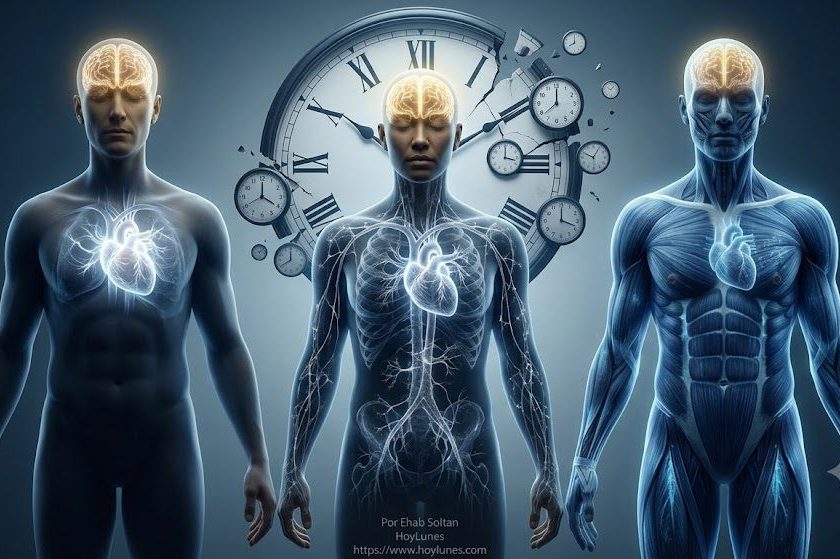

An unexpected call, a familiar voice, or a simple smell can awaken physical reactions years later. Science is beginning to understand why some experiences leave our memories before leaving our nervous system.
By Ehab Soltan
HoyLunes – Imagine for a moment a person who has been out of a toxic work environment for years. They have moved to another city, consolidated a new job, and, consciously, successfully rebuilt their life. The past seems like a closed chapter. Suddenly, on an ordinary afternoon, the phone vibrates on the table. An unknown number appears on the screen.
Before the mind processes the numerical sequence or attempts to guess the caller’s identity, something outside of conscious will occurs: the neck muscles tighten all at once, the breathing rate accelerates, the palms of the hands begin to sweat, and a sudden sensation of threat floods the chest. Seconds later, the rational mind identifies the area code or the voice on the other end of the line. The logical brain takes valuable time to understand the situation; however, the nervous system had already reacted in a flash.
This phenomenon confronts us with one of the deepest questions of the human condition: how is it possible for events apparently overcome and buried by the years to continue provoking such clear and intense physical responses?
«The brain was not designed to seek our psychological well-being, but to guarantee our survival; that is why the body prefers to over-remember rather than risk forgetting».
When the Danger Disappears, but the Alarm Remains Installed
For modern neuroscience, this reaction is neither a system failure nor a pathology; it is the result of a perfectly honed evolutionary mechanism. The stress response is a set of physiological alterations that evolved to allow our species to face imminent threats to its survival. Faced with danger, the organism redirects all its energy toward the essential systems for defense or flight: the heart pumps harder, the pupils dilate, and the immune and digestive systems are temporarily paused.
From a purely evolutionary perspective, the brain was not designed to make us happy or to seek psychological well-being; it was designed to keep us alive. This biological premise explains the so-called negativity bias: our nervous system prioritizes and stores stimuli linked to danger much more efficiently than those related to safety or pleasure. Registering what harmed us in the past with enormous precision is the best biological guarantee to prevent it from harming us again in the future.
What we feel as an exaggerated reaction is usually, in reality, an adaptive response. The organism does not evoke the past out of nostalgia; it is simply checking if the danger has returned.

The Memory That Does Not Keep Dates or Names
To understand this phenomenon without falling into mysticisms about an independent “cellular memory”, neuroscience describes the functioning of emotional memory. While declarative or explicit memory (managed by the hippocampus) consciously takes care of facts, dates, and names, implicit or emotional memory processes experiences through subcortical structures, with the cerebral amygdala as the main core.
The amygdala operates through a mechanism of unconscious associative learning. When we live through an experience of high emotional intensity or sustained stress, this structure archives the peripheral sensory stimuli of the environment—a tone of voice, a smell, a light pattern, or a background sound—and associates them directly with the fear or survival response.
We can forget the exact details of a conversation, we can erase the precise data of a difficult year from the conscious narrative, but the nervous system keeps the associations destined for survival intact. It is for this reason that an individual may not remember a specific work argument that occurred half a decade ago and, nevertheless, experience a sudden surge of anxiety upon hearing a stranger speak with the same tone of voice as their former supervisor. The brain can forget the story, but the alarm does not always forget the signal.

The Body Does Not Distinguish Between a Tiger and an Email
The design of our alert system presents a critical characteristic in the contemporary world: the inability to discriminate the qualitative origin of the threat. When the amygdala detects a stimulus associated with danger, it instantly activates the sympathetic nervous system, triggering a massive release of adrenaline and cortisol through the hypothalamic-pituitary-adrenal (HPA) axis.
The physiological mechanisms that protected our ancestors from real predators or climate accidents are exactly the same ones activated today by the threats of modern social life: a public humiliation, the rejection of a group, a conflict of authority at work, or economic uncertainty.
For a deep part of the brain, a current hostile meeting can seem more urgent than a physical threat that already belongs to the past. For the organism’s alarm system, constant criticism or an environment of prolonged hostility over time can come to be perceived as a real physical danger. The brain does not respond to the logic of the stimulus, but to the evaluation of the risk it poses to the integrity of the person.
The Invisible Scars of Everyday Life
In daily practice, these biological traces translate into behaviors and sensations in which any reader can recognize themselves:
Startling disproportionately at the sound of electronic notifications.
Systematically avoiding certain streets, offices, or cities without an immediate rational justification.
Experiencing intense involuntary muscle tension when hearing certain proper names.
Suffering episodes of insomnia or nighttime hypervigilance without an apparent environmental cause.
Enduring a deep exhaustion after facing daily social situations that the environment considers “normal”.
Many people experience these situations for years without connecting them to events they believed were completely overcome. However, it is fundamental to understand that these somatic and behavioral responses do not represent a weakness of character or a mental illness. In the vast majority of cases, they constitute learned neurobiological adaptations: the nervous system learned to maintain a state of preventive alert to protect the individual in an environment that was once hostil.

What Neuroscience Discovered About Recovery
Despite the depth with which these associative responses are engraved, biology does not dictate an immutable sentence. One of the most revolutionary discoveries of recent decades is neuroplasticity: the intrinsic capacity of the human brain to reorganize its neural connections, modify its responses, and generate new learning throughout life.
Painful experiences leave traces in the circuits of the amygdala, but those traces are not definitive sentences. Through processes of fear extinction and emotional regulation, the nervous system is capable of performing an adaptive relearning. This process consists of exposing the organism to the stimuli previously associated with danger within a current context of absolute safety, allowing the prefrontal cortex to progressively inhibit the amygdala’s alarm response. The brain that learned to live in alert can also learn to live in calm.
Why Talking Helps, Even if the Problem Seems Old
Scientific evidence demonstrates that recovery from trauma or accumulated chronic stress requires an integrative approach. Talking about a difficult experience does not change what happened, but it can radically transform the way the brain and body respond to that memory.
Verbalization and targeted emotional processing within a framework of clinical psychological therapy (such as cognitive-behavioral therapy or EMDR) allow implicit memory to finally integrate into declarative memory. By putting words to the discomfort, the experience stops being a chaotic physical response and becomes part of a personal history with a beginning and an end.
Alongside psychotherapeutic support, real social support, the practice of physical exercise—which metabolizes the excess of peripheral cortisol—and sleep hygiene are essential pillars to restore the balance of the autonomic nervous system and enhance the activity of the parasympathetic nervous system, which is responsible for relaxation and organic repair.
Scientific recovery does not consist of magically erasing the past; it consists of consistently teaching the nervous system, through present experience, that the danger is over and that the current environment is safe.
When the Body Becomes a Historian
Human memory does not function like a static library that stores files on identical shelves; it functions as a dynamic system of survival priorities. That which was once cataloged by the brain as critical information to keep us alive leaves a neurobiological mark much deeper and more resistant to the passage of time than the banal events of daily life.
Perhaps that is why some people are surprised to discover that what marked them the most is not always what they remember most consciously. Sometimes exactly the opposite occurs: the episodes that seem forgotten are the ones that continue writing small notes in the margins of daily life.
For this reason, some experiences seem to disappear completely from the conscious narrative of our biography—the logical mind decides to move forward—but remain latent in our automatic physical reactions. The body acts as a rigorous historian: it does not keep the official, sanitized version of our history, but the exact record of the battles we had to fight to survive.
The Day the Body Receives the News the Mind Already Knew
Perhaps true emotional recovery does not happen the day we stop remembering a painful experience or when we manage to archive it into oblivion. Perhaps it happens in a much more subtle and extraordinary moment: the day a phone call, a characteristic smell, a certain voice, or a place from the past suddenly returns and the biological alarms remain silent.
«True emotional freedom is not erasing the past from memory, but making the present stop activating the physical alarms that the past installed».
When the muscles remain relaxed, the breathing follows its calm course, and the heart beats to the rhythm of the present, true reconciliation takes place. In that instant, the rational mind—which had already known for years that the danger had passed—finally connects with the nervous system. The body, which for years acted as if the threat were still present, finally understands what the mind knew all along: that the battle is over. And perhaps that is one of the deepest forms of freedom.
#Neuroscience #MentalHealth #EmotionalMemory #ChronicStress #Psychology #EmotionalWellBeing #PsychologicalTrauma #Neuroplasticity #NervousSystem #ScienceCommunication #Health #HumanBrain #HoyLunes #EhabSoltan