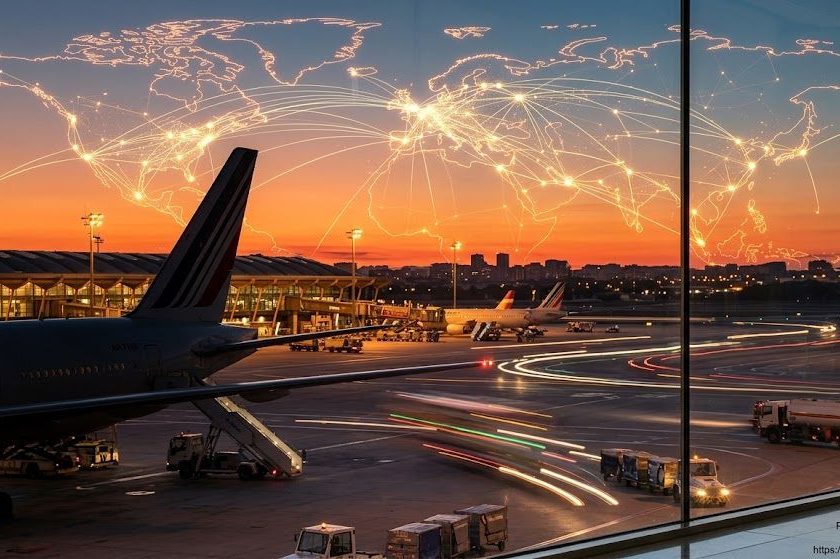
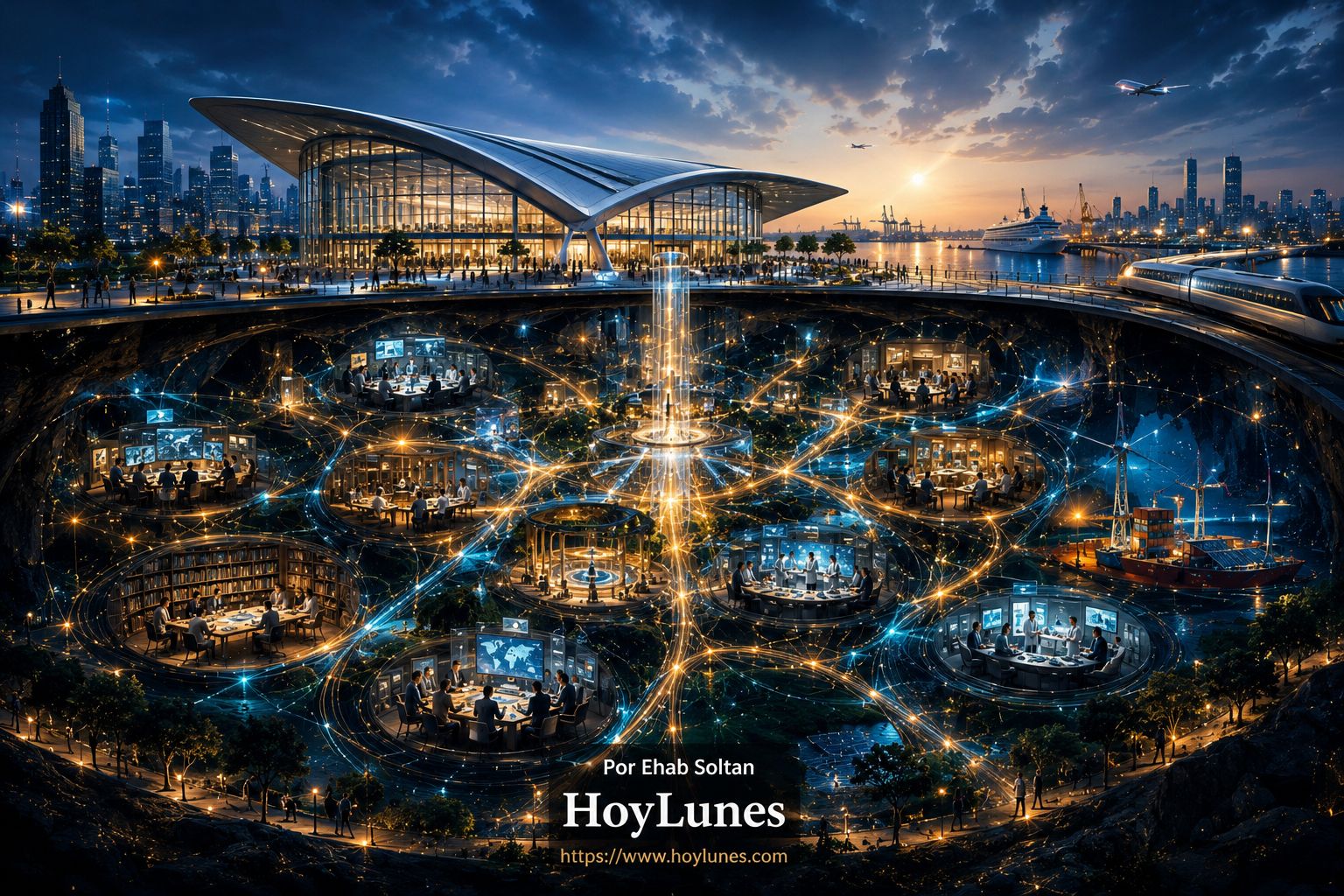
An infrastructure never ends at its walls; it begins at the relationships it manages to activate.
For decades, we have measured success by what we are capable of building. The true challenge of the 21st century lies in understanding what economic, social, and human ecosystems we are capable of activating from it.
By Ehab Soltan
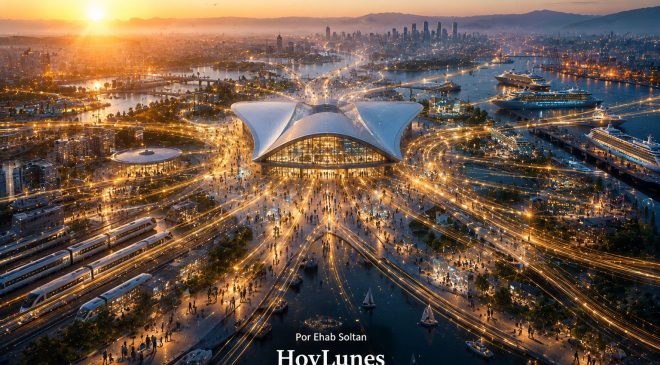
HoyLunes – The scene repeats itself in airport terminals with undulating roofs, port terminals that defy the horizon, museums with impossible geometric facades, and convention centers clad in titanium. They are architectural colossi that impose silence, monuments that seem to project, by their sheer physical weight, the infallible presence of prosperity. Any casual observer would conclude that they are contemplating wealth itself made matter. And yet, they are contemplating only its wrapper.
Behind the flash of novelty, reality poses an uncomfortable question that is rarely asked at official inaugurations: when does a construction cease to be a building to become a genuine engine of development?
The answer does not belong to the realm of urbanism, engineering, or tourism; it dwells in the heart of economic science. Real development is not born upon cutting the inaugural ribbon, but when cement ceases to be an end in itself and begins to become a catalyst for relationships, activity, and opportunities.
The Great Confusion of the 20th Century
For most of the last century, global development plans were governed by a linear equation that seemed mathematically infallible: investment equals infrastructure, infrastructure equals development, and development equals prosperity. This logical sequence worked with resounding success in a post-war world characterized by absolute physical scarcity. Connecting two cities by railway or providing a region with a commercial port generated a massive economic return because it started from zero.
The contemporary error does not lie in having followed that formula, but in failing to notice that the historical context has changed drastically. In a hyper-connected economy saturated with physical assets, the mere addition of concrete no longer automatically triggers prosperity. Infrastructure has ceased to be a differentiating element to become a basic condition of play. Building without a systemic purpose is no longer synonymous with advancing; often, it is just an expensive way to immobilize capital.
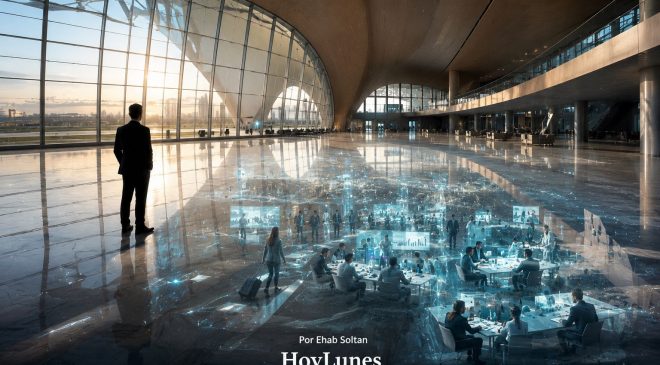
The Building Was Never the Real Product
Understanding the new scenario demands a mental revolution regarding the nature of physical assets. An international airport has never sold solid asphalt runways; it sells global connectivity. A contemporary art museum does not commercialize illuminated white walls; it sells knowledge, identity, and prestige. A hotel does not sell square meters with a bed; it sells trust, rest, and status. Similarly, a university does not sell classrooms, nor does a commercial port sell docking wharves.
They all sell an invisible intangible: relationships, experiences, innovation, and opportunities. The building is the support; the true product has always been what happens within and around it. The conceptual revolution occurs when organizations understand that the physical container is secondary. The value of any infrastructure lies in its ability to act as an exchange interface. Those who focus on managing the container become obsolete; those who focus on dynamicizing the invisible content become indispensable.
The Real Asset Was Never Physical
Under this perspective, the role of infrastructure is redefined: its only real function is to reduce friction. Cement eliminates the obstacles of space and time, decreases transaction costs, and facilitates encounters. Nothing more. Infrastructures do not produce wealth; they create the logistical conditions necessary for other social actors to produce it.
Real wealth is what happens around the building once friction is eliminated: the attraction of talent, the cross-pollination of ideas, the incubation of companies, the flow of trade, capital investment, and the development of advanced services. Confusing the runway with the economy it generates is equivalent to confusing water pipes with the miracle of agriculture. Pipes transport water; they never produce harvests. This subtle conceptual difference changes everything when designing any long-term strategy.
Infrastructures do not produce wealth. They only create the conditions for people to produce it.
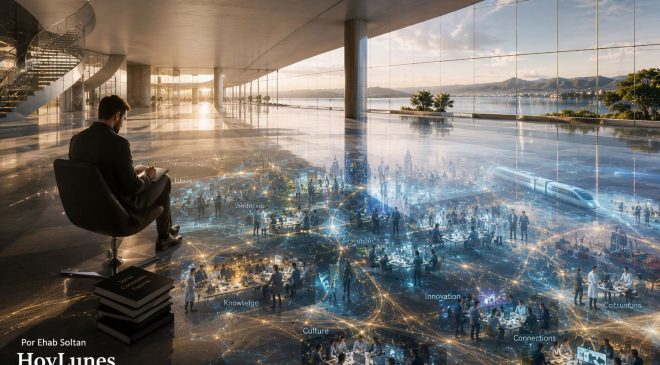
The Invisible Ecosystem
When infrastructure is stripped of its physical mystique, it ceases to be analyzed as an inert engineering object and begins to be understood as a living organism. The analyst’s focus no longer rests on the solidity of the facade, but on the vitality of the invisible ecosystem that surrounds it.
To evaluate the real impact of an asset, the metrics must be transformed into dynamic questions: What does it activate in its wake? What societal nodes does it connect? What innovation processes does it accelerate? What commercial exchanges does it facilitate? How much value does it multiply in its immediate environment? What would cease to exist if this infrastructure disappeared tomorrow? The strategic observer stops looking at fixed buildings and begins tracing the network of relationships, flows, and synergies that flow through them.
When infrastructure ceases to be a physical object and is analyzed as a living organism, success ceases to be measured in square meters and begins to be measured in the density of the human relationships it activates.
The New Unit of Measurement
This shift in vision demands the urgent adoption of a new metric paradigm. For decades, financial committees and governments have evaluated success through purely quantitative questions: How much did the work cost? How many square meters does it have? How many passengers does it move per year? How many rooms does the complex possess?
In the 21st-century economy, these questions are descriptive but strategically sterile. The determining questions belong to another dimension: How many new businesses have been born thanks to this node? How much skilled talent has the region retained and attracted? What international strategic alliances has it provoked? How many previously impossible business opportunities has it made viable? When the unit of measurement is changed, the landscape is completely transformed, because every organization ends up resembling what it decides to measure.
The Error Repeated Everywhere
This confusion between the container and the content is not a problem exclusive to the tourism sector; it is a universal error replicated in nearly any contemporary organization. Entire cities that design technology districts void of community, state-of-the-art hospitals without an integrated model of human care, universities with smart campuses incapable of retaining their researchers’ talent, or monumental libraries whose reading rooms remain deserted.
Any organization is prone to falling into the trap of hypertrophying its physical assets while its social ecosystems atrophy. Investment is massively allocated to what can be seen, touched, and photographed in a press release, forgetting the invisible fabric of relationships that justifies the original investment. History proves that no infrastructure remains relevant for decades if its ecosystem ceases to evolve.
The Activation Economy
Throughout the last few decades, the world operated under the rules of the construction economy, where power resided in the financial and technical capacity to erect structures. Today, that model has hit a ceiling. We have fully entered the activation economy.
In the 21st century, building structures will be a progressively standardized and replicable process through global capital. The true competitive advantage will no longer lie in the ability to build the stage, but in the strategic ability to activate the human ecosystem that gives it meaning. Value is no longer generated by stacking concrete blocks; it is generated by igniting the connections that occur within them.
The Question That Will Decide the Future
Resolving this model crisis does not require pre-packaged answers; it requires the courage to pose a single determining question. Because a good question can avoid decades of bad investments. Every corporation, investment fund, and public administration should answer a single question with absolute honesty before laying the first stone:
What socioeconomic ecosystem will this infrastructure be capable of activating the day after it is completely finished?
It no longer matters if the structure will be aesthetically perfect, if it will break a scale record, or if it will have the most modern technology. The only long-term survival metric is: What human and economic activities will it make possible that were simply unthinkable before?
Development never begins when a building is inaugurated. It begins when that building starts changing the lives of those around it.
Wealth Was Never Inside the Building
At the end of the analysis, the circle closes on an inescapable certainty: a runway has never created, by itself, an economic dynamic. An empty hotel room has never founded a tourism industry. An avant-garde design library has never generated knowledge spontaneously, just as a university classroom has never created talent nor a commercial dock created trade by its mere physical presence.
It was people, interacting with each other, who gave life to each of those phenomena. Infrastructures only cleared the ground and removed obstacles from the path. The true protagonist of development was never the building; it was always the human activity that the building managed to make possible.
Perhaps the greatest conceptual error of our time has been believing that development is built with concrete. In reality, it begins much later: at the precise moment when that concrete manages to fluidly connect people, ideas, companies, knowledge, and opportunities. Infrastructures do not create wealth. They create the possibility for wealth to happen. And that difference completely changes the way the future is designed.