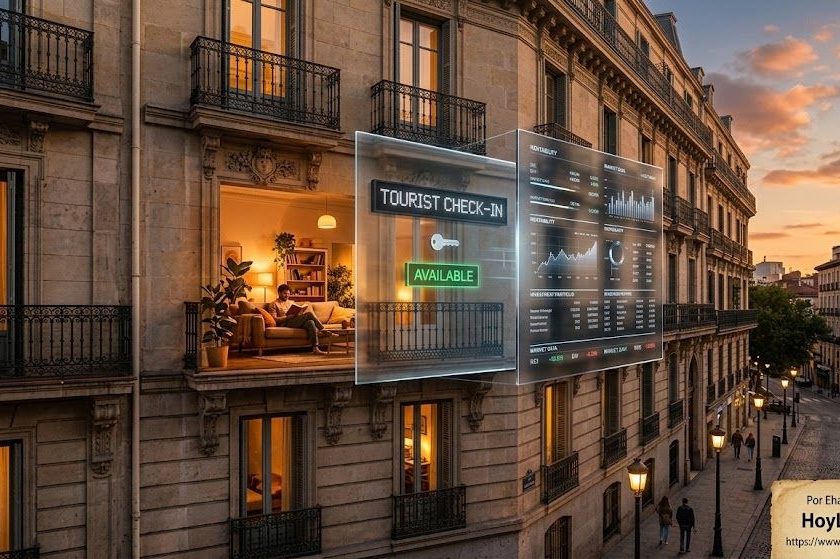
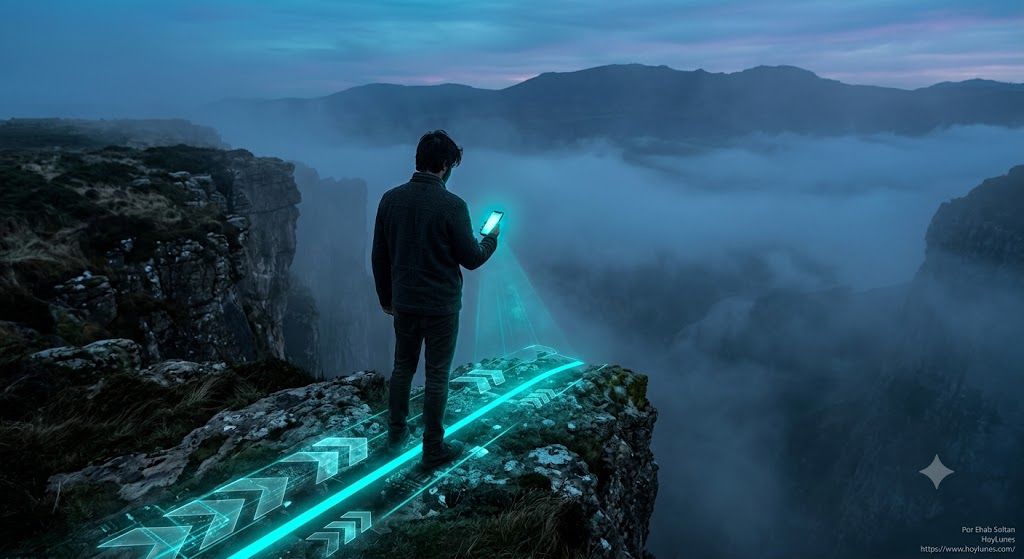
We walk through the world with the certainty of exploring, without noticing the digital thread guiding every single one of our steps.
Algorithms no longer just influence what we buy or watch online. They are also beginning to silently shape the places we dream of visiting. “To what extent are our decisions still truly our own?”
By Ehab Soltan
HoyLunes – You think you are just looking for inspiration for your next vacation. In reality, someone has already begun choosing for you.
You open your phone for just five minutes, looking for a breather in the middle of your routine. You have no intention in mind, no plan mapped out. Suddenly, a cove with water so turquoise it looks edited appears on the screen, framed by a perfect cliff. You swipe. Instantly, a charming café in a cobblestone alley, where the steam from the coffee seems to pierce the glass. You swipe again. A medieval village hidden amidst the morning mist. You are not searching for any of this; you are just looking. A week later, almost without realizing it, you are entering your credit card details to buy a plane ticket to that very destination.
You did not find that place. That place ended up finding you. And it probably was not a coincidence.
There was a time when traveling was born from a different impulse. We thumbed through geography magazines, listened to a friend’s enthusiastic tale, or became obsessed with a landscape discovered within the pages of a novel. Choice required intention, a thread to pull. Today, the process has been silently inverted. It was not a sudden shift; it happened so slowly that we barely noticed it.
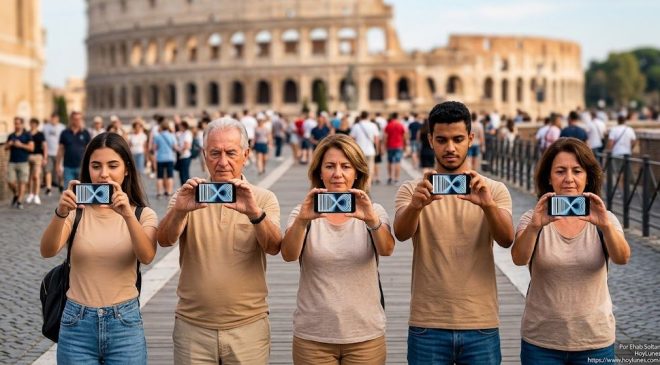
While you rest your eyes on the screen, recommendation systems—designed to select and sort the content each user sees based on their prior behavior—spring into action. Diverse research in psychology, behavioral sciences, and recommendation systems has shown that repetition, personalization, and social validation significantly influence user attention and preferences, even though each individual decision still depends on multiple factors.
Inspiration no longer always precedes the search; sometimes, the search is born from the inspiration someone decided to show us.
The system observes how long you linger on an image, when you pause a moment longer than usual, or what content triggers a repeated reaction. You do not need to search; your preferences are predicted, suggested, and subtly nudged. For the first time in the history of tourism, inspiration is no longer born solely from our curiosity; it also stems from what a platform decides to show us. Inspiration no longer always precedes the search; sometimes, the search is born from the inspiration someone decided to show us.
The common misconception is to think of these tools as neutral recommenders, like a guide who knows your tastes and suggests a special corner. But their nature is different. They do not select a place because it is the most enriching or the one best suited to your peace of mind; they select it because it possesses the exact visual structure to hold your attention for one second longer.
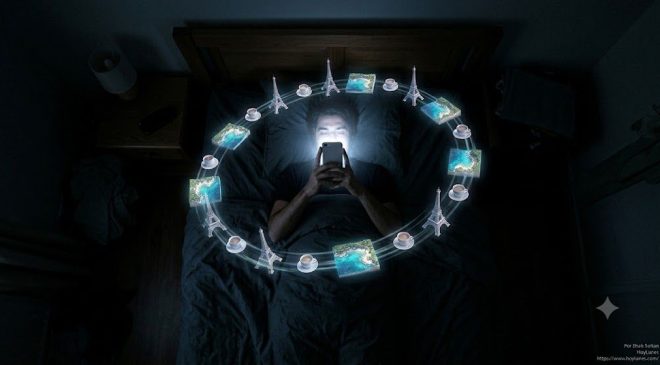
Here, we enter the realm of the attention economy, where success is not measured by the quality of your real-world experience, but by the amount of time you remain connected to the virtual world. In this model, capturing your attention is the objective; inspiring your trip is a possible consequence, but not necessarily the priority.
At the brain level, this mechanism activates ancient psychological triggers. Human beings are predisposed to seek familiarity and social validation. Cognitive psychology terms this phenomenon the “mere exposure effect”: the more we see a stimulus, the more familiar and attractive it can become to us, even without us realizing it. When our brain sees the same landscape repeated from different angles by different people, it triggers an unconscious reflex: if so many others seem happy there, that place must be desirable. We do not yearn for that trip because we have connected with its history; we yearn for it because constant repetition has transformed a foreign space into something strangely familiar. The fear of missing out on what everyone else seems to be enjoying does the rest of the work.
However, it is only fair to recognize that this technology is not an inherently negative force. As with any technology, its impact also depends on how we use it. This very magnetism has rescued uninhabited villages from oblivion, boosted local economies that were agonizing, and democratized access to landscapes that were previously only within reach of a few. The problem does not lie within the tool, but in the uniformity it generates when we allow ourselves to be blindly guided.
In this context, an expression has begun to popularize on social networks and specialized media to describe places that, after going viral, begin to attract highly similar flows of visitors inspired by the same type of content: “clone destinations”. Entire cities or natural spots that, overnight, see their influx multiplied in an identical manner. Digital visibility thus becomes a new factor of tourism competitiveness. Geography becomes an interchangeable backdrop, validating the power of that invisible pattern guiding us all toward the same point.
Here emerges the great paradox of our era. We live in the moment of human history with greater access to information and transportation options than ever before. The promise of technology was ultra-personalization, but the result is often an astonishing uniformity. Millions of independent travelers end up crossing the planet to step into the exact same street, look at the same monument through the exact same screen, and reproduce the same aesthetic experience.
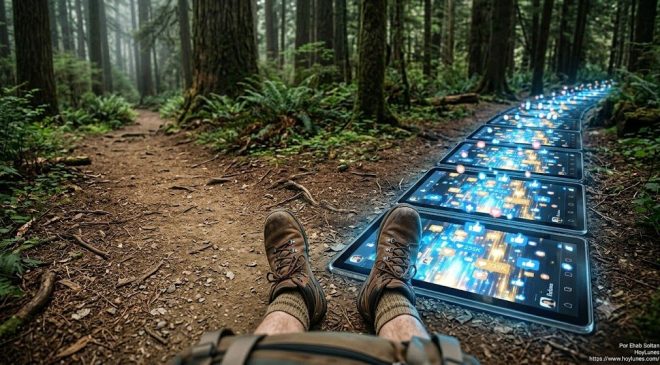
It is at this point that the phenomenon of tourism transforms into a much deeper reflection on our own personal autonomy. How many of the places you dream of visiting did you discover by chance… and how many because a platform decided you ought to see them?
How many of the places you dream of visiting did you discover by chance… and how many because a platform decided you ought to see them?
The truly transformative question is not which country you are going to travel to. The question we rarely ask ourselves is: why do you want to go precisely there? Where was that longing born? Was it a genuine connection to your personal history, an intellectual curiosity, or was it an idea patiently planted in your mind, pixel by pixel, during your minutes of disconnection in front of the screen? What if that content had never appeared on your screen?
Perhaps the true luxury of the 21st-century traveler is no longer discovering an extraordinary place. Perhaps it consists, simply, of preserving the capacity to decide for oneself why one wishes to go there. Because freedom also consists in choosing the origin of our own desires.