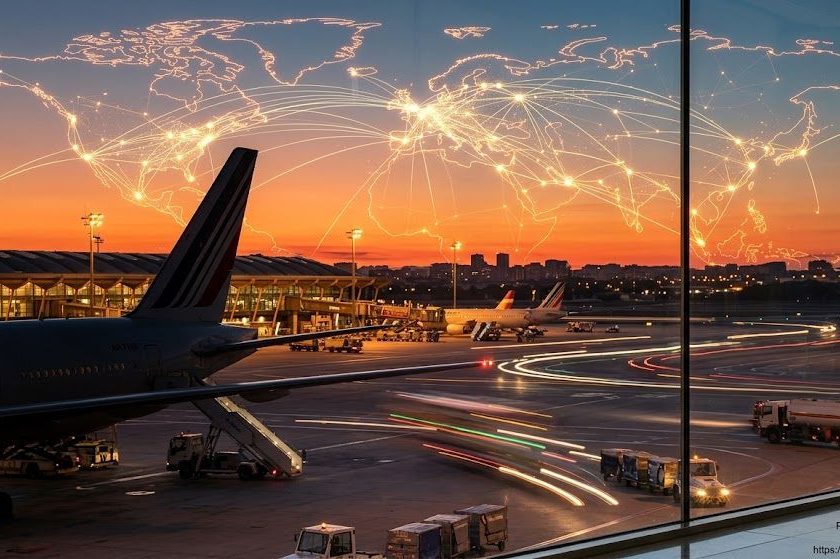

The first step of a thousand-mile journey is always taken across the canvas of a map at home.
While the industry assumes that vacations begin when crossing the departure gate, for millions of people the true displacement occurs weeks before, in the privacy of the home, revealing a particular way of inhabiting the world… and perhaps also a different way of understanding freedom.
By Ehab Soltan
HoyLunes – On a Sunday afternoon, four months before summer begins, a married couple unfolds a paper map across the dining table. There are no tickets purchased, no firm reservations, no suitcases in the hallway. The aroma of coffee and the silence of concentration float in the air. With their fingertips, they trace a line connecting a secondary train station to a wooded trail. Officially, their vacation has not started; administratively, they remain in their work routine. Yet, the journey is already happening. Because every important journey begins long before the first step.
There is an invisible border between those nations that start their vacations the day they arrive at their destination and those that inaugurate them when they switch on the lightbulb of curiosity. We do not all conceive of rest under the same premise. To better understand this phenomenon, one needs only to observe a society that has turned the prelude to travel into a sophisticated art: Germany. More than a difference in customs, it is a difference in philosophy.
The Journey Begins at Home
For a large number of German citizens, the act of planning is neither a bureaucratic burden nor a cumbersome chore; it is, in itself, the first dose of dopamine of the trip. The dissection of a railway route, the meticulous comparison of topographical maps, or reading the history of a Romanesque monastery are lived not as an obligation, but as an intellectual pleasure.
A travel guide is not an instruction manual to be used on the ground, but a novel of anticipation. By studying trails, schedules, and cultural alternatives, travelers are not limiting their freedom; they are constructing the stage where their freedom can unfold without interference. Anticipation is half the pleasure. Uncertainty diminishes. Imagination goes to work. The destination begins to acquire a concrete shape long before appearing on the horizon.
The Culture of Preparation
This behavior is not an isolated event of leisure time; it is the reflection of a deep cultural structure. The need to anticipate, to inform oneself exhaustively, and to mitigate uncertainty is a widely recognizable tendency that permeates German civic life, architecture, and social organization.
It is not a matter of neurotic rigidity, but rather an inclination oriented toward efficiency and respect for one’s own time and that of others. Knowing exactly what to expect from a place allows the mind to be freed from logistical worry to surrender it, at last, to pure contemplation.
The Journey as an Investment
In the German social fabric, the annual trip is rarely perceived as a superfluous luxury. It is a fundamental investment in a human being’s most valuable capital: their mental health, emotional balance, and personal development.
The weeks of disconnection constitute an especially protected time within German work culture, an unwritten social pact that guarantees a return to balance. Traveling is the mechanism to reconnect with nature, consolidate family bonds, and restore inner silence. Therefore, when vacation time is defended, it is not a social status being defended; well-being is being protected.
For many, travel is neither a reward for social status nor a seasonal consumption; it is an indispensable investment in mental and personal balance.
What They Are Really Looking For
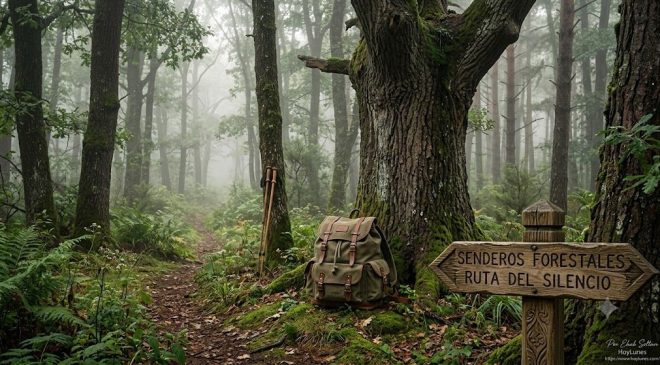
The geography of desire for a significant portion of these travelers rarely aligns with the gigantism of large tourist resorts. Value is found on the human scale. A marked trail through a centuries-old forest excites because it offers predictability in effort and wildness in the landscape.
A small village with an artisanal bakery or a secluded monastery is more attractive than a noisy city because they offer two scarce currencies in modernity: authenticity and quietude. They do not seek merely to see a place; they seek to feel that this place still retains an identity of its own. They look for places that demand to be walked and listened to, not simply photographed.
What Spain Offers Them Without Knowing It
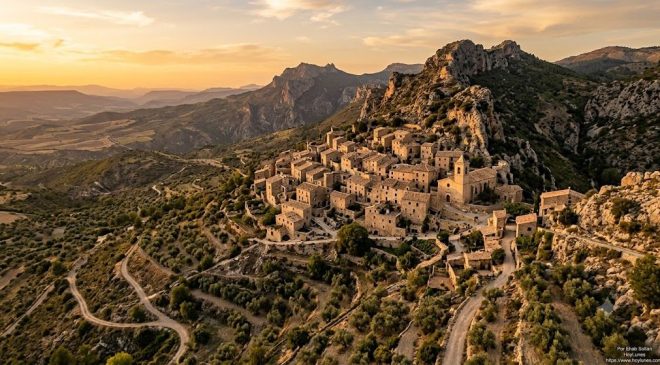
And here appears a paradox that Spain has seldom known how to explain. Many small towns and regions of the Spanish interior natively possess exactly what this traveler profile searches for insistently: miles of trails, a historical heritage integrated into the landscape, a striking silence, local gastronomy linked to its origin, and an unadulterated truth. Spain possesses much of what many German travelers seek. The challenge is not to build it; the challenge is learning how to tell it.
The Great European Misunderstanding
That is precisely where the perception of some receiving destinations runs aground. For decades, a large part of the tourism offering has been built on the idea that the German tourist is a one-dimensional consumer of sun, beach, and standardized services. It is a diagnostic error.
Although the climate is an undeniable draw, the underlying current of a very significant portion of this public seeks hidden heritage, gastronomy that respects its origin, the silence of empty coves, and the truth of the local landscape. Anyone who only offers them a spectacle and mass industry is ignoring the deepest vein of their loyalty.
Many tourist destinations make the mistake of offering spectacle and mass industry to a traveler who, in reality, insistently traces the hidden truth of the local landscape.
What the Middle East Can Learn
The challenge consists not merely in attracting visitors, but in understanding what they expect to find when they arrive. This principle is key to the new frontiers of global tourism, such as the emerging destinations of the Middle East. Building the tallest hotel, the most opulent resort, or the most technological attraction does not guarantee the interest of this traveler profile.
Monumental luxury pales before their true priorities: transparency in information, legal certainty, real environmental sustainability, and scrupulous respect for local history. To attract them, there is no need to dazzle them; it is enough to offer them a predictable, safe environment that is deeply respectful of the authenticity of the place.
Tourism Changes
We live in the era of algorithmic recommendation. Screens flood us with identical images of identical destinations, predicting our tastes before we even formulate them. Today’s traveler is torn between the convenience of artificial intelligence and the desire to maintain control over their decisions.
For many travelers, deciding for oneself remains an essential part of the journey. Perhaps that is why the German profile uses technology as an optimization tool, but avoids turning it into a substitute for personal judgment. The conscious decision, the discovery born from reading and not from the commercial impact of a feed, remains the pillar of their sovereignty.
The Paradox
We face the greatest paradox of our time: we possess the most powerful connectivity tools in human history and, precisely for that reason, the greatest object of desire is total disconnection.
True status is no longer traveling far, but being able to turn off the phone. Contemporary luxury for many is walking through a forest where there is no cell coverage, listening to the crunch of leaves under boots, breathing clean air, and reclaiming ownership of one’s own time.
Technology is the map; silence is the destination
Tal vez esa sea la nueva definición de lujo. Perhaps that is the new definition of luxury. Perhaps we have never been so connected and, at the same time, wished so much to disappear for a few days from the noise of the world.
What a Plane Ticket Reveals
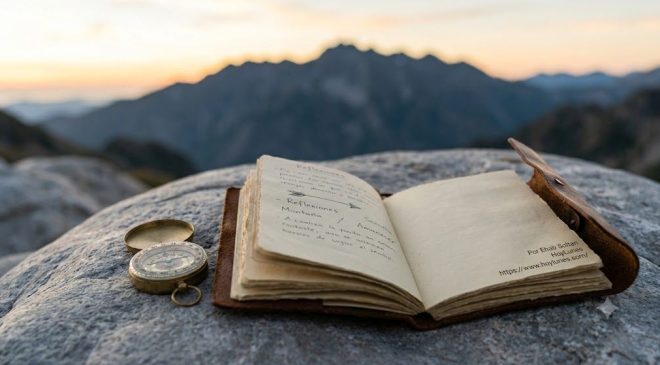
Ultimately, a society’s luggage reveals its existential priorities. Each culture leaves its mark even before opening the suitcase. The German philosophy of travel reminds us that displacement is a form of knowledge. Traveling has never been solely about changing places; it is also a way of expressing who we are when no one is watching.
Perhaps the true secret of the German traveler does not lie in the number of kilometers traveled each year, but in how they understand the very act of traveling. Because for them, the destination does not begin when the plane lands or when the train arrives at its station. It begins much before, when an idea awakens curiosity, a map unfolds on the table, and time stops being measured in days left until vacation to start being measured in experiences yet to be lived. Perhaps that is why, rather than merely moving, millions of Germans feel they travel twice: once with the imagination and once with their feet.
Because, in the end, no map explains why we travel. The answer always begins much earlier, in the way we imagine the world before setting out to discover it.