The December bank holiday bridge reveals a dynamic that goes beyond a simple transactional surge: when the calendar grants an extra public holiday, travelers not only prolong their stay, but also alter their planning habits and expand their geographical horizon toward new destinations within and outside Spain.
By Ehab Soltan
HoyLunes – The tourism industry tends to quantify its capacity through tangible parameters: highway kilometers, airport terminals, hotel rooms, or flight frequencies. There is, however, an invisible yet decisive factor capable of altering the behavior of millions without moving a single meter of ground: the architecture of the work calendar.
Adding a single day to a holiday period may seem like a minor variation on an annual scale, but in practice, it transforms the entire equation of a getaway. One more day makes a flight viable that previously felt too tight, turns a two-night stay into three, allows families to travel without the pressure of a packed schedule, and opens the door to a wider array of cities that were previously beyond the reach of available time.
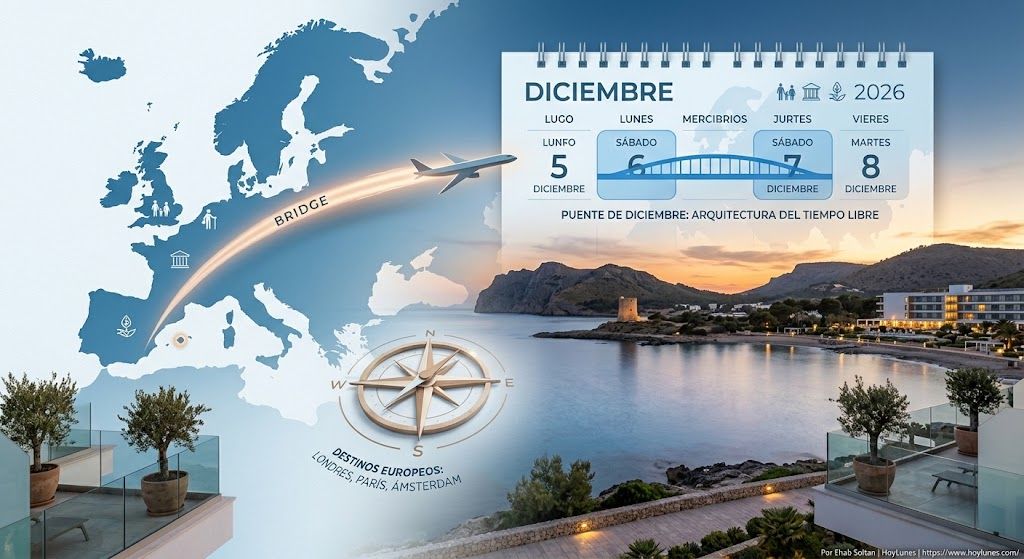
Data recorded by the Trip.com platform for the December 2026 bridge holiday offers an eloquent illustration of this phenomenon. With the holiday period extending across four consecutive days (from Saturday, December 5, to Tuesday, December 8), demand experiences a qualitative shift compared to the previous year. Flight bookings made by families with children have increased by 94% year-on-year, accounting for 25.4% of total recorded volume—representing a growth of 4.3 percentage points compared to 2025.
However, the truly relevant indicator is not merely the scale of the booking uptick, but how travelers reconfigure their use of that gained time.
An Extra Night as a Catalyst for Destination Change
The average duration of hotel stays increases from 2.6 to 3 nights, representing a 15.4% rise. While this percentage might appear modest on a spreadsheet, it marks a structural transformation for destination management and hotel operations.
Having a third night available changes the type of tourism product that can be consumed. Whereas a two-night stay forces travelers to forgo activities and prioritize urgent itineraries, adding an extra day allows them to pace their visit, integrate a cultural or gastronomic route, and enjoy the environment without turning every movement into a logistical operation.
Likewise, the perception of distance changes. A destination perceived as too distant for a short weekend getaway becomes a perfectly reasonable option when backed by a four-day window. Travelers do not necessarily seek to accumulate extra mileage, but they count on broader leeway to decide how far they are willing to go.
This distinction is fundamental: a destination’s competitiveness depends not only on its intrinsic appeal, but on its capacity to fit realistically within the traveler’s available time. The calendar does not operate as a mere organizational backdrop; it acts as an authentic infrastructure of the tourism market.
A destination’s competitiveness depends not only on its intrinsic appeal, but on its capacity to fit realistically within the traveler’s available time.
The Gestation of the Trip in the Planning Window
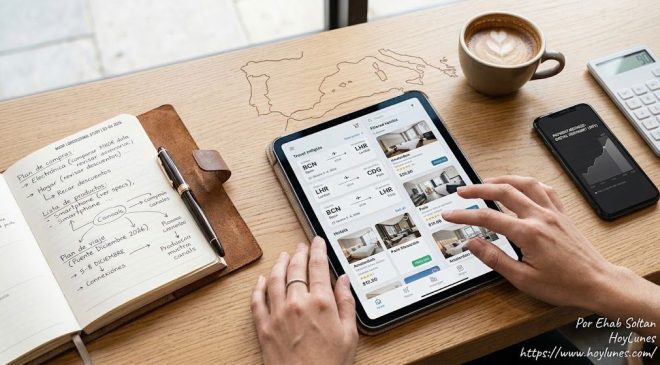
Alongside trip duration, booking lead time exhibits an insightful trend: Spanish travelers are booking their hotels an average of 95.5 days in advance, compared to 92.8 days recorded during the same period in 2025.
Although the numerical increase is modest, it outlines a clear pattern in consumer behavior: the winter getaway begins long before travelers pack their bags. It starts when they compare date combinations, analyze rates, calculate family budgets, and evaluate whether four days justify the trip.
For industry operators, this advance planning means customer acquisition is contested in early stages. Purchase decisions are rarely improvised at the counter or in response to a last-minute deal; they are structured over weeks and months of prior research.
This anticipation, in turn, broadens the competitive arena. A destination no longer competes solely against options in its immediate geographic surroundings, but against all alternatives appearing on the user’s screen the moment planning begins.
The Firmness of Major Hubs and the Opening of New Options
Madrid, Seville, and Barcelona continue to lead national hotel bookings for this bridge holiday, confirming that the position of major capitals remains solid and shows no signs of erosion.
The interesting nuance emerges further down the rankings. Valencia and Granada increased their share of hotel bookings by 2.5 percentage points, while Bilbao recorded a 1.8-point growth. San Sebastián also consolidated its place among the top ten domestic preferences, joined by Jerez de la Frontera, Málaga, and the resort areas of San Bartolomé de Tirajana and Mogán in Gran Canaria.
This evolution does not reflect an abandonment of major urban centers, but a more subtle dynamic: when granted more time, travelers diversify their spectrum of potential choices.
For destination management, this data is significant. Demand diversification does not require primary destinations to lose market share; it occurs because users add options to their decision-making process. A city that previously did not fit into a short weekend manages to enter the conversation, and being present in that initial consideration set is already a form of competing.
The International Leap in Four-Day Getaways
The trend becomes even more pronounced when analyzing travel outside Spain. Among Spanish travelers choosing international destinations for this period, London and Paris top the hotel booking ranks. Booking volumes recorded by Trip.com show year-on-year increases of 121% for London, 260% for Paris, and 263% toward Amsterdam.
These figures represent activity observed by the platform within its own transactional environment and should not be directly extrapolated to overall Spanish outbound tourism. Nevertheless, they provide a clear signal regarding the viability of continental getaways.
Four consecutive holidays are sufficient to make an international trip feel like a standard option rather than an exceptional logistical undertaking. Air transport provides the speed of travel, but calendar availability dictates the maximum reach.
This scenario presents capitals such as London, Paris, or Amsterdam with an opportunity to capture concentrated demand. At the same time, it poses a strategic question for other European cities: which destinations are prepared to position themselves when travelers have three nights of stay rather than just two?
The question no longer centers solely on accumulating tourist attractions, but on designing an offering tailored precisely to the available length of stay.
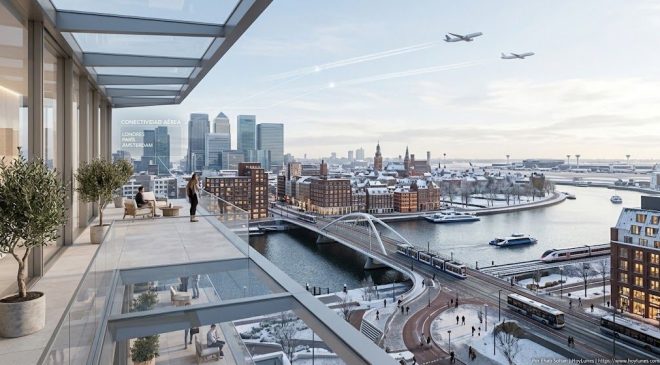
Impact on Airline Capacity Planning
For commercial aviation, this evolution opens a debate around capacity management and network opportunities. The surge in family bookings, combined with a slightly longer stay and planning horizons approaching three months, provides valuable insight for calibrating demand across specific routes.
This does not imply assuming that an extra holiday automatically generates added frequencies or seat capacity, but rather recognizing that it expands the range of trips passengers deem feasible.
For an airline, this distinction is operational: a date that traditionally generated regional proximity traffic can become a favorable environment for longer-haul routes, while an emerging destination may gain weight within a connection network.
The calendar does not single-handedly determine flight scheduling, but it helps identify when sufficient demand exists to sustain it.
Adapting the Tourism Proposal to the Visitor’s Time
Extending the length of stay places specific demands on hotels, promotional boards, tour operators, and cultural service providers. When travelers gain an extra night, marketing cannot be limited to offering a room; it must articulate a value proposal for those additional hours.
Three nights allow for a balanced stay: arrival, local exploration, main experience, and unhurried departure. This structure facilitates a more even distribution of spending and prevents overcrowding at major points of interest.
For secondary cities, this factor carries particular value. A destination not seeking to compete in sheer visitor volume with major capitals can compete on a different ground: the quality and coherence of a three-day experience.
Within that space, local gastronomy, cultural offerings, heritage, active tourism, rail accessibility, and family experiences designed to be enjoyed without rush find their place. Travel time thus becomes a central positioning argument.
The Architecture of Free Time as a Strategic Variable
For decades, the industry has focused its analysis on concepts such as seasonality, occupancy rates, average revenue, and installed capacity. Observations from this holiday period serve as a reminder to integrate another variable into analytical frameworks: the architecture of free time.
An extra holiday day increases stay duration. A longer stay expands acceptable travel distances. A wider radius brings new municipalities into consideration sets, and greater advance planning alters competition between businesses and destinations.
Without inferring a radical transformation of European tourism from a single bridge holiday—whose data must be interpreted prudently given its specific sample frame—the trend invites the industry to frame the right questions for upcoming cycles.
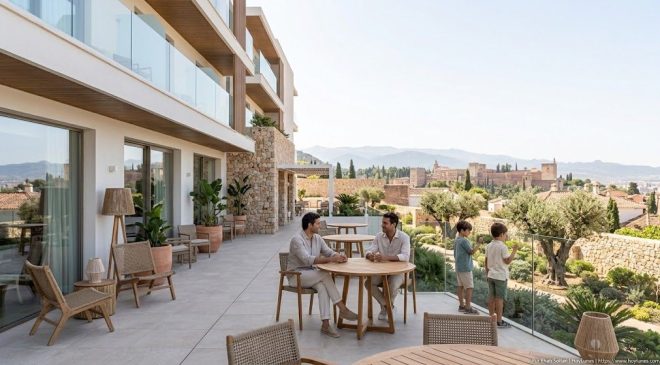
The Real Competition Will Be for Time Management
Capturing visitors in coming years will not be decided solely on price or traditional marketing, but on a destination’s capacity to be compelling within specific time windows.
A family with four days ahead does not plan the same trip as one with three. A user scheduling three nights does not consult the same type of map as someone traveling for a weekend. A city that successfully fits into that temporal window manages to attract demand without needing to transform into a mega tourism metropolis.
Ultimately, the December 2026 bridge holiday provides more than booking percentages and ranking lists: it offers a microcosm of how time reconfigures travel decisions. The opportunity for a destination lies not merely in gaining visibility, but in providing enough reason for travelers to find value in staying one extra day.