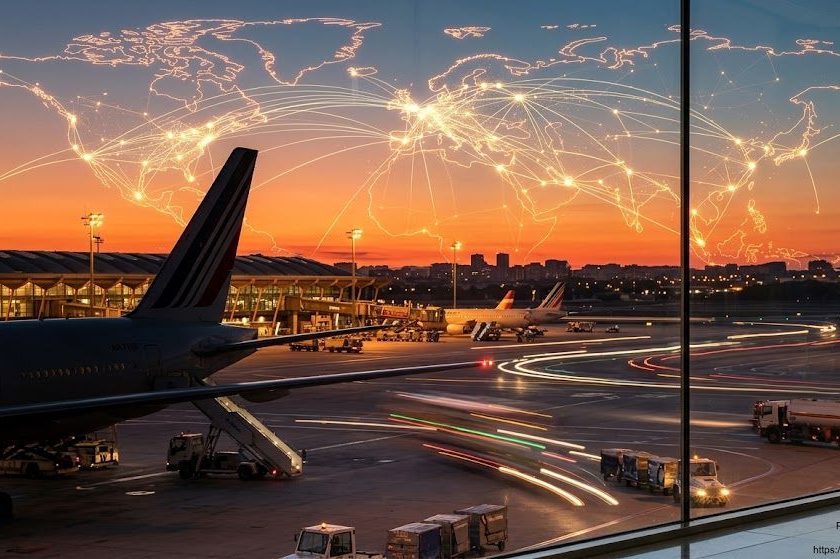
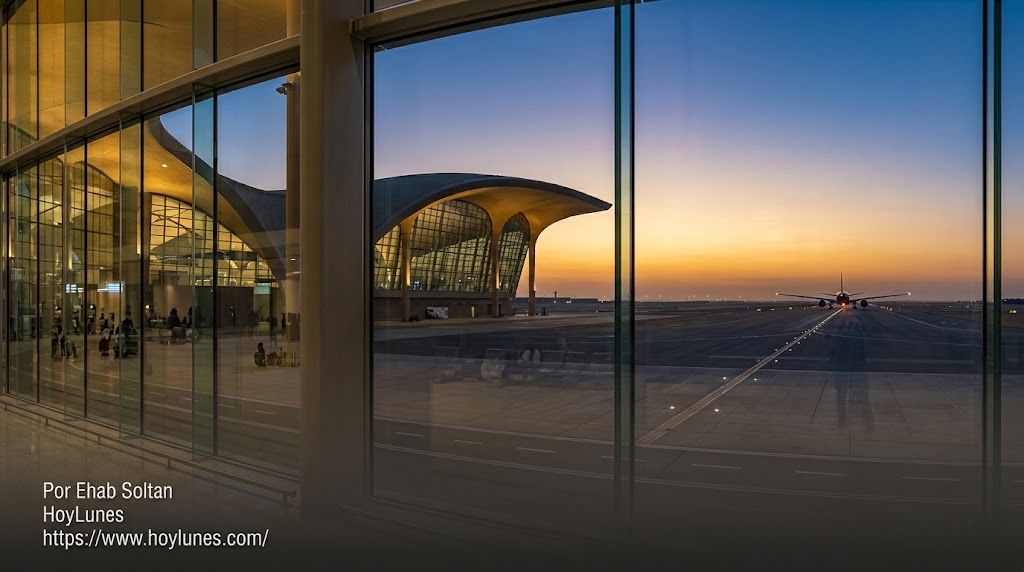
The reopening of King Khalid International Airport does not mark an automatic return to aerial normality. Cautious decisions by international airlines are testing Saudi Arabia’s capacity to restore its connectivity network, revive economic activity, and, above all, rebuild certainty following a severe security incident.
By Ehab Soltan
HoyLunes – There is a substantial gap between the physical reopening of a terminal and the effective restoration of an international airline network. The former depends on an administrative decree, an approved risk assessment, and the logistical capacity to operationalize the facilities. The latter demands a far more intangible and complex asset to quantify: trust.
After remaining closed for several days due to attacks recorded in the area, King Khalid International Airport in Riyadh resumed operations. However, this restart did not trigger an immediate return of regular traffic. Numerous international carriers opted to extend the cancellation of their routes: some for a couple of days, others for several weeks, and some even beyond the month of November. This divergence highlights that an airport can be technically ready to operate long before the complex machinery of international flights regains its customary rhythm.
The Heterogeneous Timelines of Commercial Aviation
Clear runways and operational terminals do not imply that commercial aviation reacts symmetrically. Airlines are forced to resolve a fundamental question: determining whether the necessary guarantees exist to reschedule their services. Behind every flight lies a meticulous clockwork mechanism involving aircraft, flight crews, maintenance plans, insurance coverage, commercial commitments, and global connections planned months in advance.
For this reason, when a security contingency disrupts operations, the return is neither unanimous nor instantaneous. The decisions announced following the reopening of Riyadh reflect this dispersion: while some operators plan a gradual short-term return, others maintain temporary suspensions or have indefinitely postponed their scheduled itineraries. The true signal of recovery will not be given by the landing of the first aircraft, but by the continuous and predictable restoration of flight frequencies.
The Airline as a Vector of Risk Assessment
During airport crises, media attention typically centers on the state of the infrastructure. Nevertheless, the decisive actor in the subsequent phase is the airline itself. An airport can declare itself fully capable of managing flights, and yet an airline may consider it prudent to delay the reestablishment of its routes. This caution does not stem from a decline in the destination’s appeal nor from a drastic drop in demand, but from the fact that commercial aviation evaluates risk through criteria that transcend the mere physical availability of a runway.
For any international hub of attraction, connectivity proves to be a direct function of trust. This environment of certainty is not restored through institutional press releases, but through stable operations, predictability, and the passage of time. In this context, the stances adopted by airlines over the coming weeks will constitute an indicator just as relevant as the activity of the airport itself. True consolidation will be achieved when routes are once again seamlessly integrated into airline scheduling grids.
The true signal of recovery will not be given by the landing of the first aircraft, but by the continuous and predictable restoration of flight frequencies.
The Ripple Effect of Aerial Disruption
The impairment resulting from a flight cancellation extends far beyond the direct inconvenience suffered by the passenger on the ground. An air route does not merely link two geographical points; it articulates and energizes a broad economic ecosystem. Behind a cancellation follow postponed business meetings, reorganized international conferences, losses in hotel occupancy and the catering sector, as well as the deferral of investment trips or the active search for alternative routes by the business community.
Although not every suspension produces all of these effects, the phenomenon demonstrates the extent to which aviation anchors global economic activity. Therefore, the quality of connectivity should not be measured exclusively by the volume of offered frequencies, but by the regularity that sustains them and the reliability that instills confidence in both companies and travelers. An air link does not simply connect two terminals: it connects economies.
Aviation as a Pillar of Saudi Transformation
This interruption acquires a unique dimension when framed within the trajectory Saudi Arabia has mapped out in recent years. The Kingdom’s national strategy did not conceive aviation as a secondary sector, but rather as the strategic engine to establish itself as a global hub for business, logistics, and tourism.
A testament to this is the Saudi Air Connectivity Program, specifically designed to open strategic routes and expand the country’s tourism capacity. Its 2025 results documented collaboration with 17 airlines, the development of 69 joint routes, and the generation of 4.8 million seats. The scale of this project highlights the magnitude of the current challenge. It is not merely a matter of reactivating individual operations, but of demonstrating the resilience of a critical infrastructure designed to project the Kingdom abroad, setting a precedent on how to manage a major disruption in strategic connectivity.
Riyadh’s Ambitious Airport Horizon
The scale of ongoing investments in the Saudi capital underscores the significance of this moment. The future King Salman International Airport has been projected as the cornerstone of Riyadh’s urban and economic transformation, positioning itself as a global-scale passenger, commercial, and logistical hub.
With a planned footprint of 57 square kilometers, the complex aims to handle up to 100 million annual passengers and over two million tons of cargo by the year 2030. Furthermore, construction initiated in 2026 for the addition of a third runway seeks to elevate operational capacity from the current 65 aircraft movements per hour to 85. The strength of a project of this magnitude is not evidenced solely during prosperous periods, but in its ability to absorb a severe shock and gradually restore its operational equilibrium.
The Ramifications of the Saudi Hub in the Spanish Sphere
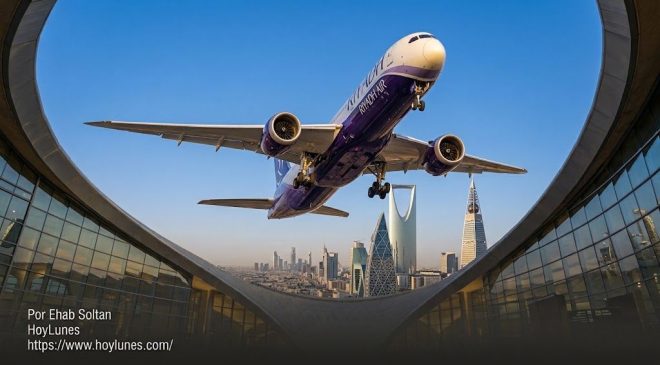
The evolution of this scenario has a direct impact on Spain. In July 2026, Riyadh Air inaugurated its regular direct flight between Riyadh and Madrid, just days after launching its seasonal flights to Málaga. These routes were institutionally presented as a key boost for tourism, commercial, and cultural exchanges, aligning with the connectivity goals of the Vision 2030 initiative.
Spain is an active part of the international network the Kingdom has been weaving. Consequently, the normalization of these flows directly concerns Spanish businesses, destinations, and travelers. Madrid is not merely a point on Saudi Arabia’s route map, but a strategic corporate and cultural bridge. When a route of this nature is altered, it is not just a flight that is suspended: the dynamics of a bilateral relationship are temporarily interrupted.
The Resilience Test of the Vision 2030 Project
Under Vision 2030, Saudi Arabia has placed transport, logistics, and international tourism as central pillars of its economic diversification. For this reason, managing the current crisis transcends the circumstantial to become a decisive test of the model’s adaptability and recovery capacity.
Building state-of-the-art infrastructure is a complex endeavor, but sustaining and restoring a global connectivity network in the face of an adverse event requires an even greater organizational effort. The international community is observing not only the date when full flight frequencies will be restored, but also the robustness of the process: transparency in information flows toward airlines, coordination among authorities, the updating of security protocols, and the aligned response of the entire airport ecosystem.
An airport can reopen in a day; international trust is built gradually, flight by flight.
Rebuilding Certainty Flight by Flight
In the face of a disruption of this severity, it is as erroneous to minimize the impact as it is to assume that it represents a permanent setback. The history of commercial aviation demonstrates that international transport systems possess a remarkable capacity for recovery after traversing episodes of severe uncertainty.
For Saudi Arabia, whose development model is intimately tied to global openness, the priority lies in transforming its operational strength into effective resilience. Full recovery will not be reached when departure screens once again display a full list of destinations, but when airlines reschedule their itineraries with complete confidence, travelers resume their bookings, and the term “normality” requires no further explanation. Reopening an airport is decreed in a single day; international trust is built gradually, flight by flight. This process offers a valuable lesson for any destination or strategic infrastructure facing the challenge of rebuilding its connections after a crisis.
An Unfolding Conversation
Disruptions in global connectivity raise complex dilemmas that require a multidisciplinary analysis from the perspectives of airlines, airport operators, tourism boards, and industry stakeholders. At HoyLunes, we maintain an unwavering commitment to rigorous analysis and specialized journalism, opening our editorial platform to professionals and institutions seeking to contribute their insights, share recovery strategies, or delve into the study of resilience in aviation and international tourism. Transforming moments of uncertainty into actionable knowledge is the essential first step toward building stronger industries and infrastructure.