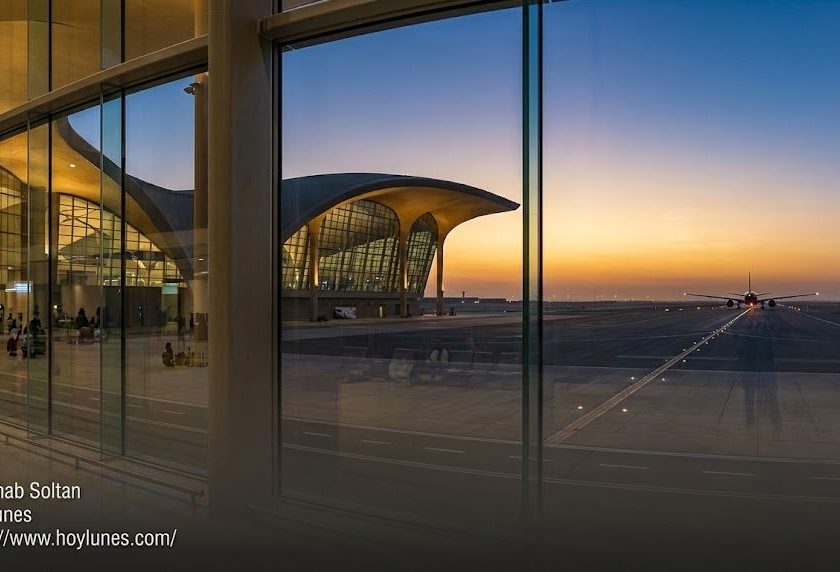
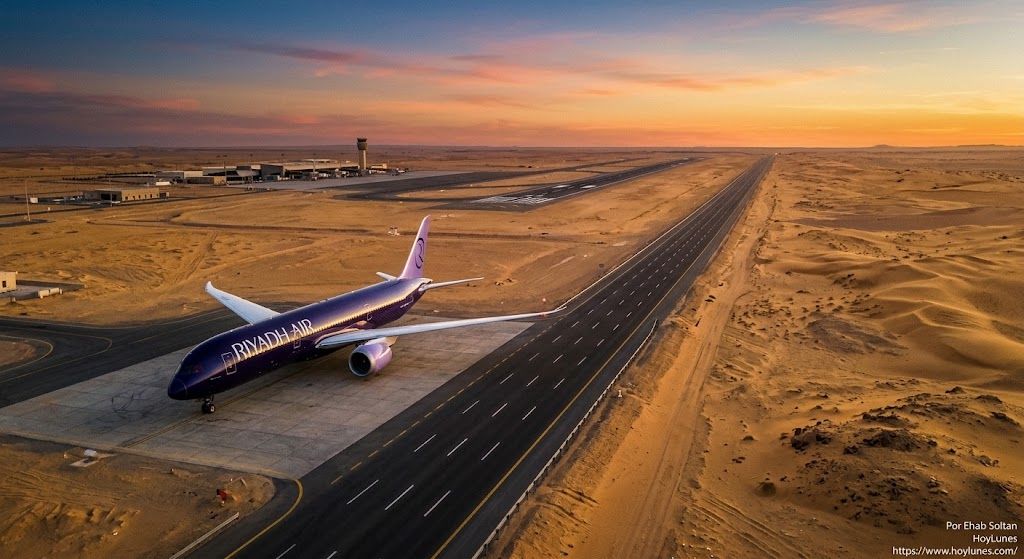
The temporary reorganization of its operations through Al Qassim reveals that air connectivity no longer depends solely on an airport, but also on the ability to articulate territories, infrastructures, and passengers when circumstances impose a new course.
By Ehab Soltan
HoyLunes — There are journeys that set into motion long before the fuselage rolls onto the tarmac of the runway. Similarly, there are itineraries that unexpectedly prolong their pulse long after the initially scheduled terminal has temporarily fallen out of the operational map.
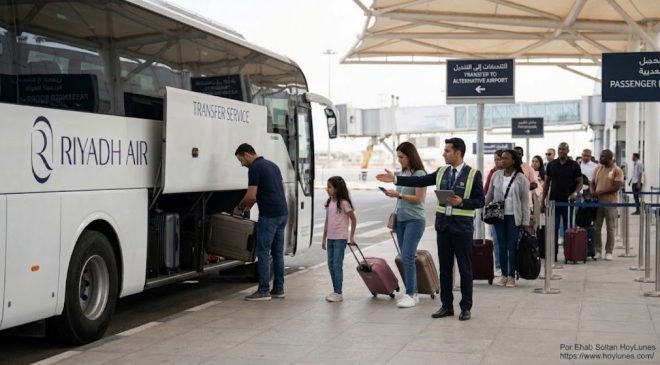
The strategy deployed by Riyadh Air in Saudi Arabia falls squarely into this second category. Since last October 25, the company’s flights originating from or bound to Riyadh have shifted their operational core to Al Qassim airport, forcing a redefinition of travel habits through a complex ground logistics system that allows passengers to start their journey in the capital and connect by road to the alternative airfield. To achieve this, the airline has established specific document management points and coordinated bus services.
Viewed on paper, the move might be interpreted as a mere technical contingency designed to overcome an extraordinary operational hurdle. However, when observing the phenomenon with proper perspective, a much deeper question arises: what does it truly mean to remain connected when one of the essential pillars of a transport network temporarily stops functioning as planned?
The answer requires looking beyond the skies to observe the territory.
The true robustness of a transport network does not lie in the number of destinations it serves when winds blow favorably, but in its ability to keep the traveler’s experience united when the predictable path is interrupted.
When the Itinerary Mutates Unexpectedly
Riyadh and the Al Qassim region are separated by approximately 340 kilometers along a highway connection that forms the backbone of the territory’s heartland. Under absolute normal conditions, that distance belongs exclusively to terrestrial geography, running completely outside the experience of a passenger who arrives at King Khalid Airport to board an international flight.
The new transport architecture designed by Riyadh Air temporarily subverts that logic. The traveler starts the process in Riyadh, completes the usual check-in procedures, and drops off their luggage on solid ground to undertake a highway journey that culminates in Al Qassim, where the aircraft finally departs. The airline has structured this transition in two ways: using the organized collective transfer from the capital or arriving directly and autonomously at Al Qassim airfield.
In this way, the road network ceases to be an invisible element. It does not replace the airplane; it makes it possible.
For decades, the aviation industry has reduced the concept of a route to a straight line drawn between two airport nodes. However, for those who travel, that simplification has never done justice to reality. Before boarding a plane, there is a city; after landing, another awaits. In between operate roads, public transport flows, hospitality networks, security controls, and human decisions. When machinery flows without friction, these elements blend discreetly into the landscape; when one fails, the entire structure emerges with clarity.
Al Qassim on the Global Aviation Map
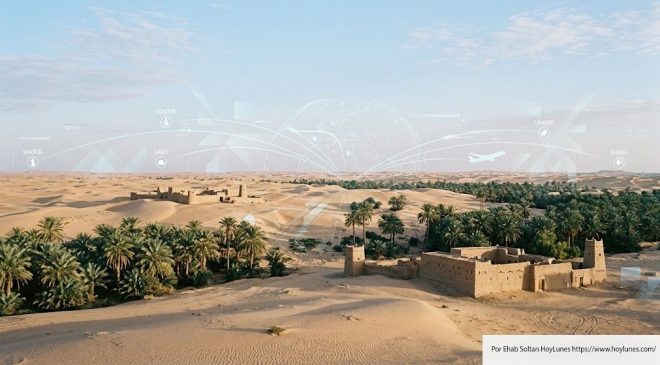
Under this prism, the Al Qassim region acquires unprecedented relevance. Far from functioning as a mere geographical patch, the enclave is provisionally integrated into the gear of international routes usually managed from Riyadh, encompassing connections to destinations as diverse as London-Heathrow, Cairo, Jeddah, Dhaka, Lahore, and Islamabad.
This transit transforms a logistical incident into an event of territorial significance. An airport infrastructure is not merely a technical showcase for aircraft takeoffs; it constitutes a gateway that directly connects local economies and cultures with the planet’s major routes. Al Qassim and its regional capital, Buraidah, thus emerge in the cartographies of travelers who might never have had a reason to stop there, revealing how operational detours are capable of redrawing travelers’ mental maps.
Passenger Experience vs. Service Continuity
The situation underscores an undeniable truth of contemporary aviation: users do not acquire mere kilometers of horizontal displacement, but continuity. What is truly relevant for the passenger is certainty regarding meeting points, luggage handling, and responsiveness to any itinerary alteration.
For a young airline like Riyadh Air — which began its commercial flights and international expansion with global ambition — facing a reconfiguration of this magnitude represents an inescapable trial by fire. Beyond corporate design or fleet modernity, the solidity of a brand is measured by its skill in coordinating ground logistics and maintaining transparent communication when circumstances cease to be favorable. The alternative refund and rescheduling options offered reflect that managing the unexpected is already a core competence of modern air transport.
Towards a Truly Integrated Mobility
The situation demonstrates that the boundaries between air and land transport are blurring at an accelerated pace. The traveler of the future tends to conceive their journey not as a sum of disconnected fragments, but as an uninterrupted experience where the bus, the car, the road, and the terminal converge into a single purpose.
At the end of the day, the true robustness of a transport network does not reside exclusively in the amount of destinations it serves when winds blow favorably, but in its ability to keep the traveler’s experience united when the predictable path is interrupted. And it is right there, precisely at the confluence between the landing strip and the terrestrial arteries that embrace it, where the future of international mobility begins to be decided.