
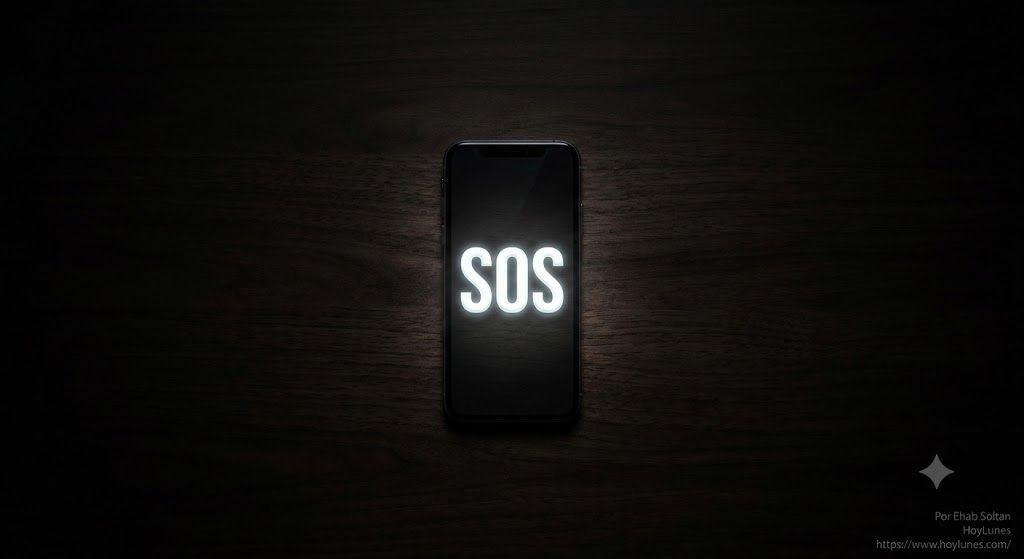
When extreme vulnerability is reduced to a screen: the urgency of deciphering a cry for help without syntax.
The challenge of deciphering calls for help on the margins of conventional communication, disability, and the collective responsibility to know how to recognize it.
When traditional reporting channels fail, the institutional and social response capacity depends on our ability to read the silence.
By Ehab Soltan
HoyLunes – A mobile phone vibrates on a desk. There is no ringtone, no voice note, no explanatory text detailing an address or a context. On the illuminated screen, only three letters appear, stripped of any name or syntax:
SOS.
For most, it would be an incomplete message. For others, it might be everything they are physically capable of sending. The message offers no further clues. There is no second line to clarify the urgency. Hours later, after several failed contact attempts by the receiver, a single additional element arrives: the sender sends a crying emoji.
This sequence is not a suspense fiction; it represents one of the most extreme scenarios of human communication. It is the reflection of a structural phenomenon: the instant in which an individual, stripped of the linguistic or physical mechanisms that society takes for granted, exhausts their last reserve of connectivity to emit a survival signal. The question is no longer whether someone asked for help, but whether the environment was prepared to understand it.
When vulnerability lacks syntax
What happens when a person urgently needs to ask for help, but their environment lacks the necessary codes to listen? The automatic response of social protection systems usually assumes that the victim possesses the physical, cognitive, and technological capacity to recount their experience coherently through a standard reporting channel (such as a hotline or a formal statement).
However, fear, complex trauma, and coercive violence frequently nullify the capacity for verbal articulation. When a motor or speech disability is added to these psychological factors, the act of reporting ceases to be an administrative decision and becomes an insurmountable barrier. When language is reduced to a single word, every second of interpretation also forms part of the response. The insistence on using a single word or a minimal code like “SOS” does not respond to a lack of will, but to the use of the only channel that has withstood physical and communicative isolation.
Fear and trauma do not always silence the mind, but they often confiscate the voice. When the environment demands a structured narrative to activate help, bureaucracy becomes an involuntary accomplice to isolation.
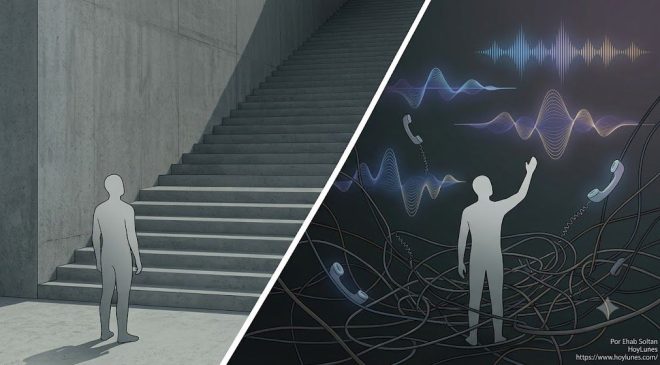
The dimensions of universal accessibility
Public debate usually reduces accessibility to the elimination of architectural barriers: ramps, elevators, or adapted platforms. Although these modifications are indispensable, they represent only the surface of a multidimensional problem. Accessibility is not a single concept; it is a system made up of multiple dimensions that must function simultaneously. Exclusion is perpetuated through four invisible barriers:
Cognitive Accessibility: The simplification and adaptation of environments and easy-to-read texts so that legal and protection information is understandable for everyone.
Digital Accessibility: The design of technological interfaces, messaging applications, and alert systems that can be operated by people with reduced mobility or cerebral palsy.
Communicative Accessibility: The real implementation of Augmentative and Alternative Communication (AAC) systems, which allow individuals without verbal speech to express themselves through pictograms, speech-generating devices, or physical switches.
Cultural Accessibility: Overcoming the biases that infantilize or invalidate the testimony of people with functional diversity within the judicial and police systems.
A starting point to reflect on a barely visible reality
This reality is precisely the conceptual core that inspires the short film “Abril, hoy no es invierno” (April, Today is Not Winter), directed by Mabel Lozano. The work, recently awarded the 2026 Fugaz Award for Best Documentary Short Film, takes as its starting point the real-life experience of lawyer Ángeles Blanco. The specific story thus acquires a meaning that transcends its protagonists and raises a matter of public interest.
Beyond its cinematic merits, the piece functions as a rigorous catalyst that brings to the screen the extreme vulnerability of those who communicate through alternative systems. By highlighting that the film’s financial endowments are allocated to the Mujeres en Modo ON VG program by the ONCE Foundation, the cinematographic work positions itself not as an end in itself, but as an ethical megaphone for a reality that official statistics are only just beginning to record.
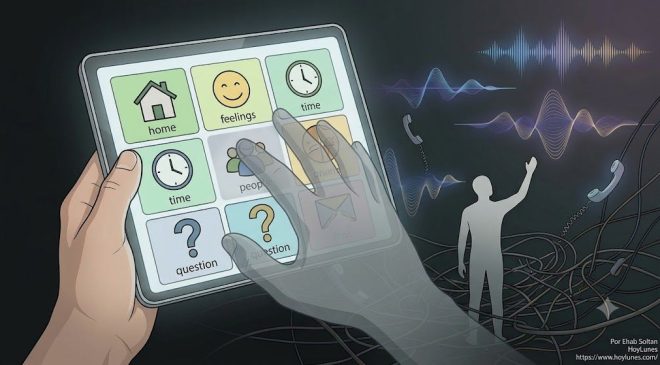
The phenomenon of invisible violence and intersectionality
Contemporary sociological and healthcare research demonstrates that disability and gender form one of the most critical intersections regarding vulnerability. Data from the Government Delegation against Gender Violence and various European Union bodies systematically reveal that women with disabilities face substantially higher rates of exposure to intimate partner violence or exploitation than average.
Violence does not always begin with physical aggression; sometimes it starts when a person loses the ability to make themselves understood. Isolation worsens when the aggressor exerts control over the victim’s own communication mechanisms, such as removing electronic communicators, blocking internet access, or invalidating the use of AAC systems. In these scenarios, the abuse leaves no immediate visible marks, and the institutional system remains blind to a cry for help that lacks a voice.
What science says: Isolation and mental health on the margins
Studies validated by the World Health Organization (WHO) and published in neurology and social psychology journals confirm that the deprivation of autonomous expression capacity generates chronic levels of learned helplessness. It is not solely an emotional reaction, but also a progressive loss of expectations regarding the possibility of being heard. When an individual repeatedly observes that their attempts at communication are ignored by the normative environment, the cognitive system enters a state of withdrawal.
Public mental health bodies warn that the true trauma does not lie solely in the aggression suffered, but in the experience of “communicative invisibility”. An emergency system that relies exclusively on voice interaction de facto excludes a definitive percentage of the population, transforming a physical limitation into a segregation of fundamental rights. Communication then ceases to be just a personal tool and becomes an indispensable prerequisite for exercising citizenship on equal terms.
Designing an emergency system that only attends to voice calls is to assume that citizenship is a privilege of those who can speak. True accessibility begins in the receiver’s capacity to listen.
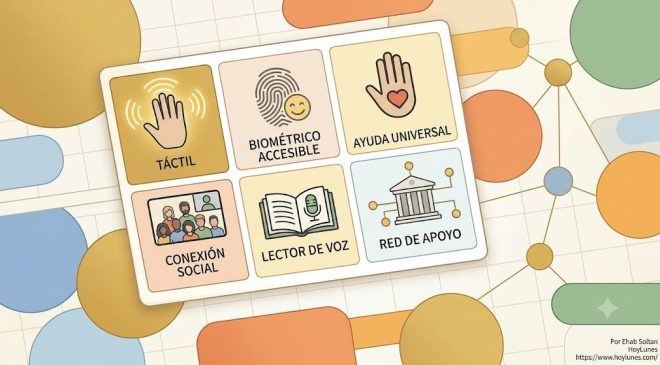
What can we do as a society?
To reverse this diagnosis and move towards real inclusion, it is necessary to implement structural solutions from the community and institutional spheres:
Broaden social awareness: Learn that not everyone asks for help in the same way, nor do they use the same verbal channels.
Technical specialization: Train professionals in the healthcare, police, and judicial sectors in accessible communication tools and the management of AAC systems.
Modernization of infrastructures: Design and implement public emergency systems and citizen reporting platforms that actively incorporate different forms of digital and cognitive interaction.
The natural tendency of institutions in the face of protection crises is to design more reception channels, assuming that the problem lies in the number of available windows. However, the analysis of augmentative communication demonstrates that the error is in reception, not emission.
Sometimes we think that helping consists of responding when someone speaks. But perhaps the true social challenge is learning to recognize the ways in which many people try to ask for help without being able to do so with the words others expect to hear. The maturity of a society is not measured by the volume of voices it attends to, but by its capacity to decipher the meaning of its deepest silences. Because behind some silences, there is no absence of words; there are people waiting for someone to learn to listen differently.