
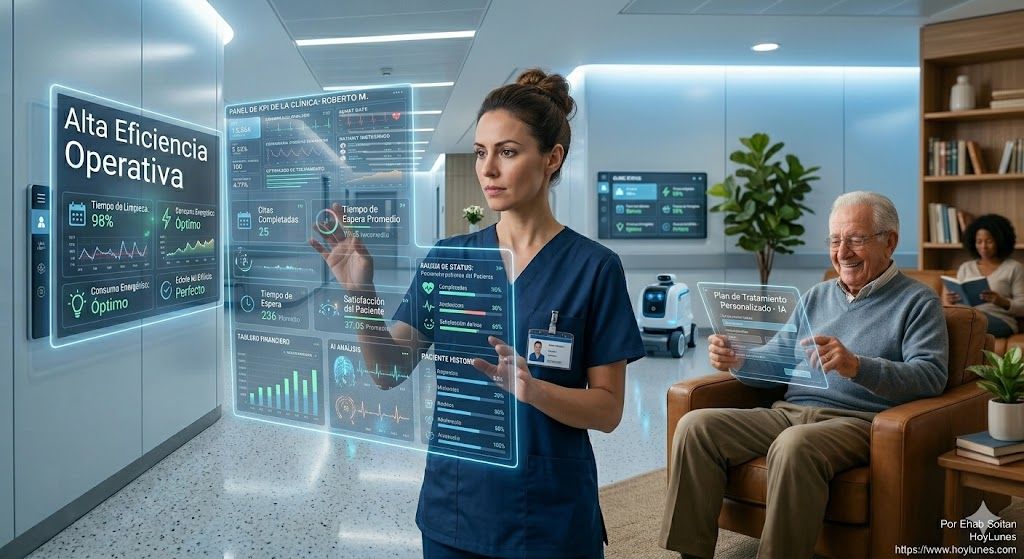
Alberto Enguita, CEO of ClinicSay, analyzes how the convergence of Flexible Management Software and Specialized Artificial Intelligence is transforming operational efficiency, the dignity of healthcare work, and the economic sustainability of the sector.
By Ehab Soltan
In the debate on the sustainability of the European healthcare system, the conversation usually focuses on financing, talent, or infrastructure. However, there is a less visible, but increasingly decisive layer: the way clinics manage their own operational complexity. It is there that a transformation begins which, although it does not always occupy headlines, is already redefining clinical and business outcomes.
HoyLunes – Healthcare in Spain and Europe is going through a silent but irreversible transformation. The old paradigm of clinical management, based on manual processes, fragmented information, and intensive administrative tasks, is showing its limits under the weight of growing demand and the requirement for greater precision. In this scenario, comprehensive digitalization is not an option for modernization; it is the foundation of sustainability and competitiveness.
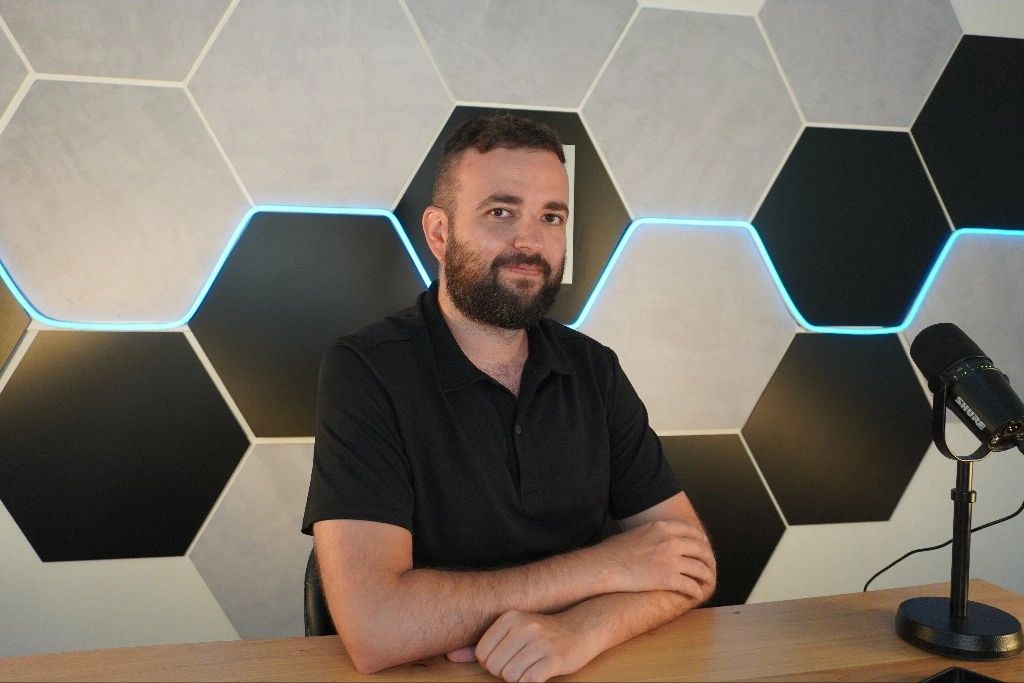
In this context, proposals emerge that not only incorporate technology but also rethink the logic of clinical management. Among them, ClinicSay proposes an approach that combines data architecture, automation, and an operational vision centered on the value of human time. At the forefront of this approach is Alberto Enguita, CEO of the company, whose perspective allows for an understanding of how this transformation is being implemented in practice.

A New Paradigm: Digitalizing to Dignify Human Time
True digital innovation in health transcends the mere replacement of paper with a screen. Strategic value arises when data is integrated and Artificial Intelligence (AI) is put at the service of the operation. Alberto Enguita redefines the purpose of this technology:
“At ClinicSay, we are transforming clinical management through our own methodology that combines flexible clinical management software with custom-developed artificial intelligence agents for each center. Our goal is not just to digitalize processes, but to dignify and add value to human time. We want clinical teams to stop dedicating hours to repetitive and administrative tasks that can now be automated, to focus on what really adds value: care, empathy, decision-making, and the patient experience”.
This vision shifts the role of technology: from a control tool to a real enabler of clinical talent. The unification of data is critical to this process, as Enguita explains:
“The true transformation occurs because we unify all critical clinic information into a single platform: income, expenses, daily operations, processes, productivity, and performance. On that foundation, we build layers of automation and interconnected AI agents, adapted to the reality of each clinic. Furthermore, we incorporate real-time KPI dashboards that allow for measuring the performance of the clinic, the teams, and the AI agents themselves. This opens the door to a new level of management: more strategic, more efficient, and much more results-oriented”.
The 3 Key Trends for the Next 5 Years: Inguita’s Vision
These trends do not arise in the abstract, but as a direct response to the structural limitations of the current model. Based on market data and ClinicSay’s experience, Alberto Enguita identifies three major vectors of innovation that will define the sector:
Consolidation of AI Agents in Daily Operations:
“Just as today no one imagines driving without power steering, soon it will be difficult to understand a clinic without intelligent systems that help manage appointments, follow-ups, administrative processes, and communication with patients”.
Intelligent Post-Treatment Follow-up:
“Thanks to the analysis of clinical histories, treatments, and behavioral patterns, clinics will be able to better anticipate complications, improve adherence, and move towards a more preventive and personalized medicine”.
Diagnosis Support and Democratization of High Quality:
“Diagnosis support and clinical decision support through big data and artificial intelligence (…) will allow for raising the average level of healthcare, helping professionals from any environment to access analytical and support capabilities comparable to those of the best centers in the world”.
Operational Efficiency and Economic Sustainability: The Impact on Margin
In a competitive healthcare ecosystem, economic sustainability directly depends on efficiency. Comprehensive digitalization not only improves internal organization; it becomes a decisive strategic advantage for growth. Alberto Enguita quantifies this impact:
“Digitalization has a direct impact on both the economic sustainability and the competitiveness of clinics. When a clinic incorporates software, automation, and AI agents, it can better attend to more patients without needing to proportionally increase its personnel structure. That improves operational efficiency, reduces hidden costs, minimizes errors, and frees up the team’s time for higher-value tasks. Consequently, the clinic gains in profitability, growth capacity, and service quality. (…) It becomes a strategic advantage to grow in a more solid, sustainable, and scalable way”.

The Patient Experience: Unified with Operational Excellence
A clinic’s success is no longer defined solely by medical quality, but by its capacity to sustain that quality consistently throughout the entire patient journey. In this sense, the patient experience is the new competitive standard. However, for ClinicSay, this experience is inseparable from internal efficiency. Alberto Enguita details how they integrate both dimensions:
“At ClinicSay, we start from a very clear idea: you cannot offer a great patient experience without efficient internal operations, and you cannot have a truly efficient operation if information is fragmented. That is why we integrate everything into a base platform with a flexible architecture, capable of unifying clinic data at all levels: patients, schedules, treatments, team, processes, finances, and operational performance. From that base, we develop AI solutions and agents that follow the specific guidelines, protocols, and needs of each clinic. This allows us to simultaneously improve two key aspects: on one hand, the patient experience (…) and on the other, operational efficiency. The key is to connect both dimensions within the same system, with clear governance adapted to each organization”.
Beyond the immediate impact on costs or efficiency, this change introduces a new way of competing in the sector: the ability to scale quality without scaling structure. In an environment where access to the patient is increasingly contested, this difference ceases to be merely operational and becomes strategic.
Barriers and Leadership: The Cultural Challenge of Transformation
This point is especially relevant because many clinics have already attempted to digitalize without obtaining the expected results. Despite the clear benefits, technological adoption faces resistance. Enguita is unequivocal in identifying that the main barrier is not technical, but human and managerial:“The main barrier is usually not technological, but cultural and leadership-based. Real transformation begins when clinic leaders understand that digitalizing is not about incorporating isolated tools, but about changing the way they manage, operate, and make decisions. (…) The way to overcome it is with a clear vision from management, a progressive but decisive implementation, and a strategy that connects technology, processes, and people. When leadership is aligned and committed, changes can be very profound. In fact, within a period of 6 to 12 months, it is already possible to see very relevant improvements in efficiency, control, patient experience, and profitability”.
The Future Is Being Built (And Is Still Open)
ClinicSay’s experience and Alberto Enguita’s vision do not offer a closed solution, but a clear direction: clinical management is entering a phase where technology, operations, and patient experience cease to be separate dimensions and merge into a unique model.
For clinics, the challenge is not simply adopting tools, but integrating a new functioning model. For technological companies in the sector, the opportunity is even deeper: it is not just about developing solutions, but about accompanying organizations in a process of real transformation, where every decision directly impacts the quality of care and the sustainability of the system.
In this context, a question arises that is not just technological, but strategic: what role do the companies already within the system want to play? Will they be providers of tools or actors capable of influencing how the new clinical operations are defined? The difference is not minor, because it implies moving from accompanying change to actively participating in its design.
This scenario is not completely defined. And precisely for that reason, it is an open space for collaboration, learning, and joint construction among actors who understand that innovation in health is not imposed: it is designed with judgment and executed with responsibility.
#FutureClinics #ClinicalDigitalization #DigitalHealthES #ClinicSay #AlbertoEnguita #HealthTechEurope #ClinicalManagement #PatientExperience #AIinHealth #HealthcareSustainability #HealthcareInnovation #HoyLunes #EhabSoltan