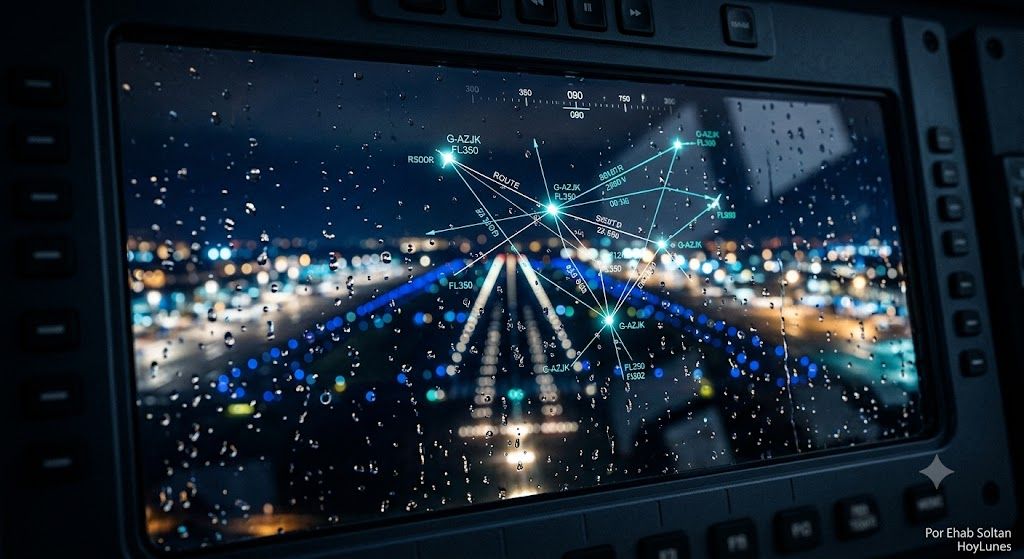
The invisible redesign: algorithms and new laws trace the future of the European sky map.
European airspace is entering a new era marked by ´automation, artificial intelligence´, and the transition toward more sustainable fuels. The social challenge will be to determine whether this process succeeds in preserving ´accessible travel´ for citizens, businesses, and territories.
By Ehab Soltan
HoyLunes – Buying a plane ticket still feels like an everyday gesture. We choose a destination, pass through security, and wait for boarding like someone repeating a learned ritual. The normalcy of travel conveys stability: airplanes connect cities with a precision that few modes of transportation have ever matched.
But that sensation is misleading. While passengers travel as they always have, the system supporting each flight is changing at a barely visible speed. The majority of these changes pass unnoticed because they occur far from the passenger’s daily experience. It is not an evolution announced on airport screens; it takes place in control centers, in the algorithms that coordinate traffic, and in the regulations that will redefine how we fly in the coming decades.
Two processes are advancing in parallel. The first seeks to manage congested airspace through automation and artificial intelligence. The second aims to reduce emissions by replacing conventional fuel with sustainable alternatives that, as of today, are far more expensive. Both alter the equilibrium upon which modern aviation was built.
The issue is no longer just about achieving safer or cleaner flights. It means understanding how these changes could modify the cost of travel and the way we understand freedom of movement within Europe. The crucial turning point lies in decisions made long before the passenger ever reaches the airport.
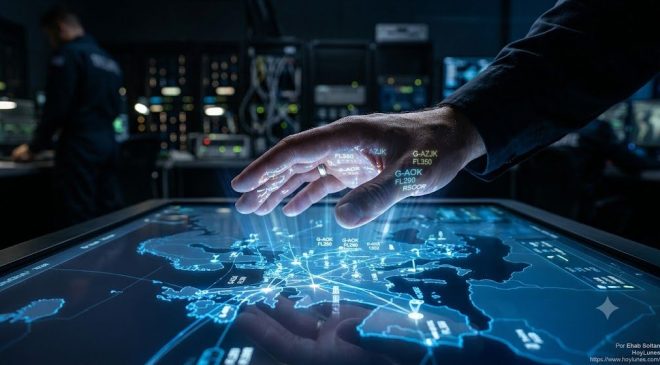
The Sky Automates: The Delegation of Trust
For decades, aviation safety rested on human expertise and constant coordination between controllers and pilots. That model is evolving into one where operational decisions are assisted by systems capable of processing, in seconds, volumes of information that far exceed human capacity.
Automation responds to a real problem: saturated airspace and growing demand. During peak holiday seasons, thousands of flights must be coordinated simultaneously over limited airspace. Faced with the urgency of reducing delays and emissions, artificial intelligence is transitioning from an experiment into a core management tool.
However, the key shift is institutional and social. Every advance in automation alters the distribution of responsibilities between humans and computer systems. The debate no longer revolves around the efficiency of an algorithm, but around a broader question: how is public trust built when operational decisions depend on invisible processes that few understand in depth?
How is public trust built when a growing share of operational decisions depends on invisible processes that few understand in depth?
Aviation safety has always depended on the relationship between technology and the human factor. The success of this new era will not be measured solely by fewer delays, but by the ability to maintain public confidence in a system that is becoming more complex and less visible.
Regulation and Sustainability: The Structural Cost of the Transition
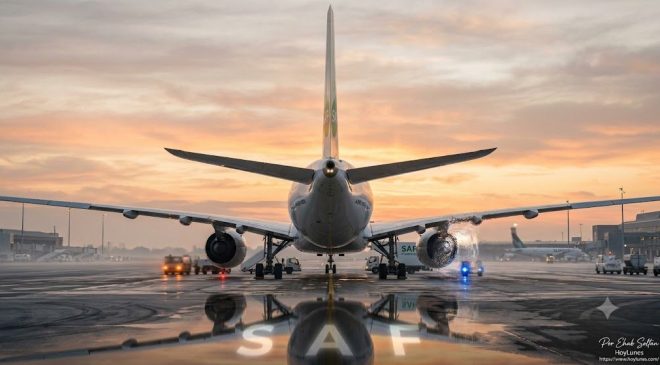
The energy transition at airports is an immediate legal imposition. Community regulations such as the ReFuelEU Aviation framework mandate the progressive introduction of Sustainable Aviation Fuels (SAF). At the same time, the tightening of the European Union Emissions Trading System (EU ETS) eliminates free carbon dioxide (CO₂) emission allowances, forcing airlines to pay for every single ton released.
In practice, these measures shift part of the cost of the energy transition directly to the daily operations of airlines. Decarbonizing air transport with clean fuels is technically viable, but the price gap with conventional kerosene is massive. By squeezing operating margins, airlines lose the flexibility to absorb the extra cost without altering their fares. Clean travel shifts from being a consumer’s environmental choice to a mandatory structure that makes flying more expensive from its technical roots.
Social Impact and Local Economy
When the fare floor rises, household budgets suffer. During the last quarter of a century, Europe was structured around access to affordable transport. Weekend getaways to another capital, the frequent return of Erasmus students, retirement trips, or the travel needs of freelancers were taken for granted. Rising ticket prices force families to recalculate their plans, limiting opportunities to discover new places, maintain personal ties, or access new experiences.
This shift in habits creates a domino effect across the continent’s economic geography. Destinations reliant on air connectivity suffer a direct contraction when tourism drops. Hotels, shops, and restaurants are forced to redefine their pricing or reduce staff, risking a wealth polarization between regions accessible by land and those isolated on the European periphery.
The System’s Paradoxes:
- Efficiency vs. Intervention: Airspace is designed with smaller margins of error, but dependence on digital networks increases while the capacity for direct human intervention decreases.
- Climate Balance vs. Equity: Clean fuels are adopted to protect the planet, but they act as an economic filter that can exclude low-income earners. Is an environmental policy sustainable if its direct toll is an increase in social inequality?
- Innovation vs. Territorial Cohesion: Europe can build more efficient aviation without ensuring that all its regions benefit equally.
The paradox is immediate: clean fuels are adopted to protect the planet, but they act as an economic filter that risks excluding the lowest-income brackets.
Four Scenarios of Tomorrow
- The middle-class family: Cancels international getaways and opts for domestic car travel instead.
- The international student: Reduces trips back home to an absolute minimum due to unaffordable fares, increasing their isolation.
- The island destination: Loses weekend travelers and sees its tourism desestonalization threatened.
- The low-cost airline: Abandons secondary routes to focus on major airports with corporate traffic, reducing regional connectivity.
None of these scenarios is inevitable. But all illustrate the kind of choices that a poorly balanced transition could generate.
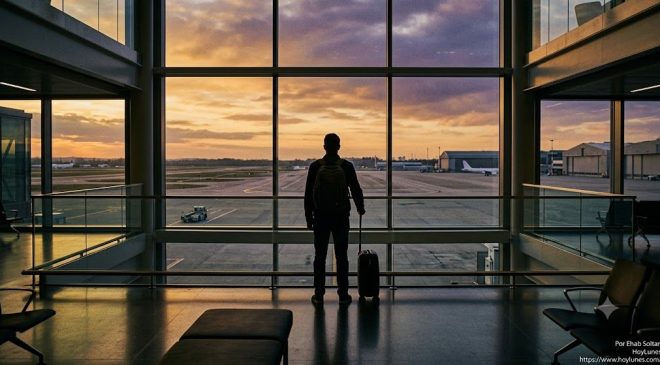
Who Can Fly
European aviation has operated for decades as a social infrastructure that brought families closer together, facilitated academic exchanges, and drove regional development.
The ongoing improvements pursue legitimate goals: operational efficiency, safety, and a reduction in climate impact. The challenge involves proving whether these advances can be achieved without turning the opportunity to fly into an inaccessible asset for a segment of the population.
No technological transition is neutral; every innovation redistributes costs, opportunities, and responsibilities. The key question for the coming years will not just be how much carbon is avoided or how many flights the airspace can handle. It will be how to distribute the costs of this new era among citizens, businesses, and administrations.
The decisive question is whether the evolution toward more efficient aviation will manage to preserve one of the greatest achievements of recent decades: ensuring that the option to fly does not depend exclusively on income level. The history of European aviation has always been about shortening distances. The challenge of the coming decades will be to ensure that this technological conquest remains within reach of the majority and does not become, once again, a privilege reserved for a few.