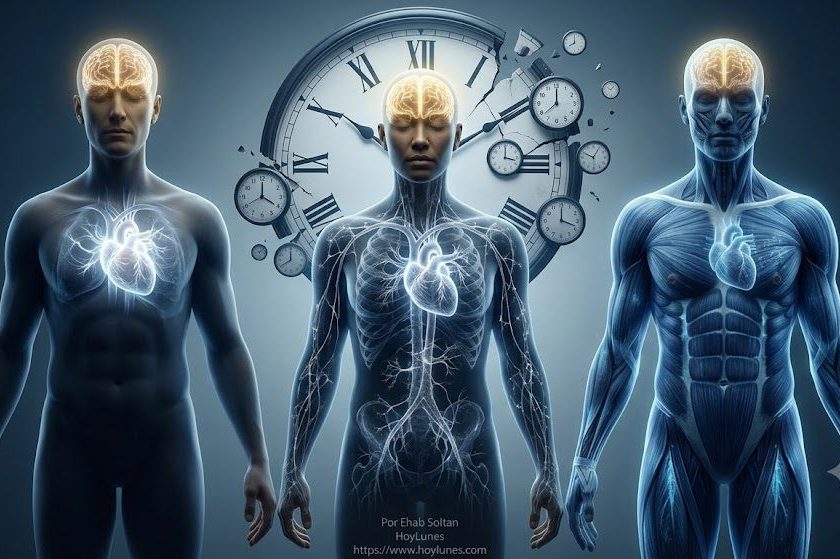

Daily Micro-Transformations: The Clinical Art of Listening to the Organism’s Silent Changes Before They Turn into Pain.
By Ehab Soltan
HoyLunes – One morning, while trying to open a glass jar, you notice the lid offers unusual resistance. You need to ask for help. A few weeks later, you notice you are walking up the stairs a bit slower. Months later, you discover the aroma of morning coffee no longer floods the kitchen with its usual intensity; you simply assume they have changed brands at the supermarket.
None of this seems important. It all seems to fit into daily fatigue or the idea that getting older brings inevitable small changes.
Until one day, during a routine check-up, the doctor looks away from the lab results, observes you, and asks an unexpected question:
Since when have you felt that some things you used to do without thinking now take a bit more effort?
For a long time, much of clinical medicine focused on detecting diseases when they were already evident. Clinical success used to be measured by the ability to identify damage when pain, fever, or a drastic alteration in a lab test had already taken control. Today, however, longevity-oriented science and preventive medicine are changing perspectives to study minute changes. Not because these variations serve on their own to provide a diagnosis, but because they reflect how the organism is changing before obvious symptoms appear.

The Body Speaks Through Its Functions
The organism rarely initiates its deep transformations with a strident alarm signal. Before resorting to pain, it communicates through subtle alterations in the performance of our daily activities.
Current clinical research—backed by institutions like the “World Health Organization (WHO)” and the “National Institute on Aging (NIA)”—pays increasing attention to the loss of small physical and sensory capacities. Scientific reviews published in “The Lancet Healthy Longevity” and “JAMA Network” suggest that many chronic diseases do not appear suddenly but can be preceded by gradual changes in basic functions like walking speed, muscle strength, or sense of smell.
These functions have something in common: they depend on the coordination among different systems of the organism. Walking, maintaining balance, sleeping well, or conserving strength in the hands do not depend on a single organ, but on the joint functioning of the brain, muscles, heart, lungs, metabolism, and senses. Precisely due to that complexity, small, persistent changes in these capacities can offer valuable information about the general state of health.
It is fundamental to understand that these functional changes can have multiple explanations, and many of them are due to benign or transient causes. What is relevant for doctors is not an isolated detail, but the persistence of the changes, their evolution over time, and the general clinical context of the person.
The organism rarely initiates its deep transformations with a strident alarm signal. Before resorting to pain, it communicates through subtle alterations in our daily activities.

The Six Silent Messages
Modern preventive medicine invites us to observe how our everyday capacities evolve through simple gestures we perform almost without realizing it.
Walking the Same… But Taking a Bit Longer
Marching speed is one of the most studied functional indicators in geriatrics. Walking requires tight coordination between the cardiovascular system, muscles, and the nervous system. A sustained decrease in the pace of the step does not confirm a specific pathology, but functions as a thermometer of vitality and general state of health.
That Jar You Used to Open Without Thinking
The progressive loss of strength in the hands when unscrewing a lid, turning a key, or carrying bags is analyzed in medicine as a marker of frailty. This grip strength reflects the state of muscle mass and nutrition, and constitutes one of the indicators used to evaluate healthy aging.
Sleeping No Longer Means Resting
This is not about occasional insomnia due to a day of stress, but a recent change in sleep quality: waking up three or four times per night habitually or getting up in the morning feeling constant exhaustion. If these patterns persist, they alter the organism’s recovery and it is advisable to discuss them with a professional to find their origin.

Coffee Doesn’t Smell the Same Anymore
The sense of smell is an organ intimately connected with our neurological system. Various studies have observed that a persistent loss of olfactory acuity, in addition to detracting enjoyment from food, can be related early on with some neurodegenerative diseases or with variations in general health that deserve to be assessed.
Balance Transformations Before Strength
Transformation is usually detected in subtle gestures. The person does not manage to fall, but begins to lean subconsciously against the wall when putting on shoes or instinctively seeks the handrail when going down stairs. This change is usually one of the first possible indications of neuromuscular, vestibular, or visual variations.
Not Recovering the Same Way Anymore
The indicator here is time. If before the body needed one night of rest to recover from a long walk or intense physical effort, now it requires two or three days to return to normal. The slowing down of physiological recovery is an area of growing interest for understanding how the body manages its energy.
A Single Cloud Does Not Herald a Storm
To understand this new medical approach, it is necessary to avoid alarmist conclusions. What is important is never an isolated signal, but the overall picture.
A single dark cloud in the sky does not mean an imminent storm is about to break… With the body, the same is true: what is important is never an isolated signal, but the overall picture.
Utilizing a meteorological analogy, a single dark cloud in the sky does not mean an imminent storm is about to break; it may be a passing phenomenon without consequences. However, if the pressure drops, the wind changes direction strongly, and the sky becomes completely covered, the weather deserves attention. With the body, the same is true: having difficulties one day opening a jar can be simple local fatigue, but if that change persists and coincides with poor sleep or a slower walk, the organism is offering a set of clues that helps the doctor to prevent future problems.
Why Do We Ignore These Signals?
Human beings tend naturally to normalize these subtle variations in their daily performance for several basic reasons in which anyone can recognize themselves:
- Because They Don’t Hurt: We are accustomed to consulting the doctor only when there is physical pain or acute discomfort.
- Because They Arrive Slowly: Occurring so gradually, the mind adapts and redefines little by little what it considers normal.
- Because We Tend to Attribute Them to Age: It is common to justify any loss of capacity under the pretext that “it’s just getting older”.
- Because Everyone Is Tired: Today’s pace of life camouflages real physiological changes under the label of common exhaustion.
The Consultation of the Future
The first step of the preventive medicine of the future may not be a complex blood analysis or a last-generation radiological test. It will probably begin with a more attentive and natural conversation in the consultation, through direct questions about daily life:
Are you walking the same as one or two years ago?
Do you feel you get tired sooner doing your usual activities?
Have you noticed significant changes in your sleep quality?
Do you feel the same strength in your hands performing daily tasks?
Do you recover the same way after walking?
Have you noticed changes in balance?
These questions do not seek to substitute traditional diagnostic tests, but to act as a valuable prior guide so that the specialist knows exactly where to look.
Learning to Listen to the Body’s Rhythm
The human body rarely transforms overnight. It does so little by little, in a manner so progressive that we learn to coexist with those small changes without giving them importance.
Preventive medicine does not consist of living with fear nor interpreting every small annoyance as the announcement of a grave problem. It consists, simply, of educating the gaze to pay attention to that which changes persistently and consulting with a healthcare professional when those variations begin to affect our quality of life.
Sometimes, the greatest advancement in medicine is not inventing a new technology, but learning to listen with a little more attention to the silent signals the body emits every day.