What happens in a geographically distant region ends up knocking on the door of European households through electricity, food, airline tickets, and the shopping basket. Qatar and Saudi Arabia hold distinct yet decisive pieces in a global gear system that Europe can no longer afford to watch from the sidelines.
By Ehab Soltan
HoyLunes – There are international conflicts that seem confined to a remote geography until, without warning, their shrapnel begins to manifest in the most everyday places. The Persian Gulf may feel like a distant reality for a family living in Madrid, Valencia, Rome, Paris, or Berlin. However, that physical distance dissolves as soon as any alteration in its maritime routes or energy infrastructure ends up transferring to the electricity bill, the price of an airline ticket, freight transport, or the final cost of food at the supermarket. The Gulf is not simply a basin for hydrocarbon extraction; it constitutes the central gear where energy, global logistics, and international security converge. When that piece wobbles, the shockwave shakes all of Europe.
The Illusion of Distance Versus the Real Economic Map
For decades, European citizens grew accustomed to interpreting upheavals in the Gulf as geopolitical episodes limited to the Middle East. Economic reality, however, refutes that apparent remoteness. The Strait of Hormuz, for instance, represents one of the most critical energy arteries on the planet: in 2025 alone, around 20 million barrels per day of crude and refined products—nearly a quarter of global seaborne oil trade—crossed this narrow waterway, through which a decisive portion of liquefied natural gas (LNG) from Qatar and the United Arab Emirates also travels (IEA). A prolonged disruption in this enclave does not need to physically touch the continent’s shores to make its effects felt; it is enough for it to alter the fragile balance between supply, demand, risk, and freight rates for the financial market to immediately transfer that tension to end prices.
The First Shockwave: The Energy Market and Global Competition
Energy constitutes the primary transmission channel to the European economy. Both oil and gas—the latter increasingly globalized thanks to the LNG market—respond immediately to any reduction in volume or logistical complication. Although the European Union has made a remarkable effort to diversify its purchases and decouple from Russia—achieving a structure in 2025 where Norway provides 31% of gas, the United States 26%, and Qatar nearly 4%, within a market where LNG already represents 45% of total imports (Energy)—interpreting these percentages as a protective shield would be a mistake.
The trap lies in the fact that energy markets do not operate through isolated national plots. If a supplier of Qatar’s magnitude suffers a setback, the disappearance of its cargoes unleashes fierce global competition for the remaining volume. In that scenario, Europe’s dilemma ceases to be a question of direct dependence and transforms into a problem of pure competitive tension. The EU Agency for the Cooperation of Energy Regulators (ACER) itself has warned that a prolonged interruption of Qatari production would generate a severe global deficit, forcing European countries to turn to the costly spot market to secure supply, proving that while alternatives always exist, they come at a significantly higher price.
Europe’s energy dilemma ceases to be a question of direct dependence and transforms into a problem of pure global competition.
Qatar: The Gas Giant Moving the Global Balance
To understand the scope of this phenomenon, it is essential to look at Qatar, a country whose small territorial area contrasts with its enormous strategic weight. As one of the absolute leaders in global LNG exports—with over 112 billion cubic meters commercialized in 2025, virtually all of which must pass through the Strait of Hormuz (IEA)—any flaw in its operations drastically alters the international chessboard.
Current signals harshly reflect the delicacy of the scenario: QatarEnergy has been forced to extend declarations of force majeure to various international clients, extending supply suspensions to operators such as Italy’s Edison well into December. Data collected by Reuters indicates that the Qatari firm dispatched barely 18 LNG cargoes during the first months of the conflict, compared to 509 recorded in the same period the previous year. When Italy or Asian economies are forced to seek large-scale alternatives simultaneously, the impact ceases to be a regional event and becomes a global inflationary problem.
Saudi Arabia: The Oil Pivot and the Persistence of Risk
While Qatar embodies the vulnerability of the gas market, Saudi Arabia holds the most relevant position in the architecture of oil. Although the European Union imported 7.4% of its crude from Saudi sources in 2024 (Eurostat), Riyadh’s true weight lies in its installed production capacity and its ability to act as a shock absorber for the entire international energy system. Any threat looming over its facilities immediately impacts investor expectations.
This was demonstrated last September when several attacks against Saudi infrastructure caused temporary stoppages in its main export outlets to the Red Sea, canceling freight destined for European clients and forcing an accelerated search for substitute suppliers. Although Gulf oil flows managed to recover more than 81% of their usual levels shortly thereafter (Reuters), the fundamental lesson of this episode is that the partial normalization of deliveries does not eliminate the risk premium. The shadow of new disruptions keeps the market on permanent alert, as confirmed by the rally in crude to five-month highs following new incidents in Saudi territory in late October.
The Silent Impact on Logistics, Maritime Routes, and Aviation
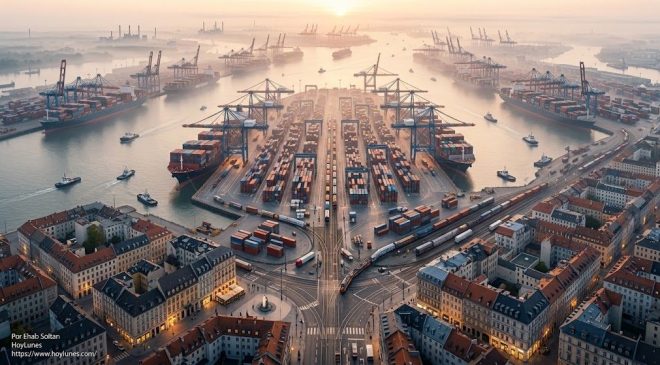
The second transmission channel of the crisis runs more discreetly but with identical destructive capacity: international logistics. The price of a product does not depend solely on its manufacturing cost, but on a complex chain composed of freight rates, maritime insurance, routes, and fuel. Faced with heightened insecurity in critical areas, shipping lines are forced to evaluate lengthy detours, assume war risk insurance, and pass on surcharges that ultimately consolidate in the real economy. Data from S&P Global and Freightos confirm that traffic through Hormuz has fallen drastically, while rates between Asia and Europe continue to absorb the added cost of this high-tension scenario.
This strain is replicated with extraordinary immediacy in the aviation sector. Airlines do not wait for a complete shutdown to react; faced with a lack of airspace safety, they modify itineraries, lengthen routes, redistribute crews, and cancel connections, as occurred in October following warnings issued by the European Union Aviation Safety Agency (EASA) regarding areas of Saudi Arabia. Since commercial aviation operates as an interconnected network, disruption in the Gulf ends up making both passenger travel and air cargo transport between Asia and the European continent more expensive.
Major geopolitical decisions are made in distant offices, but their economic consequences end up being absorbed at the household dining table.
From Trade Arteries to the Shopping Basket
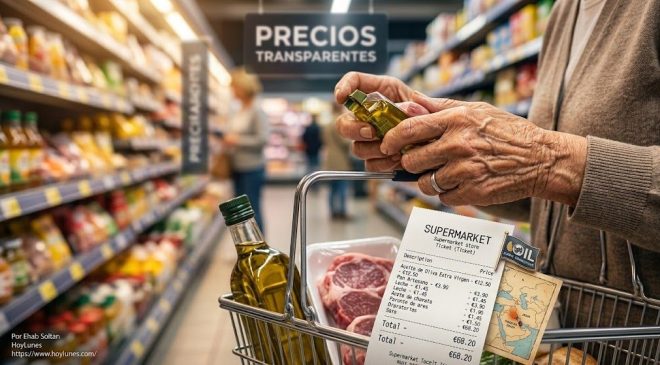
There is a direct thread linking international tensions with family budgets: the sequence extending from primary energy to production, transport, distribution, and final retail price. Modern agricultural activity is deeply energy-intensive, imperatively requiring natural gas for the synthesis of nitrogenous fertilizers. If we add to this the rising cost of fuel for machinery, electricity for cold storage, and distribution freight, the result is inevitable upward pressure on food prices (S&P Global).
While it is true that multiple factors influence the final value of the shopping cart—from weather conditions and harvests to wages, commercial margins, and tax policies—it is undeniable that when energy and transport become sustainedly more expensive, food production ultimately becomes costlier. It is a cross-cutting economic pressure that, sooner or later, trickles down to the end consumer.
The Citizen as the Last Link in the Geopolitical Chain
Major international crises contain a recurring paradox: while strategic decisions are made in offices far removed from the daily lives of citizens, their consequences end up being absorbed in the domestic economy. A resident of a European city does not negotiate LNG contracts, nor set oil tanker premiums, nor plot airline routes; nevertheless, they end up assuming the financial impact through heating, refueling their vehicle, the shopping basket, or the general increase in the cost of living.
As the European Commission has warned, although the Union does not face an imminent risk of supply shortages thanks to its strategic reserves and the buffer provided by alternative markets, instability in the Middle East continues to inject a high level of volatility into crude oil, diesel, and aviation fuel prices. We are not facing an identical replica of the 2022 energy storm, but neither are we looking at a minor disturbance. The difference lies in the system’s capacity to absorb the blow over time and the price that will have to be paid for alternative routes.
Two Complementary Roles for a Single European Challenge
Qatar and Saudi Arabia hold distinct yet closely linked functions on this board. While the former conditions the stability of liquefied natural gas on a global scale, the latter acts as the gravitational axis of the oil market and of the capacity to respond to supply imbalances. Neither replaces the other; rather, their crises reinforce each other. A setback in Qatar intensifies the scramble for LNG carriers, a disruption in Saudi Arabia triggers uncertainty over crude, and the combination of both multiplies the costs of global transport and logistics.
The great lesson of the current situation is not that Europe depends exclusively on any single country, but that it forms an indivisible part of an intricate global network of energy, trade, and transport whose stability is beyond its control. Strategic reserves buy time and diversification mitigates vulnerabilities, but no measure eliminates the basic rule of an open economy: when a major artery of world trade narrows, the extra cost is distributed throughout the entire social body. And it is precisely there that the Gulf stops being a remote geography and becomes a daily reality.