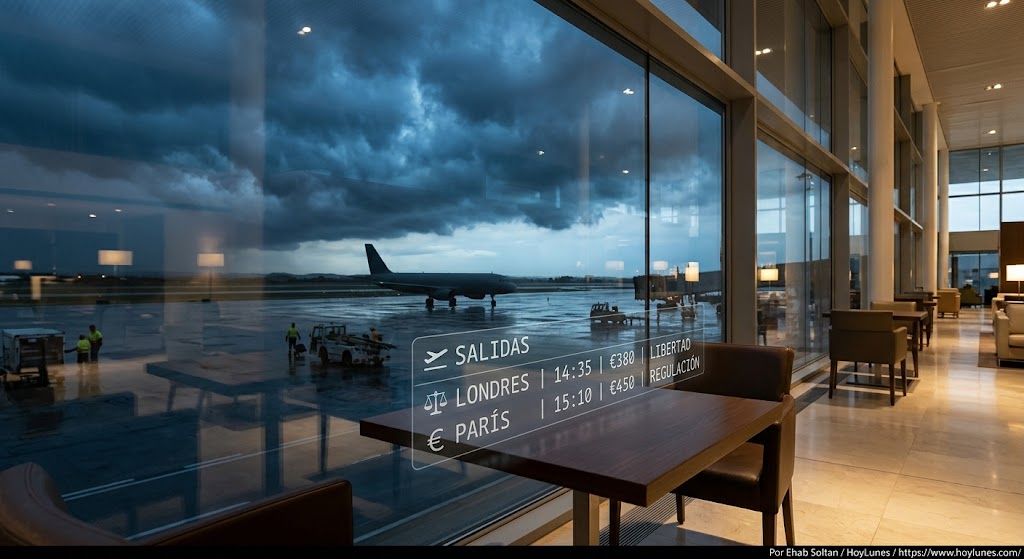
Spain has introduced an extraordinary mechanism designed to curb price surges when an emergency substantially alters supply and demand. However, in the realm of air transport, this initiative encounters a key regulatory boundary: the European principle of pricing freedom.
By Ehab Soltan
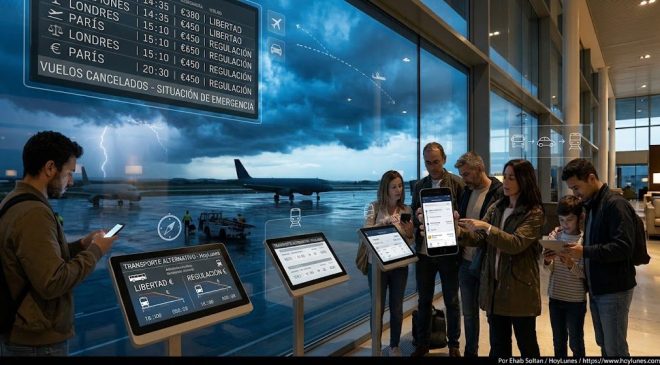
HoyLunes – When an emergency strikes, market dynamics undergo a drastic transformation: operational routes are disrupted, demand concentrates across very specific channels, and services typically chosen for convenience become urgent necessities.
Under normal conditions, a high fare is usually a variable that consumers manage by comparing options, postponing travel, or selecting alternative transport. Yet, when a crisis drastically restricts those choices, ticket pricing stops reflecting a simple commercial decision and raises a broader question: what is the acceptable value of a service when users have virtually no room for choice? This is precisely the issue addressed by the reform introduced in the consolidated text of the General Law for the Protection of Consumers and Users (Article 20 ter), enacted via Royal Decree-Law 32/2026 on November 4, which seeks to curb excessive price increases during emergency or high-risk scenarios. Nonetheless, when extending this framework to air transport, the regulation transcends the strictly national sphere.
The Tension Between Pricing Freedom and Consumer Protection
The commercial aviation model in the European Union relies primarily on the freedom to set prices, an express right protected under Article 22 of Regulation (EC) No 1008/2008. Airlines adjust their fares through revenue management algorithms based on occupancy rates, operating costs, and demand fluctuations.
However, in the event of a catastrophic incident or a sudden disruption of ground infrastructure, demand for air transport can skyrocket while available supply shrinks or becomes saturated. In such scenarios, an airline ticket stops operating under the logic of leisure travel and becomes a critical mobility resource. Here, the principle of market freedom collides directly with consumer protection imperatives in situations of vulnerability.
The Architecture of the New Control Mechanism
It is essential to clarify that the new Spanish regulation does not label every crisis-driven price increase as illegal. For a price limitation to take effect, specific prerequisites must be met: either an official declaration of a zone severely affected by a civil protection emergency, or the activation of an extraordinary procedure via a Council of Ministers Agreement. Said agreement must formally specify the affected services, the timeframe of the critical period, and the applicable reference price.
Consequently, the rule does not automatically suspend standard market operations, nor does it prohibit the exhaustion of cheaper fare classes from driving up the average price of remaining seats. What it establishes is an exceptional framework conditioned upon a formal act that triggers legal containment for a specific service.
Determining Reference Prices and the Market Signal Dilemma
The system establishes the maximum price at which the service was offered during the 30 days preceding the extraordinary event as its benchmark. Furthermore, it incorporates an adjustment to avoid distortions: if that maximum price exceeded the average for that period by more than 50%, the reference price is capped at the average plus 50%. Exceptions are also granted for demonstrable increases in operating costs, costs associated with deploying additional capacity, or verifiable seasonal variations.
From the standpoint of economic theory, this intervention presents a paradox. In scarcity situations, high prices act as a signal for operators to mobilize additional resources—for instance, by scheduling charter flights or repositioning fleets. If caps are rigidly enforced, consumer budgets are protected, but airlines risk being disincentivized from incurring the extraordinary costs required to deploy new capacity in record time.
The EU Frontier and Approval from Brussels
Mindful of European competencies regarding aviation, the Royal Decree-Law explicitly stipulates that limitations affecting air transport will not take effect without express authorization from the European Commission. The preamble grounds this condition in the necessity to ensure full compatibility between national measures and the regulatory framework of the internal market.
Therefore, the effective application of this mechanism within the aviation sector goes beyond the decisions of the Spanish Executive and requires a formal ruling from EU authorities. Brussels will need to weigh whether the extraordinary protection of consumers during a local crisis justifies a temporary exception to the principle of pricing freedom enshrined in Regulation 1008/2008.
Physical Seat Scarcity Cannot Be Resolved by Decree
A price cap alone does not generate additional seats. An airport’s transport capacity is bound by strict physical and infrastructural constraints: slot availability, fleet rotation cycles, flight crew duty limits, and ground handling capacity.
Price regulation constitutes an instrument of economic equity, but it does not resolve the underlying problem stemming from the physical collapse of transport alternatives.
For this reason, price regulation serves merely as a tool for economic fairness; it does not solve the underlying issue caused by the breakdown of transport alternatives. True system resilience during a mobility crisis depends fundamentally on operational network flexibility and coordinated response capabilities among airlines, airport operators, and regulatory authorities.
Operational Implications: Price Traceability and Legal Consequences
For airlines and online travel platforms (OTAs and travel agencies), the regulation introduces price traceability requirements. Distributors may be required to prove their historical average and maximum prices over the preceding 30 days, adding considerable technical complexity to real-time sales channel synchronization upon the activation of a price containment agreement.

On the user rights front, the law establishes that any charge exceeding the maximum allowable price during the enforcement period will trigger an automatic refund of the excess amount. Nevertheless, exercising this claim strictly requires that the limitation measure has been formally declared and applies to the specific route in question. Consumers must therefore retain supporting documentation for their tickets and booked fares.
The debate sparked by Spanish regulation places a strategic question at the heart of the European agenda: how to strike a balance between market freedom and the right to mobility when an unexpected crisis transforms transport into an essential commodity. The resolution of this regulatory conflict will define the rules of the game for managing future emergencies within European airspace.
Sources:
Official State Gazette (BOE). Royal Decree-Law 32/2026, of November 3, on assistance to victims of the Urda (Toledo) railway accident and ensuring equitable accessibility to goods and services in emergency situations. Published November 4, 2026.
Consult the official text on the BOE: (https://www.boe.es/eli/es/rdl/2026/11/03/32?utm_source=chatgpt.com)
European Union — EUR-Lex. Regulation (EC) No 1008/2008 of the European Parliament and of the Council of 24 September 2008 on common rules for the operation of air services in the Community.
Consult Regulation 1008/2008 on EUR-Lex: (https://eur-lex.europa.eu/eli/reg/2008/1008/oj/eng?utm_source=chatgpt.com)