

Early detection has become one of the great challenges of this disease. Research is exploring new ways to recognize risk through the combination of clinical data, imaging, and biomarkers, while specialists refine the monitoring of individuals at higher risk.
By Ehab Soltan
HoyLunes — There are diseases recognized because their symptoms quickly form an understandable story. Pancreatic cancer is usually different. One person may lose weight without knowing why. Another may develop a glucose alteration. Abdominal or back pain, digestive changes, or jaundice may appear. Occasionally, a test performed for another reason discovers an alteration in the pancreas that had previously gone unnoticed. None of these situations means by itself that cancer exists. But together they help explain why this disease represents one of the great challenges of modern medicine: its initial manifestations can be confused with much more frequent problems and, therefore, take time to acquire a common meaning. Research is trying to change that scenario not through a single test capable of solving the problem, but through an increasingly precise combination of clinical, genetic, radiological, and molecular information.
A Disease That Can Begin in a Non-Specific Way
The pancreas is located deep within the abdomen and participates in essential functions for digestion and glucose control. When a tumor appears, initial changes may not produce clear symptoms. When these do appear, they can include pain in the upper abdomen or back, weight and appetite loss, jaundice, changes in stools or urine, nausea, and fatigue. These are manifestations that can also appear in numerous digestive, metabolic, or hepatobiliary diseases.
Therefore, in clinical practice, context acquires extraordinary importance. Age, family history, certain genetic alterations, smoking, chronic pancreatitis, obesity, and some metabolic changes can modify the risk level. The recent onset of diabetes has also awakened growing interest among researchers. The key lies in integrating the information. An isolated sign usually has many possible explanations, while a combination of circumstances can justify a more careful evaluation.
New-Onset Diabetes Is Opening a New Line of Research
The relationship between diabetes and pancreatic cancer is especially interesting because it works in both directions. Some people who develop pancreatic cancer present diabetes, and in certain patients, the metabolic alteration may appear before the tumor is diagnosed. This has led researchers to study whether new-onset diabetes can help identify a group of people with a risk higher than that of the general population.
The National Cancer Institute notes that approximately one in every one hundred people with new-onset diabetes subsequently receives a diagnosis of pancreatic cancer within the following three years. At the same kiel, about a fourth of the people diagnosed with pancreatic cancer already had diabetes. The figure must be interpreted with caution: the vast majority of people who develop diabetes do not have pancreatic cancer. Its importance lies in finding out whether, within that huge group, there are certain characteristics capable of signaling those who could benefit from an additional evaluation through age, family history, weight changes, and metabolic characteristics. It is a more precise way of using the information that the doctor already obtains during routine care.
The Future of Detection May Lie in Combining Small Signs
For years, the search for a tool to detect pancreatic cancer early has concentrated on finding a sufficiently reliable marker. The current evolution of research points toward something more complex and potentially more useful: combining different signs to build an individual picture of risk.
Genetics can identify hereditary predispositions. Family history can reveal patterns that do not appear in a conventional consultation. Imaging can show structural changes. Blood tests can provide molecular information.
The evolution of symptoms provides a temporal dimension. And artificial intelligence can help analyze large amounts of information to find patterns that are difficult to recognize at a glance. No single element has to function as an isolated answer; the sum can be much more informative.
Surveillance of High-Risk Individuals Is Already a Reality
Here there is an important difference between research and clinical practice. For the general asymptomatic population with average risk, there is currently no recommended screening test to detect pancreatic cancer. The National Cancer Institute indicates that screening may benefit individuals with elevated risk, while it is not routinely recommended for average-risk individuals.
People with certain hereditary syndromes, some genetic variants, or significant family history may have a significantly higher risk and be candidates for specialized surveillance programs. In these cases, imaging techniques such as magnetic resonance imaging and endoscopic ultrasound are mainly used. It is not about indiscriminately testing the entire population, but rather about concentrating surveillance where risk justifies a specific strategy.

Imaging Is Learning to Recognize Increasingly Subtle Changes
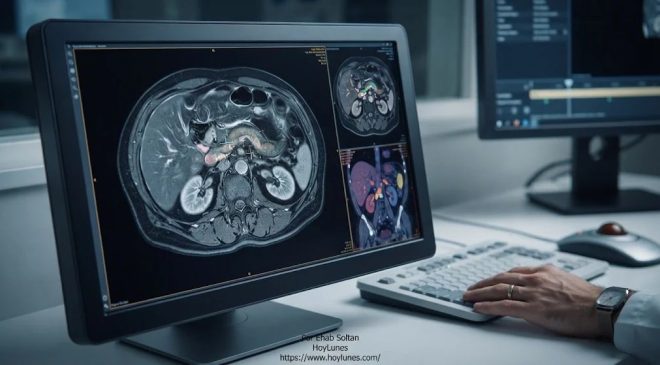
Radiology occupies a central place in this effort. Computed tomography, magnetic resonance imaging, and endoscopic ultrasound allow the pancreas to be studied from different perspectives to detect lesions, alterations of the pancreatic ducts, or structural changes that require follow-up.
Artificial intelligence and the technique known as radiomics add a new dimension by extracting quantifiable characteristics from medical images and relating them to biological and clinical information. It is a promising field, but still under development: in medicine, demonstrating that an algorithm can distinguish certain images requires verifying how it works in real patients, across different centers and populations, and whether its use ultimately improves diagnosis and clinical outcomes.
A Drop of Blood Can Contain Information That Was Previously Inaccessible
One of the most interesting advances comes precisely from blood research. An international study published in Nature Medicine developed and evaluated a test based on microRNAs—small molecules involved in gene regulation—combined with the CA 19-9 marker. The study included 1,785 participants from four countries, and in the test cohort, the microRNA signature reached a sensitivity of 83.8% for early-stage pancreatic cancer (rising to 86.8% when combined with CA 19-9 for stage I-II tumors).
These are relevant results because they point toward the possibility of obtaining information about an early pancreatic tumor through a blood sample. However, the researchers themselves consider it necessary to carry out larger-scale prospective studies before this strategy can be incorporated into general clinical practice. It is not yet a blood test that can be generally requested in consultation.
CA 19-9 Explains the Difficulty of Finding a Perfect Marker
CA 19-9 is one of the best-known markers in this field, but its utility has limits. It can be elevated in some benign diseases and not all people produce this antigen, so it does not work as an independent screening test for the general population. Its value increases when it is interpreted within an appropriate clinical context and alongside other tests.
This characteristic helps understand where research is heading: instead of looking for a figure that by itself says “cancer” or “no cancer,” scientists are trying to develop models capable of integrating multiple signals to offer a more personalized evaluation.
Liquid Biopsy Can Also Change Monitoring
New blood tests are not only of interest for their possible capacity to detect a tumor earlier. They can also provide information during treatment. In the study published in Nature Medicine, the levels of the microRNA signature decreased in a small group of patients during neoadjuvant chemotherapy and after surgery, while they increased before some recurrences, which justifies further research on their potential to monitor the disease. The direction is clear: blood can become a much richer source of information about tumor behavior.
Precision Medicine Is Also Entering Pancreatic Cancer
Detecting earlier is only part of the problem. When a diagnosis exists, knowing the biological characteristics of the tumor can help determine which treatments make the most sense for each patient through molecular studies that identify genetic or molecular alterations (such as KRAS and BRCA) targeted toward specific therapies. An international consensus published in 2026 highlights precisely the growing importance of these molecular tests, liquid biopsy, and precision imaging in the individualized management of pancreatic cancer. Precision medicine means that diagnosis increasingly incorporates information about the particular biology of each patient’s disease.

Spain Also Needs to Arrive Earlier
In Spain, pancreatic cancer continues to be a healthcare problem of great importance. Estimates from SEOM and REDECAN place the new cases projected for 2026 at 10,405, making it one of the most frequent tumors in the country with an upward trend over recent decades. Smoking continues to be the best-established risk factor, along with others such as obesity, a sedentary lifestyle, and certain dietary patterns.
But prevention cannot be limited to risk factors; it also needs to improve the ability to recognize situations that require appropriate medical investigation through collaboration between primary care, gastroenterology, radiology, endocrinology, genetics, and oncology. The early diagnosis of complex diseases depends on information circulating.
The Goal Is Not to Live Apprehensive About Cancer
Talking about early signs can have an undesired effect if done without context. Abdominal pain, fatigue, weight loss, or glucose alterations are frequent problems with multiple possible causes, and automatically turning them into a suspicion of cancer would produce anxiety and unnecessary tests.
The usefulness of knowing these signs is understanding why certain persistent changes or combinations of factors deserve a specialized medical evaluation, especially when there are personal or family histories that elevate risk. Medicine does not need people to interpret their own symptoms as if they were specialists, but rather for them to consult when something changes persistently or inexplicably and for that information to reach the healthcare professional with sufficient context.
A New Stage Begins with Better Tools
Pancreatic cancer remains a complex and serious disease, but current research offers a different picture: blood biomarkers for early signs, sophisticated medical imaging, genetics to identify elevated risks, specialized surveillance, and the molecular study of tumors.
The future will probably not depend on finding a single miraculous test, but on something much more realistic and powerful: learning to gather the pieces we already have sooner and adding new tools as science proves their utility.
Note:
This article is for informational purposes only and does not replace the diagnosis, evaluation, or follow-up of a qualified healthcare professional. In the event of any persistent symptom or concern related to pancreatic cancer, always consult your physician.