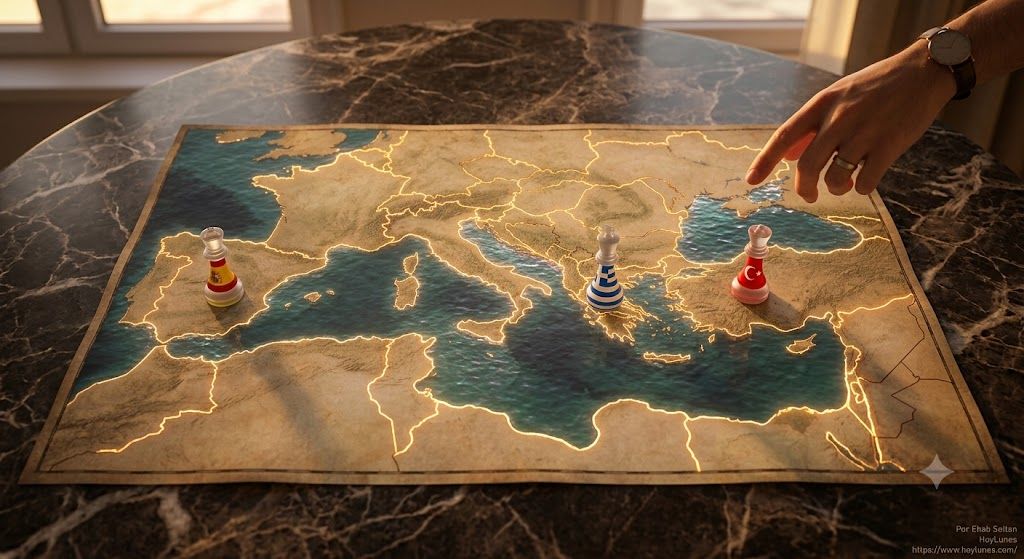
The new geopolitical chessboard where destinations no longer compete for space, but for trust.
Competition is no longer decided between countries, but between tourism models capable of responding to the new international traveler.
By Ehab Soltan
HoyLunes – The travel agent falls silent for a few seconds. In front of him, a Saudi couple looks at three open brochures on the table. Greece. Turkey. Spain. Neither of them asks anymore which country has the most beautiful beach.
The conversation revolves around other matters: how many direct flights exist, how long it will take them to cross the border, which destination conveys greater stability, and where their children can move around with more peace of mind. Just a few years ago, many of these questions were not even part of the conversation. Meanwhile, hundreds of miles away, tourism ministers, airlines, and hotel chains compete to answer exactly those same questions.
The scene illustrates a profound transformation. Traveler preferences change slowly; crises accelerate that change. Over the past five years, geopolitical crises and economic fluctuations have not only temporarily diverted traveler flows, but have reconfigured the choice criteria of demand.
The end of the crisis in the Middle East will not simply determine which destinations will regain tourists, but rather which countries have better understood how the crisis and the Arab traveler have changed over the last five years.
“Crises do not change the traveler’s direction; they act as a particle accelerator that exposes their true priorities.”
When geopolitical uncertainty ends, will tourists simply return, or will the world tourism map change?
Why This Question Matters on a Global Scale
The relevance of this question transcends the borders of coastal nations; it directly impacts the macroeconomics of global tourism. The Middle East, driven by the Gulf Cooperation Council (GCC) nations, possesses one of the most dynamic demographic structures on the planet. It is a young, hyper-connected population with a purchasing power that has registered sustained growth in recent decades. Furthermore, this market presents one of the highest average expenditures per trip in numerous European destinations.
International travel from the region has increased steadily, albeit with interruptions linked to geopolitical and health crises. Many European destinations consider these travelers strategic due to their average expenditure and relatively long stays.
Capturing or retaining this traveler profile is not a secondary marketing option; it is the differentiating factor between organic growth and the competitive leadership of the sector. However, to attract them, one must first understand that the old concept of “mass tourist” is dead.

The New Arab Traveler No Longer Responds to a Single Profile
The most recurrent error of traditional promotional strategies consists of homogenizing markets under the label of the “Arab tourist.” That oversimplifies too much. Sector reality demands a sophisticated segmentation based on micro-profiles with radically opposite needs:
- Families: They demand absolute privacy, spacious villas or residences within resorts, and controlled environments with high-end children’s entertainment.
- Medical Tourism: A high-value segment that plans prolonged stays linked to medical treatments and preventive wellness.
- Avant-Garde Luxury: It is not limited to the five-star hotel; it requires hyper-personalization, 24-hour private concierge services, and exclusive behind-closed-doors experiences.
- Shopping and Identity: Global cities that act as fashion and design platforms, where the shopping experience is seamless, preferential, and friction-free.
- Nature and Cultural Tourism: Travelers fleeing the extreme summer heat of their home countries seeking green landscapes, heritage routes, and temperate climates.
- MICE, Generation Z, and Digital Nomads: Young professionals who merge remote work with cultural discovery (bleisure), prioritizing robust technological infrastructures.
Understanding this diversity will be a much more important competitive advantage than increasing the promotional budget. Each of these profiles seeks something different. And that search is redrawing the map.
The New Mediterranean Chessboard: Models Versus Value Propositions
Just a few years ago, the Gulf tourist traveled mainly to Europe. Today, they have many more alternatives. They can choose between remaining within the Gulf itself (with embryonic, pharaonic projects like Neom or AlUla), traveling to the Eastern Mediterranean, to the Western Mediterranean, or opting for Asian markets. Competition is no longer solely between European destinations; it is an open competition between entire regions.
Each destination competes with different strengths. Comparing them solely by the number of visitors leads to incomplete conclusions. The real battle is fought model against model:
| Destination Model | Main Exponents | Central Value Proposition |
| Sun, Beach, and Large-Scale Leaders | Turkey (Antalya), Spain (Balearic/Canary Islands) | Family specialization, optimized volume, competitive advantages in all-inclusive regimes, and massive connectivity. |
| Premium and Scenic Exclusivity | Greece, Italy, Turkey (Bodrum), Montenegro | Boutique hospitality, fragmented luxury, mega-yacht nautical tourism, and high environmental preservation environments. |
| Cultural Legacy and Historical Identity | Egypt, Jordan, Italy, Spain (Andalusia) | Archaeological tourism, heritage routes, and immersive cultural experiences linked to world history. |
| Emerging Frontiers and Flexibility | Albania, Croatia, Morocco, Tunisia | Cost diversification, authenticity in development, residential positioning, and dynamism in new products. |
In this new scenario, success will not depend on the number of rooms built, but on the control of four strategic variables.
Four Variables That Will Decide the Future
- Air Connectivity and Border Facilitation The winner is not the one with the most hotels; the winner is the one who is easiest to reach. An excellent destination can lose to another simply because entry is simpler. This concept encompasses direct flights, air frequency, travel times, and the reduction of administrative friction (streamlined border processes, biometrics, and visa requirements).
- Perception of Safety In tourism, perception weighs as much as reality. A localized incident can temporarily affect the image of a much wider region (contagion effect), while a sustained improvement in perception can accelerate the recovery of demand. It is always advisable to distinguish between subjective perception and objective risk.
- Cultural Experience and Inclusion It is not enough to translate a menu. The visitor must be deeply understood: respect for hospitality codes, an adapted gastronomic and wellness offer, and the creation of an environment where the international traveler feels truly welcome and understood.
- Digital Trust Digitalization covers the entirety of the trip, operating under the logic of an integral trust formula. Intuitive platforms, secure payments, data protection, and efficient digital customer service are already an indissoluble part of the tourism experience. Ho
How do these variables interact in the real world? The current market already offers us a clear answer.

Case Study: What Turkey Is Really Teaching Us
Turkey is not the protagonist of this analysis; it is the laboratory where the effects of this transformation can already be observed. Its recent evolution illustrates to what extent factors such as geopolitics, costs, or connectivity can alter tourist flows in a short time.
According to official data from Turizm Databank and the Turkish Ministry of Culture and Tourism, during the first five months of 2026, foreign visitor arrivals to the country decreased by 2.56% year-on-year, standing at 15.2 million. However, the drop was substantially more severe in the hard core of its sun-and-beach product, a direct rival of Spain:
Antalya Province: -9.2% (3.24 million tourists).
Muğla Province (Bodrum and its luxury niche): -10.4%.
İzmir Province: -4.2%.
The question is whether this loss responds to a cyclical situation or anticipates a deeper change in the preferences of the international traveler.
According to market intelligence firms such as Data Appeal and Mabrian, this behavior initially responds to the “contagion effect” of regional geopolitical instability in the Persian Gulf during the first quarter of the year. Nonetheless, following the signing of the agreement between Iran and the United States (which ended the military conflict that began in late February 2026), destinations like Turkey, Jordan, and Egypt began to show remarkable resilience and early signs of recovery in their safety perception. The recovery of perception is usually faster than the reconstruction of trust. That difference can mark several tourist seasons.
“In the new economy of hospitality, perception travels at the speed of light, while trust is built at a human pace. That temporal gap defines the winners.”
But geopolitics is only one layer. The real structural challenge is the rising cost of the offer due to operational expenses. Economist Erol Karabulut reveals a worrying reality: according to data based on Eurostat, a set of hotel and restaurant services that cost 100 euros in the European Union in 2025 was equivalent to 78 euros in Turkey, which represents a drastic increase compared to the 69 euros recorded just a year earlier, in 2024. The price level increased by 13% in just twelve months. As Karabulut concludes: “The problem is not our current price level, but that we are becoming more expensive much faster than our competitors.” Competitive advantage erodes rapidly in price-sensitive markets.
Based on this dynamic, the market is heading towards three possible futures.
Three Prospective Scenarios
None of these scenarios is mutually exclusive. It is possible that different regions evolve simultaneously towards different models:
Scenario 1: Great Eastern Recovery: A massive and immediate return of flows to Turkey, Egypt, and Jordan. The macro-resort and tour-operation model of the Eastern Mediterranean rapidly recovers its hegemony of aggressive pricing.
Scenario 2: Diversification and Fragmentation: Travelers spread out. Europe retains the premium segments captured during the crisis, while destinations in the Gulf and the emerging Mediterranean (such as the Balkans or Morocco) consolidate specific market niches, diluting traditional monopolies.
Scenario 3: Much More Selective Tourism: International travelers reduce the frequency of their annual trips but spend more per stay. They seek absolute quality, not quantity; accredited sustainability, and hyper-personalized cultural proposals. Quality completely cancels out volume.
What Destinations Should Do Today
To capitalize on the transition toward stability, national tourism organizations (DMOs) and hotel chains must replace conventional advertising promotion with structural actions:
Improve Connectivity: Incentivize stable, direct air connections throughout the year, overcoming dependence on seasonal charter flights.
Reduce Administrative Barriers to Entry: Implement immediate electronic visas and biometric corridors to minimize initial friction at the border.
Invest in Digital Trust: Develop technological ecosystems with diversified payment gateways, data protection, and AI-based predictive customer service, without increasing complexity for the user.
Adapt Services to Different International Profiles: Train staff in international hospitality and cultural intelligence, adapting the culinary and wellness offering.
Reinforce Resilience Through Data: Use big data tools (such as Mabrian or Data Appeal indices) to monitor safety perception and travel intention in real time, allowing them to anticipate shifts in demand.

The Final Decision Is Still Made at Home
No tourist compares prices alone. They compare peace of mind, time, accessibility, experiences, and trust. Every internet search, every family conversation, and every recommendation received is part of the decision-making process. Destinations that understand this mental journey sooner will have an advantage that no advertising campaign can buy.
During decades, success in Mediterranean tourism was played out in a competition to offer the most striking beaches, largest hotels, or lowest prices.
The next decade will be decided by radically different factors: who inspires more trust, who best facilitates the journey, and who sooner understands the new expectations of an increasingly diverse international traveler. If that change consolidates, the true tourism map of the Mediterranean will no longer be drawn solely on the physical geography of its coasts, but on the capacity of each destination to adapt to a world in constant transformation.
Perhaps the next great winner of the Mediterranean will not be the destination that builds the most hotels, but the one that manages to stop the traveler from wondering if it is worth traveling and start wondering only when to return.